


Why is it that slowing down the tempo makes it harder to place each note accurately in time? Our logical brain might tell us that surely it should be easier, with plenty of time to make the decision and execute the movement required to produce the note.
What makes it difficult is that our human brains perceive time as continuous. We experience it as flowing freely from one moment to the next, where each “moment” has no precise duration.
Clearly we do have some kind of “inner metronome” which allows us to judge time in broad terms, and keep a steady Beat, and we are capable of handling a range of tempos. We are able to turn that continuous stream of time into a structured sequence of evenly-spaced moments. But unless we do something further, we don’t actually have a precise sense of how time passes during each one of those moments.
The solution? Do the same thing again! Just as we transformed free-flowing time into a series of evenly-spaced beats, we can transform the duration of each one of those beats into its own structured timeline:
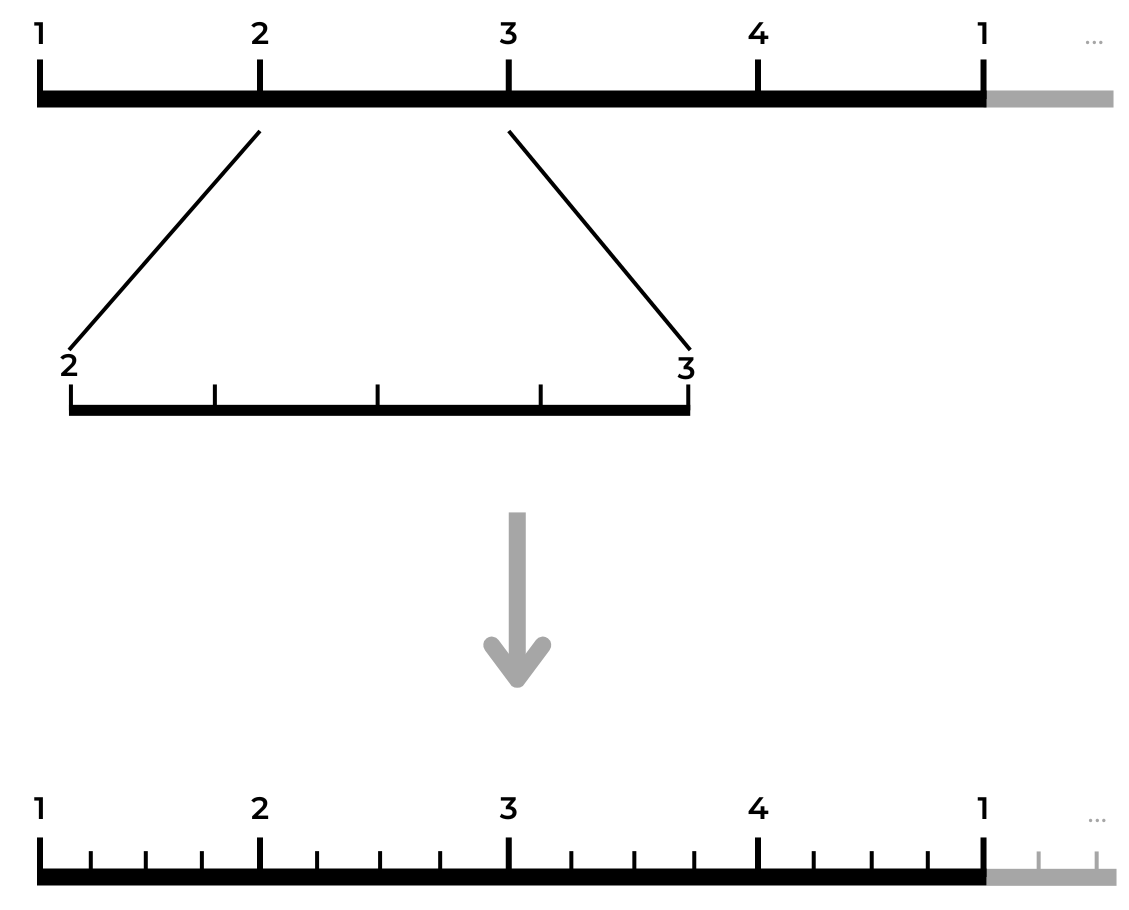
Now our musical mind has something structured to latch on to as each beat occurs.
In music we typically divide each beat into either two or three parts, known as simple or compound time respectively.
EXERCISE: Simple and Compound Time
|
You can extend this exercise by stepping a steady Beat (perhaps using the Rhythm Dance) and clapping each of the subdivisions. You will clap twice for each beat for simple time, and three times for compound. Your claps should have their own steady tempo i.e. the claps should be evenly-spaced.
If you’ve never done this before, don’t be surprised if it’s a challenge. You may find it easier if you continue speaking the “one and two and…” or “one and a two and a…” as you add the clapping.
As you do this exercise you’ll see clearly how we are using the same ability of our musical mind to produce a steady Beat, but now at two different levels: the underlying “pulse” Beat and another, faster, Beat on top of it and synchronised with it, subdividing each beat of the pulse into equal-duration parts. You’ll also see why there isn’t a single strict correspondence between the sound of a rhythm and how we might write it down. Are your claps communicating, for example, a 120 B.P.M. pulse? Or are they the simple subdivisions of a 60 B.P.M. pulse?
These are the two major classifications of subdivisions, but we can of course divide each beat further. For example, if we took things one layer more fine-grained with simple time we could divide each of our two half-beats into two equal parts, each lasting a quarter of a beat.
EXERCISE: Dividing The Beat In Four
|
_________________________________________________________
Side Note: Time Signatures and Meter Names
You may be familiar with the concept of a time signature, written at the start of a piece or section. A time signature consists of two numbers, written one above the other, for example:
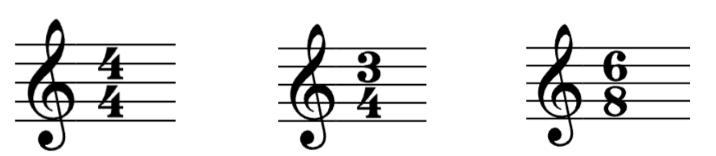
The bottom number specifies the note symbol used for each beat, so that e.g. “4” indicates quarter notes and “8” indicates eighth notes. Then the top number specifies how many beats are in each measure.
Simple meters have a 2, 3 or 4 on top. So the simple duple meter (“1 and, 2 and”) introduced above would be written 2/2 or 2/4. Simple quadruple meter (“1 and, 2 and, 3 and, 4 and” or “1 e + a, 2 e + a, 3 e + a, 4 e + a”) would be 4/4.
Compound meters have a 6, 9 or 12 on top and almost always an 8 on the bottom. So the compound duple (“1 and a, 2 and a”) would be written 6/8, and compound quadruple meter (“1 and a, 2 and a, 3 and a, 4 and a”) would be written 12/8.
_________________________________________________________
| Zac Says…
I like to encourage people to listen to music in various meters, and allow the music to move them and notice how their body naturally moves to 3/4, 4/4, 6/8, etc. I find that a balanced practice between two ways of experiencing the beat allows for the most fun and the most progress:
|