


It’s one of the most counter-intuitive truths in all of music, but what my clarinet teacher told me at age 8 turned out to be spot-on: it’s actually harder to play slow than fast.
To the 8-year-old me, this sounded like nonsense. There I was, struggling to get my fingers to move fast enough to play that run of 16th notes in the minuet for the concert next week, and she was telling me slower would be… harder?!
Well, it’s certainly true that slowing things down gives your brain more time to process what’s coming up and your fingers more time to get into the right positions and make the right movements. But when she had me slow it way down, although I was now able to hit the right notes in the right sequence, I discovered just how hard it was to time each of those notes!
You may have experienced this yourself, in the exercises above or in your own music-making: when we’re keeping a Beat at a moderate speed, everything seems comfortable. Go too fast, and it becomes hard to process and move quickly enough. But go too slow, and suddenly you realise how easy it is to get lost in all that time between beats.
A bit later in the chapter we’ll look at subdividing the Beat, which can go a long way to helping with this challenge. First, let’s explore this topic of the speed of the Beat further.
The rate at which beats occur is called the tempo. A faster tempo means that there is less time between each beat, while a slower tempo means that there is more time between each beat.
We’ve already experimented with Beats at a variety of speeds—that is, a range of different tempos.
Typically music is written with an intended tempo in mind. This is generally specified in beats per minute (written as “B.P.M.”, or sometimes “M.M.” which stands for “Maelzel’s Metronome”, after Johann Maelzel who built the first metronome devices) so that the number 60 implies each beat lasts one second, the number 120 implies each beat lasts half a second, and the number 90 would be halfway in between those two speeds, etc.
The tempo can also be indicated (especially in Western classical music) with Italian terms that are typically placed at the beginning of a piece or a section of music:
| Term | Meaning |
|---|---|
| Prestissimo | Very, Very Fast (> 200 B.P.M.) |
| Presto | Very Fast (168-200 B.P.M.) |
| Allegro | Fast (120-168 B.P.M.) |
| Moderato | Moderately (108-120 B.P.M.) |
| Andante | Walking Speed (76-108 B.P.M.) |
| Adagio | Slightly Slow (66-76 B.P.M.) |
| Lento | Very Slow (40-60 B.P.M.) |
| Grave | Slow (20-40 B.P.M.) |
Don’t feel you need to memorise these. If they are commonly used in the genres you tend to play, you’ll find you get familiar with them over time. We include them here to illustrate the wide range of tempos that are used, even within a single genre of music—from 20 B.P.M. to 200 B.P.M. is a speed difference of 10 times faster!
We have already experienced the effects of changing tempo in our earlier exercises in this chapter. In Chapter 5: Active Listening we cover listening for and appreciating the tempo of a piece, in Chapter 6: Superlearning we introduce Superlearning techniques which rely on choosing and changing the tempo of the piece you’re practicing, and in Chapter 17: Expression we’ll explore the creative, expressive applications of tempo changes.
As we develop our relationship with the Beat, one of the most important areas to explore is the distinction between how fast the Beat is, and how fast the Rhythm is. If a grave section can have a tempo 10 times slower than a prestissimo section, does that mean the instruments are playing notes 10 times as quickly? Not necessarily!
Ultimately it is the Rhythm which dictates how frequently notes occur. The Beat is measuring only the perceived underlying pulse. Remember, it’s something we feel rather than something we necessarily play.
It’s entirely possible to represent exactly the same musical passage at a range of different tempos. For example, a sequence of quarter notes (which each last one beat) Technically this will depend on the time signature—see box below. But the relationship described here holds, regardless. at 120 B.P.M. would sound identical to a sequence of eighth notes (which each last half a beat) at 60 B.P.M.:
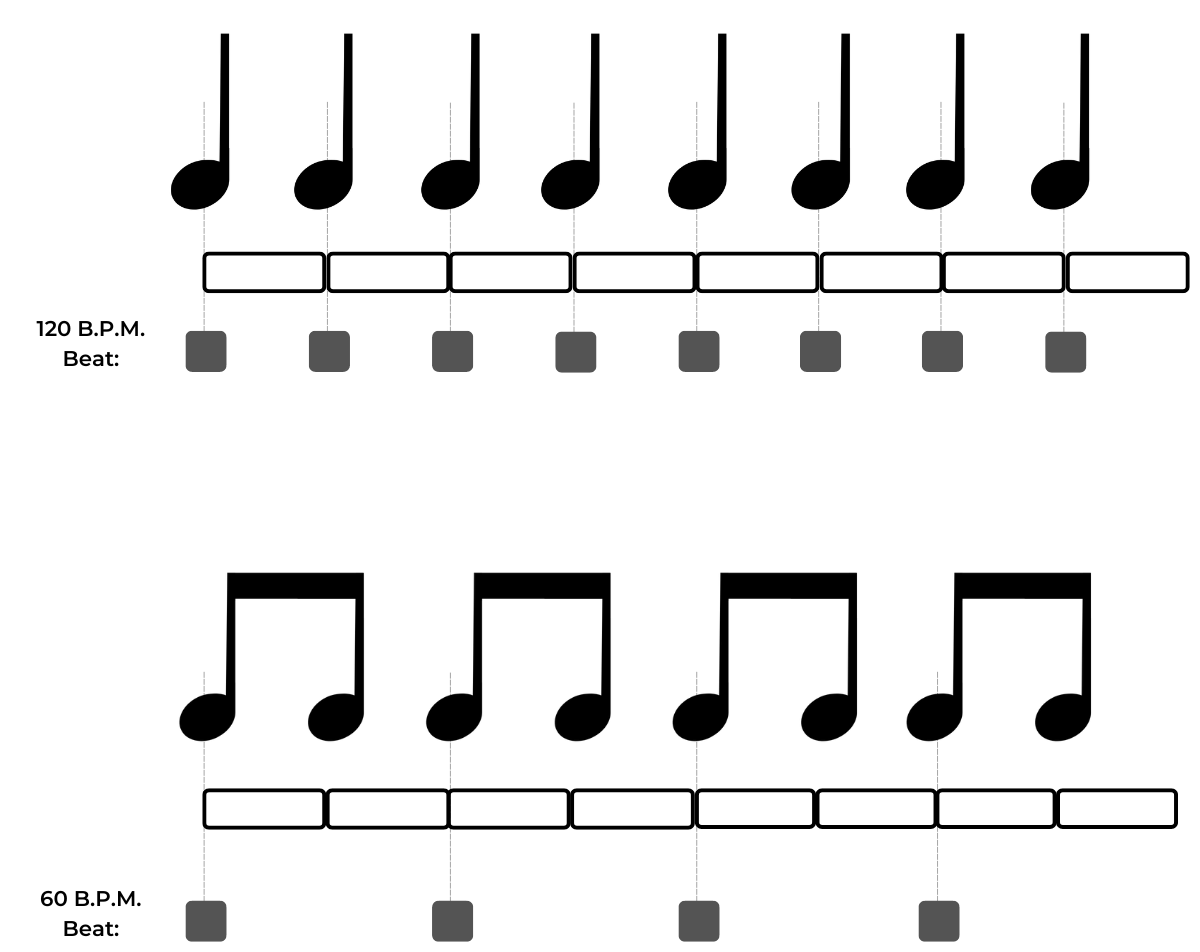
This brings us to our next layer of Rhythm. If the beat is our most basic foundation for musical time, the next layer would be how we subdivide each beat into smaller time units. This is what sets up all the rhythmic possibilities which can then be built on top.
Before we dive into subdivisions though, let’s zoom out and discuss one more aspect of the Beat which exists at a higher layer of time: how we group beats, known as the meter.