


It’s common to confuse Beat and Rhythm. This isn’t helped by the fact that we use the word “beat” to also refer to a certain rhythmic pattern, like “that track has a great rock beat.”
To really understand the relationship, and start to connect with the underlying beat, separate from any rhythms we might wish to express, we need to go back to basics.
Instead of the notation-first approach to Rhythm which is common in instrument learning, we will take a feeling-first approach, connecting our Hearing and Hands (body), to the actual pulse of The Beat itself.
Instead of the linear approach to Rhythm, where a musician is just thinking about the sequence of note durations, one after another, we will take a layered approach. This will let us better understand, appreciate, and express how rhythm exists as a set of layers, from the particular notes played, down through the subdivisions of the beat, and to the beat itself.
Instead of an instructions-based approach relying on notation to dictate what notes to play when, we will develop an instinct-based approach where you have internalised both a reliable, precise “inner metronome”, and a facility with the subdivisions and layers that can be built on top.
So if “the beat” is distinct from “the rhythm”, and most musicians have spent little time really studying and connecting with the beat, you might well be waiting to hear:
What is “The Beat”?
The Beat is the steady, underlying pulse of the music. There might be any number of rhythms laid on top, playing by various instruments, from long, sustained note pitches to fast flurries of notes. Underneath them all though, is a steady pulse. If it changes, it’s either gradual (slowly speeding up or slowing down) or there’s an abrupt change, usually marking the start of a new section. For the most part, The Beat is steady and unchanging, no matter what patterns of note durations and silences are being played.
So The Beat is something we sense rather than necessarily play.
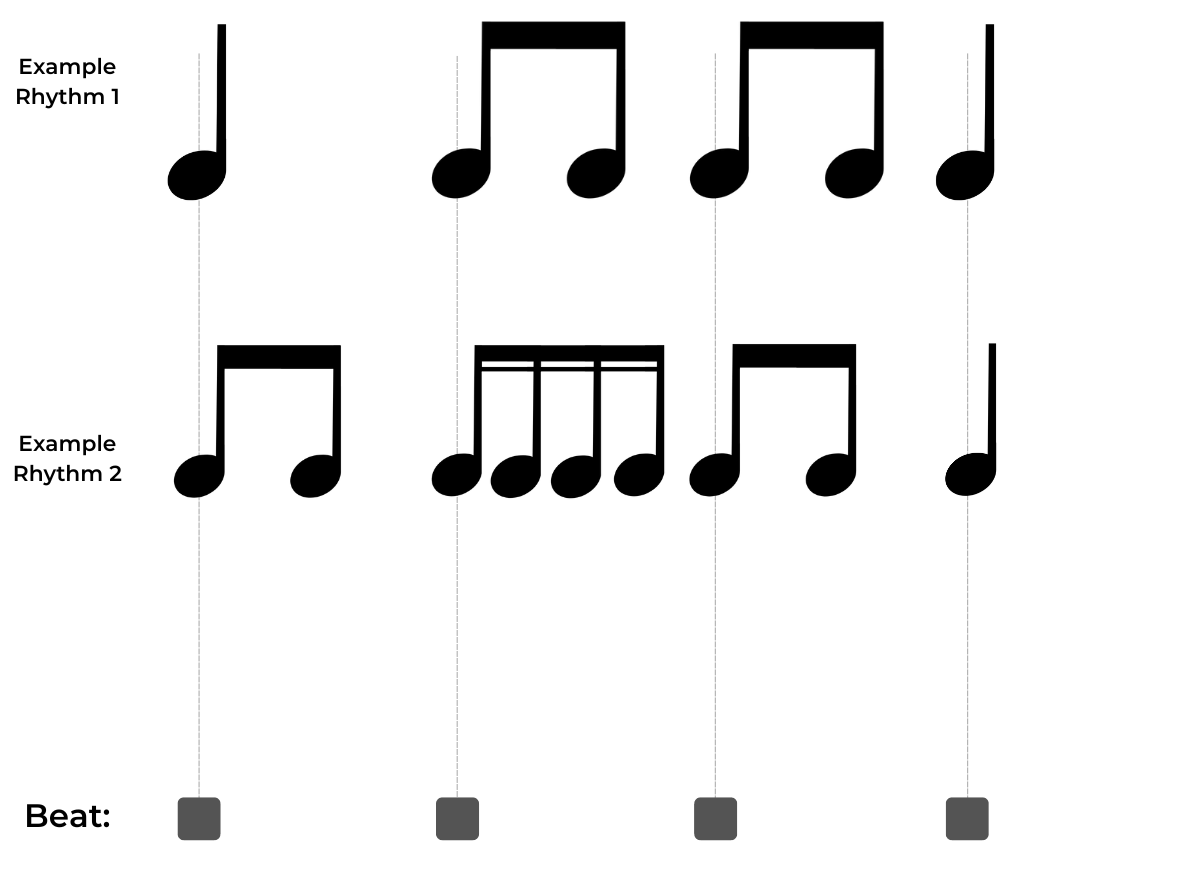
Here’s a visual representation of The Beat with two different rhythmic patterns on top:
If you’re not familiar with these note symbols, here’s the same two rhythmic patterns, shown with rectangular blocks indicating the length of each note:
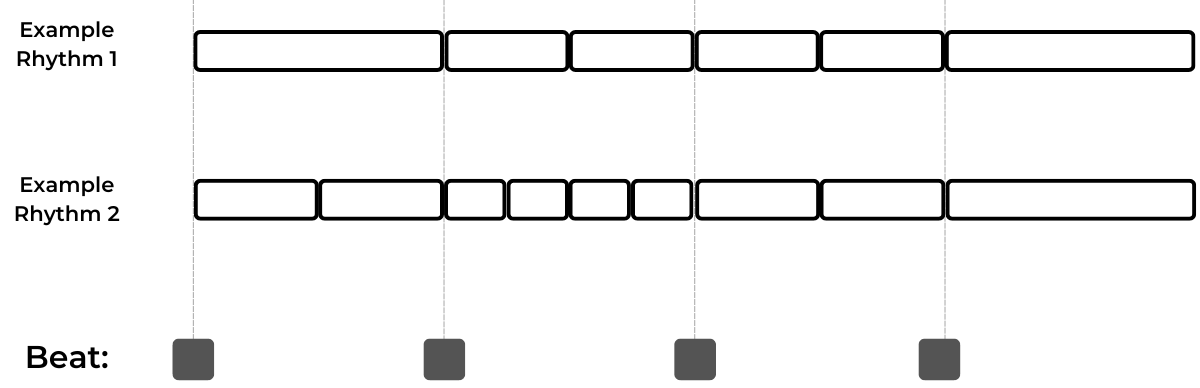
In this diagram we’ve used a single instantaneous marker, a square, for each beat. Some people also like to draw it as a heart symbol, drawing the analogy to our steady heartbeat.
But beats aren’t actually an instant—they’re a moment, with duration. This is an important distinction! The overall Beat exists as a series of individual beats, each one an equal-duration segment of time, occurring one after another.
If we say “a beat” this can refer either to one of the individual beats which make up the overall pulse (e.g. “on beat two of the measure”), or to a pulse at a certain speed (e.g. “play a fast Beat”).
We will use a capital (“Beat”) to refer to the concept and to the overall pulse, and lower-case (“beat”) to refer to the individual beats within it.
If we “clap the Beat”, for example, we are marking the start of each beat—but each beat actually lasts until the next one begins.
So really, The Beat looks something more like:

For convenience of writing and interpretation, we can leave little gaps between each beat:

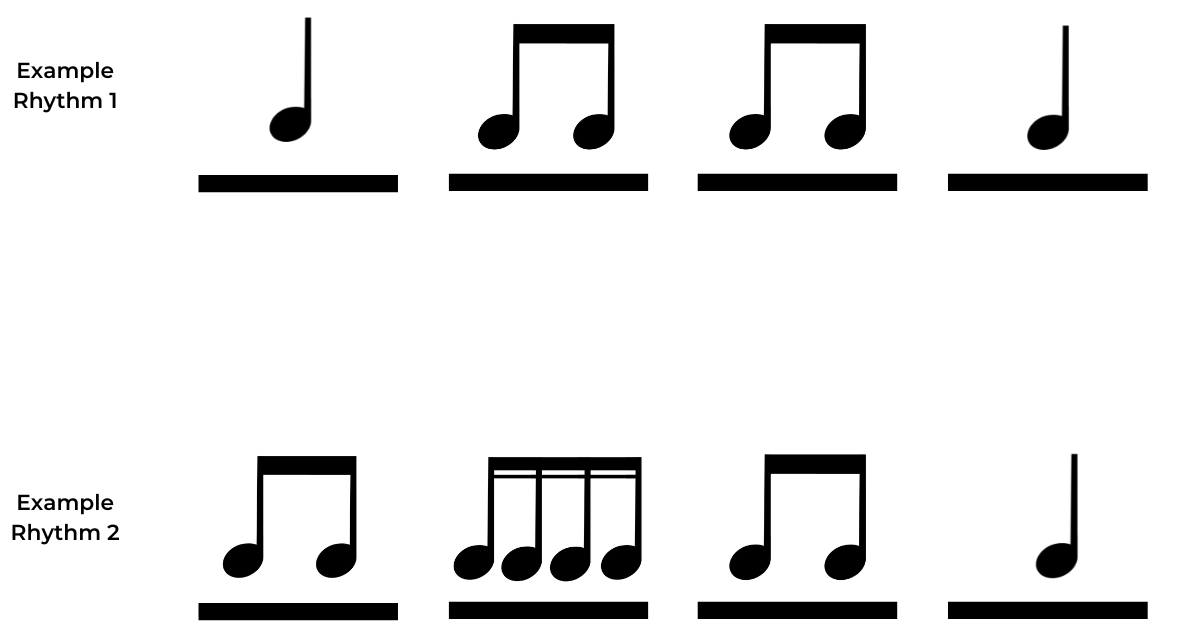
We call these short horizontal lines “Beat Blanks” because, as we’ll see, they provide a “blank slate” framework of time, to which we can add various annotations to show additional musical information such as rhythms or pitches.
For example, here are the same two example rhythms, shown now on Beat Blanks:
Beat Blanks are extraordinarily useful, and we’ll come back to them later in the chapter. First, let’s get intimately familiar with the Beat, free of any notation at all.
Developing Your Sense of the Beat
To help us get to know the Beat, we’re going to borrow the “3 C’s” of the Performance Free-Flow framework you’ll learn about in Chapter 18: Performance: Connection, Creativity and Conversation.
Connection
In the spirit of our Musical Inside And Out Pillar Belief, we want to develop both our internal sense of the Beat and our ability to relate to an external Beat we perceive.
Internal Connection
I could wax lyrical about how intrinsic and innately powerful Rhythm is for humans, how the earliest forms of music-making known were for the sake of communal dance, how music could not exist in any meaningful way without Rhythm and its underlying Beat… But instead, let’s experience just how innate the concept of a steady pulse is.
EXERCISE: Find Your Heartbeat
|
Clapping is a powerful tool for expressing Beats and rhythms, really ingraining them into your body physically, without needing to think about note pitches or instrument technique.
It might sound funny to say, but clapping can take practice! Don’t start with your hands too far apart from one another, small claps are easier to time accurately. You may find that clapping vertically rather than horizontally, with your dominant hand on top, is easier and more effective.
If you’re tapping your foot, some of our members have found that tapping your heel rather than your toes helps internalise the beat more fully.
EXERCISE: Walk The Beat
|
Again, don’t be surprised or discouraged if you get muddled, or if you find it a challenge to get things as synchronised as you can hear they should be. This is exactly what we need to practice!
The U.K.-based drummer Dave Smith introduced us to a wonderful approach to connecting with The Beat which we call the “Rhythm Dance”. The idea is to have a way of moving your body which allows you to express both the Beat and its grouping into measures (a.k.a. “bars”). We’ll explore that more in the section on Meter below, but you can try the Rhythm Dance for yourself now:
EXERCISE: Rhythm Dance
This should leave you where you started. So you are still stepping once on each beat, but now we’ve got four distinct moves:
|
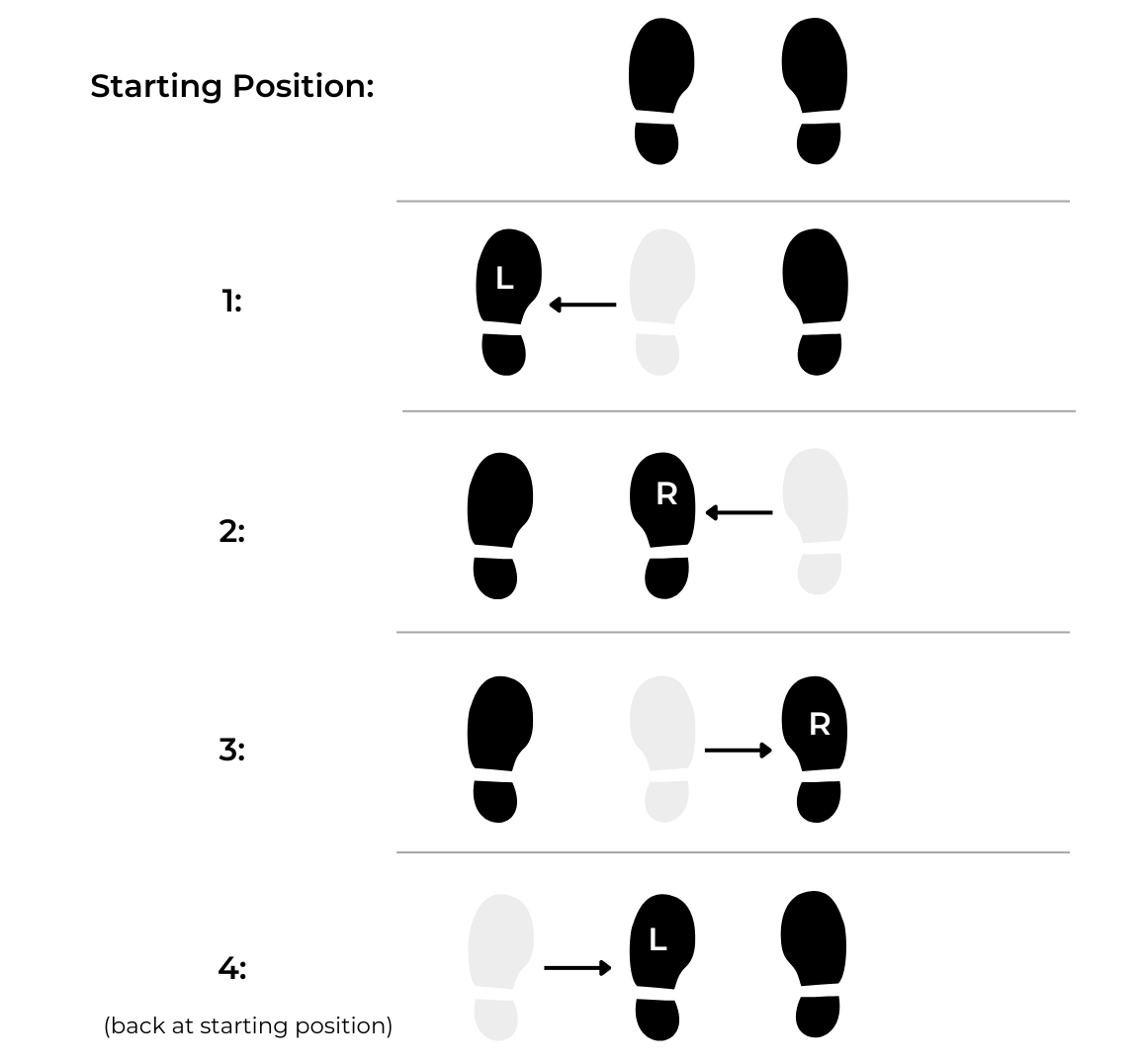
Practicing just this exercise is a very effective way to get more deeply in touch with the Beat, and it also provides a powerful basis for a range of other Rhythm exercises, as we’ll see.
As before, don’t worry if you get muddled or find it challenging. Remember Growth Mindset, and acknowledge those difficulties as revealing your learning opportunity. You can adjust the speed as needed, or try just clapping and stepping, or just speaking and stepping, before returning to all three together.
We’ve seen consistently that musicians who’ve been taught music in a very Head-and-Hands focused way often haven’t learned the fundamental skill of moving our bodies to the Beat. It seems like it should be so simple (especially if the level of our Hands skill on our instruments is high!) it can feel embarrassing when we struggle with it. Practice in private to begin with, and Tak Courag. The results can be truly life-changing.
External Connection
Now that we have a feel for producing a clear, steady Beat, let’s start practicing synchronising with some external source of a pulse. You’ve already had a taste of this, as coordinating your hands, feet and speech may well have felt like you were trying to synchronise two different Beats together!
There are rhythms all around us. This can be anything from the sounds of traffic and the city to the quiet of the woods, to the rushing and cyclical pounding of ocean waves on the shore. Birds, insects, weather… all have rhythm. Learning how to discern different pulses within a greater soundscape will help you learn how to properly clap in time and find the Beat.
EXERCISE: The Pulse of LifeFor this exercise, take a few minutes to simply sit still and listen. As you sit:
It could be the steady drip, drip, drip of raindrops from your roof, the ticking of a clock, the clattering of trains going past, a gentle pulsing of the human hubbub around you. This is a wonderful Active Listening exercise which you can practice in your day-to-day life, to wake up your ears and become more mindful of the musicality of both the natural and man-made worlds. |
Now let’s turn our attention to something which almost always has a clear, intentional Beat: music!
Funnily enough, the exercise below is often introduced as the first step in learning to connect with the Beat! But as you’ve seen, there is some really important groundwork we can usefully lay, before ever getting to clapping along with fully-arranged music tracks.
EXERCISE: Clap Along With Music
|
| TIP: If you find this tricky, one great stepping-stone is to practice with drum loops. These are short, repeating percussion tracks. The big advantage is that drums will often be playing the pulse itself as part of their rhythm, or it will at least be very clearly implied. You can search online for free examples or see the Additional Resources, where you’ll find tracks with and without a prominent “click” track to reveal the Beat. Once you get the hang of finding and clapping along with the Beat in drum loops, you’ll find it easier to tune in to the drum part in rock/pop music or other genres with similar drum parts, and then to music where the Beat is less prominent. |
We’ll explore that sensation of being “in time” (i.e. synchronised with the Beat) and “out of time” more below, so if you found it hard to judge if you were “getting it right”, you can return to this exercise again later.
Creativity
As you’ll discover in the following chapter on Rhythm, and in Chapter 15: Improvisation, simple rhythmic improvisations can be a powerful gateway into improvising your own musical ideas. And the simplest possible rhythm is… the Beat!
Although it may not yet feel like “creating” to you, try creating your own Beats by:
- Using clapping, tapping, stepping or dancing to produce a steady pulse, without reference to anything else. Experiment with starting a pulse which is a moderate speed, then stop, and start again at a new, faster speed. Then slower. Experiment with a wide range of speeds.
- Experiment with emphasising certain beats. For example if you’re speaking the numbers (as in some of the exercises above, including the Rhythm Dance) you can speak the “one” louder than the “two”, “three”, or “four”. How does that change your experience of expressing the Beat? What if you emphasise “two” and “four” instead? What if you ditch the “four” and only speak “one, two, three, one, two, three, …” in a loop?
- Extend the Rhythm Dance with your own movements. Start with stepping and counting, as in the earlier exercise. Then try adding finger clicks instead of clapping. Or add arm movements that feel right to you. Do different things on each beat. Follow your instinct!
- This is a great time to introduce any instruments you play. Don’t worry about choosing pitches for now, just choose a single note pitch and play that note in place of clapping. Try all the various exercises covered so far, using your instrument to express the Beat.
These may all seem far too simplistic to count as “being creative”, but notice how in each case you are conjuring up a steady pulse out of nowhere, relying solely on your own “inner metronome”. Notice too how taking on the mindset of “being creative” shifts your experience of the pulse, contrasting with just “following instructions”, and how much more deeply these activities invite you into the Beat and connect you with it.
Conversation
In our 3 C’s framework, “Conversation” represents the back-and-forth interplay of music. This can be between you and your instrument, you and other musicians, you and the audience, you and the music itself.
Let’s try having a “conversation” with the Beat.
We’ll invite a friend: the metronome. We cover some metronome basics in Chapter 6: Superlearning, but it’s enough to know that any physical or software metronome is fine for our purposes here.
EXERCISE: Have a Conversation with the Beat
|
The key here is to have fun with it! You might be surprised by how enjoyable, and even humorous this can be, if you treat it like a true musical conversation between you and the metronome. You will probably also realise how much creative freedom you have even when expressing the simplest possible rhythmic pattern—something we’ll explore much more in the Expansive Creativity framework of Chapter 15: Improvisation, as well as Chapter 17: Expression.