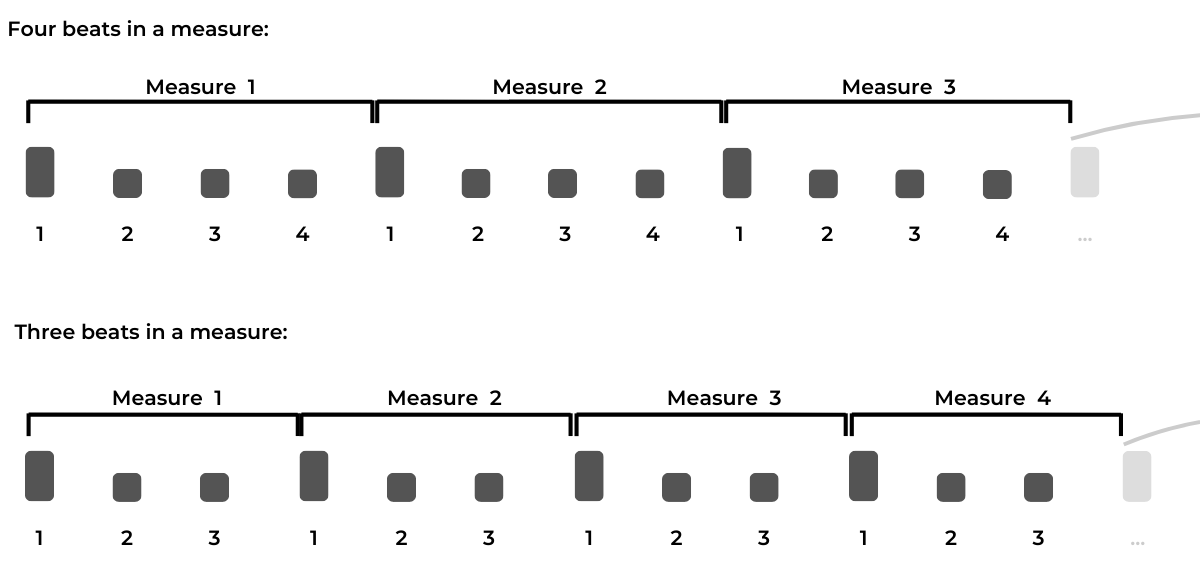
As you may know, or remember from Chapter 5: Active Listening, not all beats are created equal! In fact, as music-makers we tend to emphasise some more than others, and do so in a way which groups them together with a set number of beats in each group (most commonly three or four beats to a group) which we then call “a bar” (or “a measure”).
This gives music another layer of structure in time, in larger units than beats:
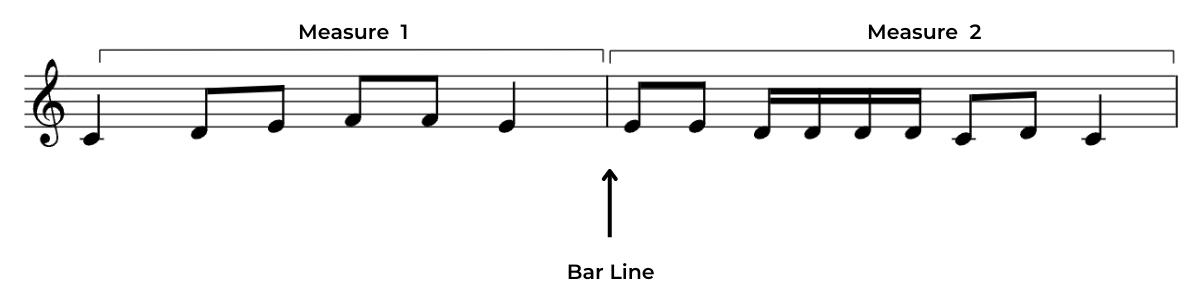
This is convenient when working with written notation, to be able to visually break the music down rather than just having a single endless stream of notes. We use vertical “bar lines” to mark the measures, like this:
But it’s important to know that this is a reflection of the music itself, not just a notation convenience or rule of music theory. Even with no notation involved, we play music in a way that implies this structure to the listener.
As mentioned, we do this by giving more emphasis to the notes which occur on certain beats, most notably the first beat of each measure.
In the exercises above where we spoke “one, two, three, four” in a loop, we were communicating the groupings of four beats. You may have also tried the exercise involving speaking certain beat numbers louder than others. If so, did you notice that emphasising the first beat of each group felt particularly familiar and natural?
Changing volume, known as Dynamics, isn’t the only way we can emphasise beats or communicate this structure. It can also be reflected in when the chords change, when a new section begins, which part of the drumkit is played on that beat, where musical phrases begin and end, and many other ways. How much, and in which ways, the musician (whether composer, songwriter, improviser, or performer) chooses to express the meter is a creative choice.
Having four beats per measure is called quadruple meter. Other common meters are duple (two beats per measure) and triple (three beats per measure).
Earlier in the chapter we introduced the idea of Beat Blanks. Rather than have them go on forever in a single horizontal line as the Beat continues, naturally we can instead write them in a way which also reflects the meter, by having each measure be written as its own line.
Here’s what four measures of Beat Blanks would look, with two, with three, and with four beats per measure:

So far our Rhythm Dance used quadruple meter, with four movements and counting “one, two, three, four, one, two, three, four, etc.” You can express a duple meter beat with the Rhythm Dance by simply stepping on the spot (right, left, right, left, etc.) and speaking “one, two, one, two, etc.”.
What about a Rhythm Dance for triple meter?
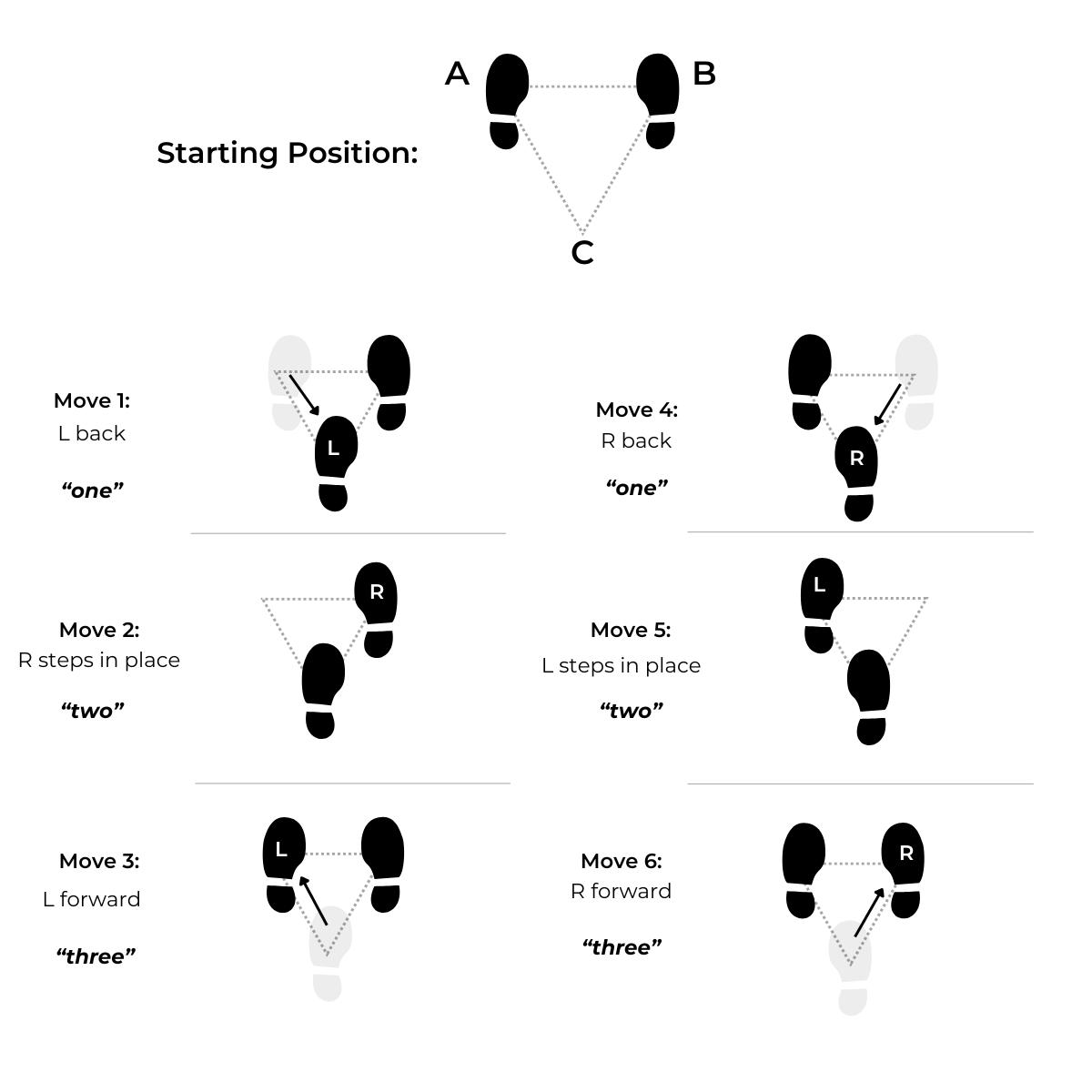
EXERCISE: Rhythm Dance in Triple Meter
This should leave you where you started. So you are alternating stepping with your left and right feet, but now we’ve got six distinct moves, breaking up into two groups of three which each leave you in the starting position.
|