


Before we move on to Additional Exercises and Applied Activities, let’s briefly survey what lies beyond Major and Minor Triads, and the I, IV, and V chords. Several of these possibilities have been mentioned already.
For most musicians we recommend first gaining some proficiency with the main building blocks we’ve been focusing on so far. For that reason, you may wish to skim, or skip over this section entirely for now! Continue working with those building blocks and the “Additional Exercises and Applied Activities” below.
When you are ready to begin introducing other Chord Types or Progressions, you can return to this section. All the same exercises presented throughout this chapter can be used, simply incorporating the new possibilities introduced here.
This allows you to naturally and organically expand your comfort zone and competence with recognising Chords and Progressions, in a way that suits your musical interests and activities.
For example:
- A pianist may wish to move quickly on to exploring different chord voicings, to allow for more variety and creativity in Playing By Ear and Improvising.
- A songwriter may choose to explore Minor Keys sooner rather than later, to suit their songwriting style.
- A guitarist will probably want to adapt their triad skills to the traditional six-string chord shapes before introducing other types of Chords and Progressions.
And so on. In some cases, a musician may know already that they want to introduce some of these possibilities sooner. For example, if you play jazz, you may choose to focus on ii-V-I Progressions even before I, IV, V Progressions.
Whatever route forwards you choose, the information provided in this section should be enough to tailor all the exercises from this chapter to suit.
Chord Voicings
So far we have limited ourselves to root-position Triad chords: three-note chords consisting of a Third and a Fifth above the root note. There are many other ways to “voice” the same chord. With the same root note (degree) and Chord Type (quality), a musician can choose a variety of notes across different registers to play what is, in terms of overall sound and musical function, the same chord.
For example, in the section “How Chords Work” above, we saw several possibilities for voicing a C Major chord:
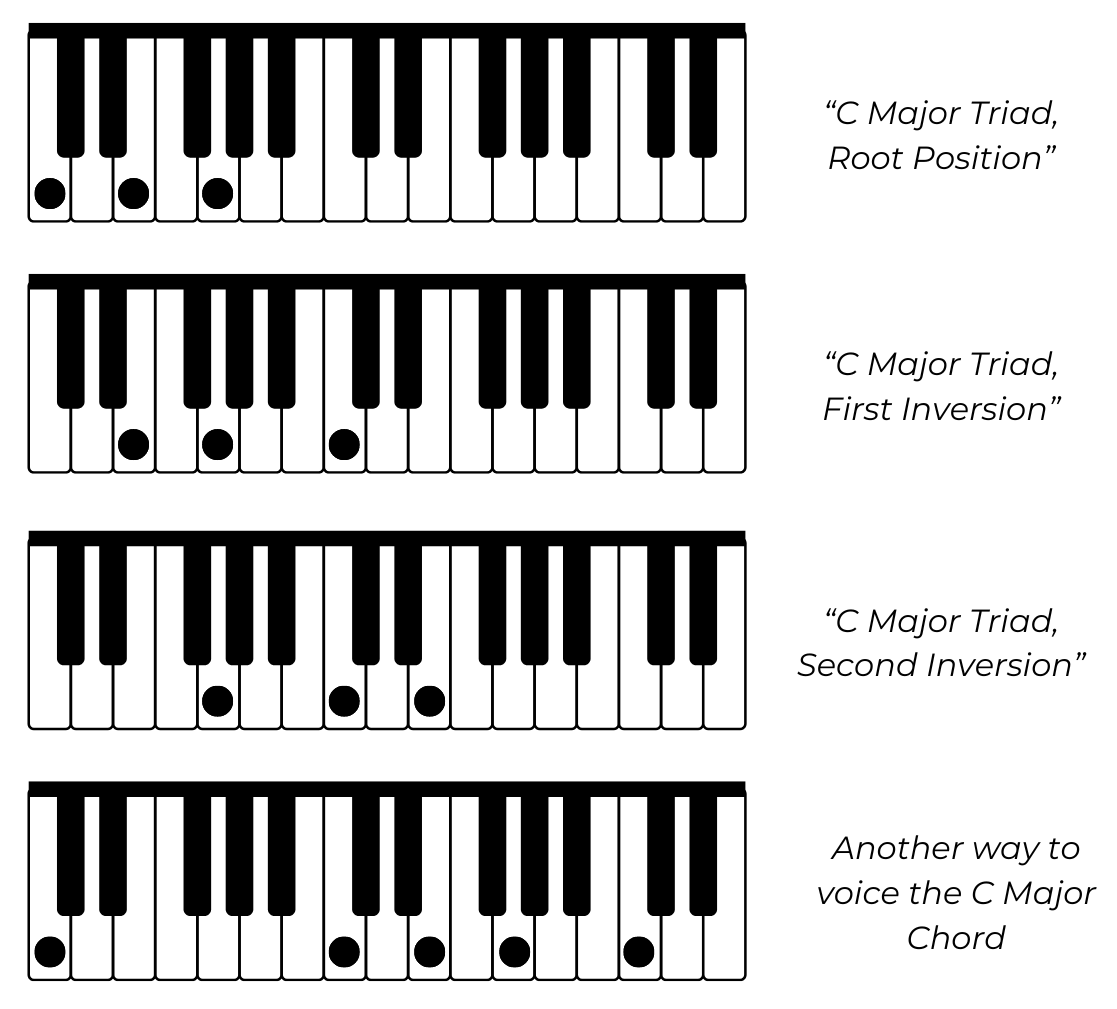
Another example is the way a guitarist plays a chord using up to six strings of their instrument, and can choose different chord “shapes” at different positions on the fretboard to play the same chord. Here are three ways to play a C Major chord, for example:
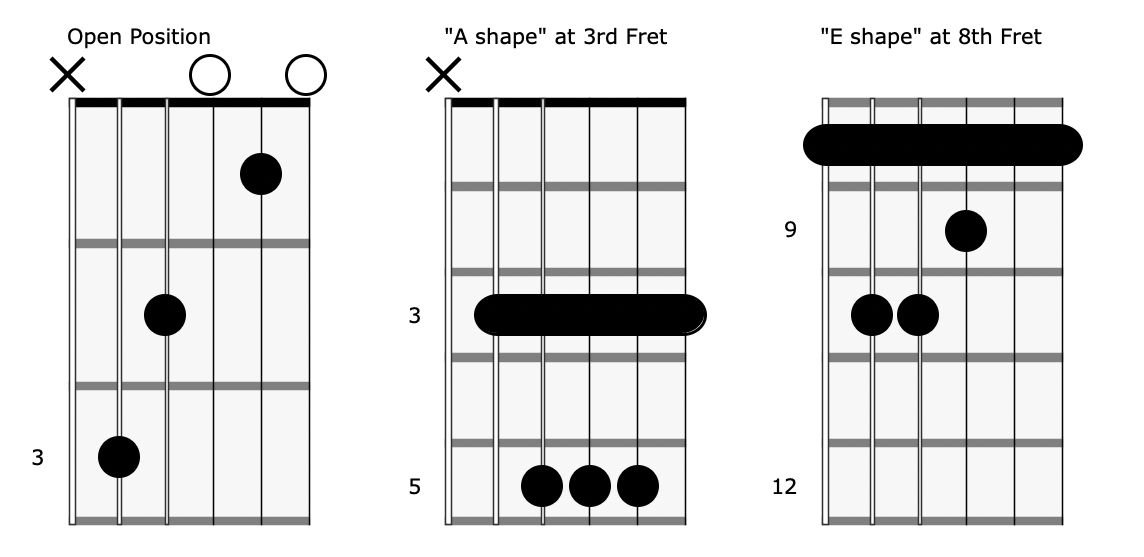
When it comes to Ear Training and voicings, there are two useful skills to develop:
- Recognising the chord’s identity, regardless of its voicing.
- Recognising the voicing being used.
The first skill is important for any musician, because in a real musical context it’s rare for the music to use only root-position Triad chords! Fortunately, this is quite an easy skill to develop once you’re solid with those root-position Triads, because listening for the degree and quality works the same way, regardless of voicing. Simply broadening the range of example chords you use in practice exercises will allow you to make your recognition skills more versatile and robust. This will also happen naturally as you try the Applied Activities below, using real music tracks.
The second skill is more advanced, and for many musicians won’t be a high priority. If you play a keyboard instrument then recognising voicings can be valuable, to let you play them precisely by ear, or to be able to audiate different possibilities for how you might choose to voice the chords you play. If you play guitar then it can be valuable to hear the difference between chords played at different positions on the fretboard, for the same reasons.
If you do want to develop this skill, then one good approach is to adapt the practice exercises in this chapter to feature a variety of voicings, and set yourself the task of identifying the particular voicing being used. On keyboard you’ll want to draw on Solfa and Intervals to let you spot the relationships between the notes of the chord.
Guitarists tend to listen more for the distinctive overall sound of each moveable fretboard shape, and the overall highness or lowness of the chord’s notes. Compare and contrast, for example, an open-string E chord with the barre-chord version played at the 7th fret, and you should immediately be able to hear a substantial difference between the two. You are still tuning in to the relationships between the notes of the chord, but in a more broad, subconscious way, recognising for example the “A shape” versus the “E shape”, and so on.
Four-Note Chords
What about chords with more than three notes? Well, again, we’ll tip our hat in acknowledgement to the fundamental truth that a chord can use any arbitrary set of notes, but take advantage of common building blocks to help us focus our efforts where they’ll produce the greatest payoff.
One possibility is to repeat one of the three notes again. As covered above, we can consider this a different voicing of the same Triad chord, rather than a distinct Chord Type.
If we are adding a different fourth note to a chord, the most common choice is the seventh degree counting up the scale from the chord’s root. Just as we skipped a note to go from the root note to the third, and skipped another to get to the fifth, we skip one more to reach the seventh.
Coming back to the idea of seeing this as “stacking thirds”, we are stacking one more Major or Minor 3rd above the fifth, which takes us to the seventh.
Since we have four possible Triads and two options for stacking another Third on top, there are actually eight different possibilities. One of these, consisting of all Major 3rds, brings us back to the root note again, Since three Intervals of four Half-Steps each produces a total of 12 Half Steps, which is equivalent to an octave. so in fact there are seven possibilities.
For the sake of completeness, here they are:
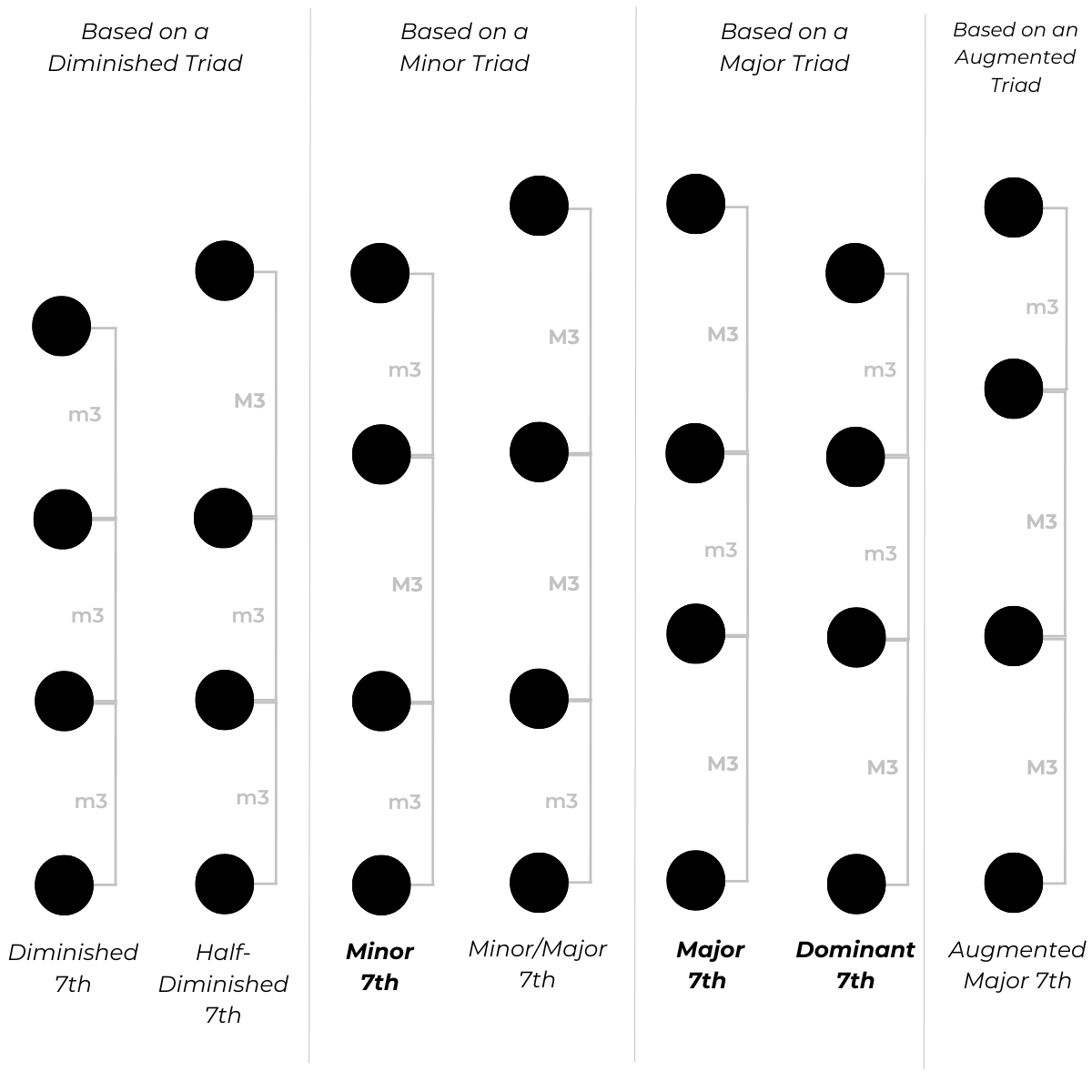
That may well seem overwhelming to you right now! Fortunately there are two valuable simplifications.
Firstly, some of these types of Seventh Chord are used much more often than others. Specifically, the Dominant 7th is probably the most common, followed by the Minor and Major Sevenths (names bolded in diagram). The Minor/Major 7th and the Augmented Major 7th are quite unusual. The Half-Diminished and Diminished Sevenths are somewhere in between.
Secondly (and related), the most common choice of Seventh Chord is to use the type which occurs naturally from a given scale degree. If we choose the type of top 3rd which keeps us within the notes of the key, there is just one Seventh Chord we can build from each degree of the major scale:
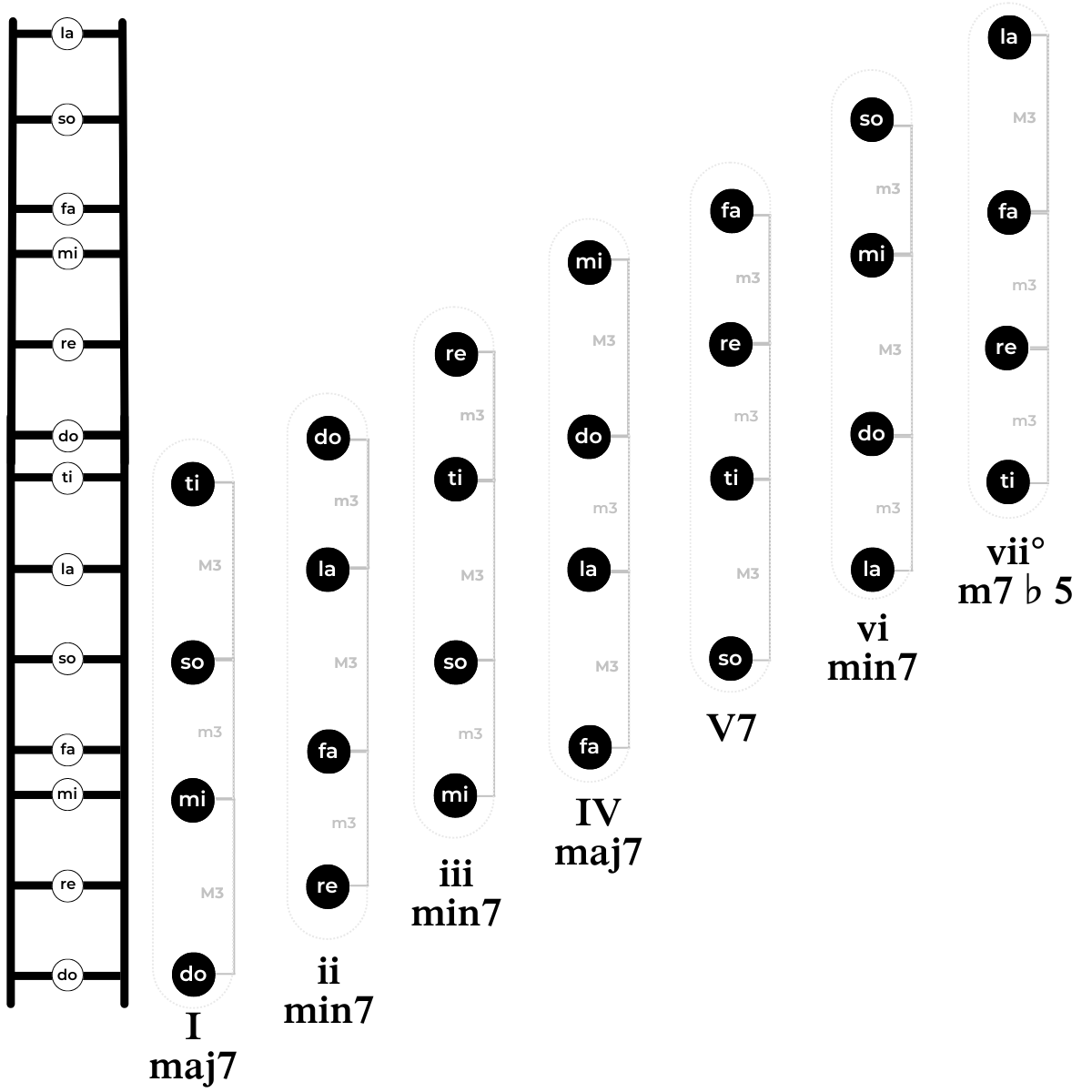
You can see that the three major chords, I, IV, and V become Major 7th, Major 7th and Dominant 7th chords, respectively. The three minor chords ii, iii and vi all become Minor 7th chords. And the diminished vii° becomes a Half-Diminished 7th chord (often written “min7♭5”, as in the diagram above, because it’s the same as a Minor 7th chord but with the fifth lowered a Half Step).
Since the vii° chord is relatively uncommon, you can see that if you want to gain the most payoff from practicing with Seventh Chords, just focusing on the Major 7th, Minor 7th and Dominant 7th types can take you a long way.
| A Note For Jazz Musicians In the jazz world, musicians are often thrown in at the deep end with seventh chords, being encouraged to learn to play all seven types in all 12 keys as soon as possible. That may or may not be good advice. It certainly can help you gain facility with playing from lead sheets quickly. However, when it comes to Ear Training, the guidance here still applies. You don’t want to overwhelm your ears, so introduce the different types gradually, and focus on the most commonly-used to begin with. Adapting the exercises in this chapter for ii-V-I progressions, first as Triads and then as Seventh Chords (ii, V and I become a Minor 7th, a Dominant 7th and a Major 7th chord respectively) is a great way to start familiarising yourself with the three most common types of Seventh Chords. |
We’ve already featured one of these chords: the V7. As you can see here, that’s the only Dominant 7th chord in the major key, and it brings a lot of powerful tension with it! It amplifies the unresolved feeling of the V chord, and even before you tackle Seventh Chords in earnest, it’s a great one to start experimenting with, as we saw above and will return to below.
Borrowed, Altered And Suspended Chords
Depending on your musical background and activities you may have come across the terms “borrowed chord”, “altered chord” and “suspended chord”. We’ll provide here a brief description of each, so you can understand how to factor them into your Ear Training.
A borrowed chord is simply a chord from outside the “family” of chords which naturally exist in the key. For example, a common choice in Songwriting is to change the quality of a chord in the family from Major to Minor or vice-versa. This can make for a very distinctive progression.
If you “borrow” too many chords from outside the key, it can disorient the listener by making the tonal centre (i.e. which note is the tonic) unclear. This may be the desired effect! But in general, it’s more normal to just change one or possibly two chords from the expected family. Aside from changing the quality, it’s also of course possible to change the degree, for example moving it up or down by a Half Step Note that although we’re saying “change a chord”, this needn’t necessarily replace the chord from the key—it can be an addition rather than replacement. For example, one highly effective technique is to use the “normal” chord from the family in one section of a song or piece, and then change its quality in another, such as featuring the iii chord in verses but the III chord in the chorus. .
An altered chord is a chord in which one or more of its notes have been moved up or down by a Half Step. This moves outside the notes of the key and is typically used momentarily to create a smooth movement from one chord to another.
There are particular norms and expectations in jazz music for how to interpret a chord marked as “alt” which is worth diving into, if relevant for your musical life. In a sense these are a very advanced topic. On the other hand, if your Solfa skills (for example) make it easy for you to spot when one note of the chord is a Half Step higher or lower than you expect it to be, you may find that altered chords are easier to wrap your ears around than all the complicated theory might suggest!
A suspended chord is one where the usual 3rd is replaced by either a Major 2nd or a Perfect 4th. So instead of taking the first, third and fifth notes going up from a certain root, you are taking either the first, second and fifth (called a “suspended 2nd” chord, written “sus2”) or the first, fourth and fifth (called a “suspended 4th” chord, written “sus4”).
In Songwriting these can be used either to replace the regular version completely, or as a flourish by switching between the regular version and one of the suspended versions. On guitar, for example, many simple riffs involve placing and removing one finger, changing back and forth between the 3rd and a 2nd or 4th.
Again, all of these possibilities are relatively advanced topics in Ear Training overall, but depending on your musical background and activities, you may wish to introduce them into your practicing sooner or later.
The various additional Chord Types introduced here (seventh, borrowed, altered, suspended) can all be considered somewhat niche, advanced, or specialist, for the average musician. However, as we move on to additional possibilities in Chord Progressions, we are returning to the mainstream. It will be relevant and useful for any musician to extend their Chords and Progressions Ear Training to what follows.
Introducing vi
If 3-chord songs using I, IV, and V are the most prevalent across the wide world of music, then a close second would be 4-chord songs using I, IV, V and vi. It’s been said that to write a hit song, all you need is “four chords and the truth”. If that’s the case, then I, IV, V and vi are the chords!
The vi chord is the most commonly-used minor chord in major keys, across a wide range of styles and genres, and 4-chord songs are almost as numerous as 3-chord songs (as suggested by the bar chart of chord use earlier in this chapter). This makes the vi chord an excellent choice for the next one to add to your skillset, once you have a firm grip on I, IV, and V.
If you’ve spent some time working with I, IV, and V, then the vi chord will generally stick out clearly, being the only minor chord among them. This goes double if you’ve diligently spent some time practicing Major vs. Minor Triads too. With that being said, it can be surprising how hard it sometimes is to hear that Major vs. Minor chord quality in a real musical context! So you will want to make use of both listening for the degree and listening for the quality to reliably tune in to the vi chord.
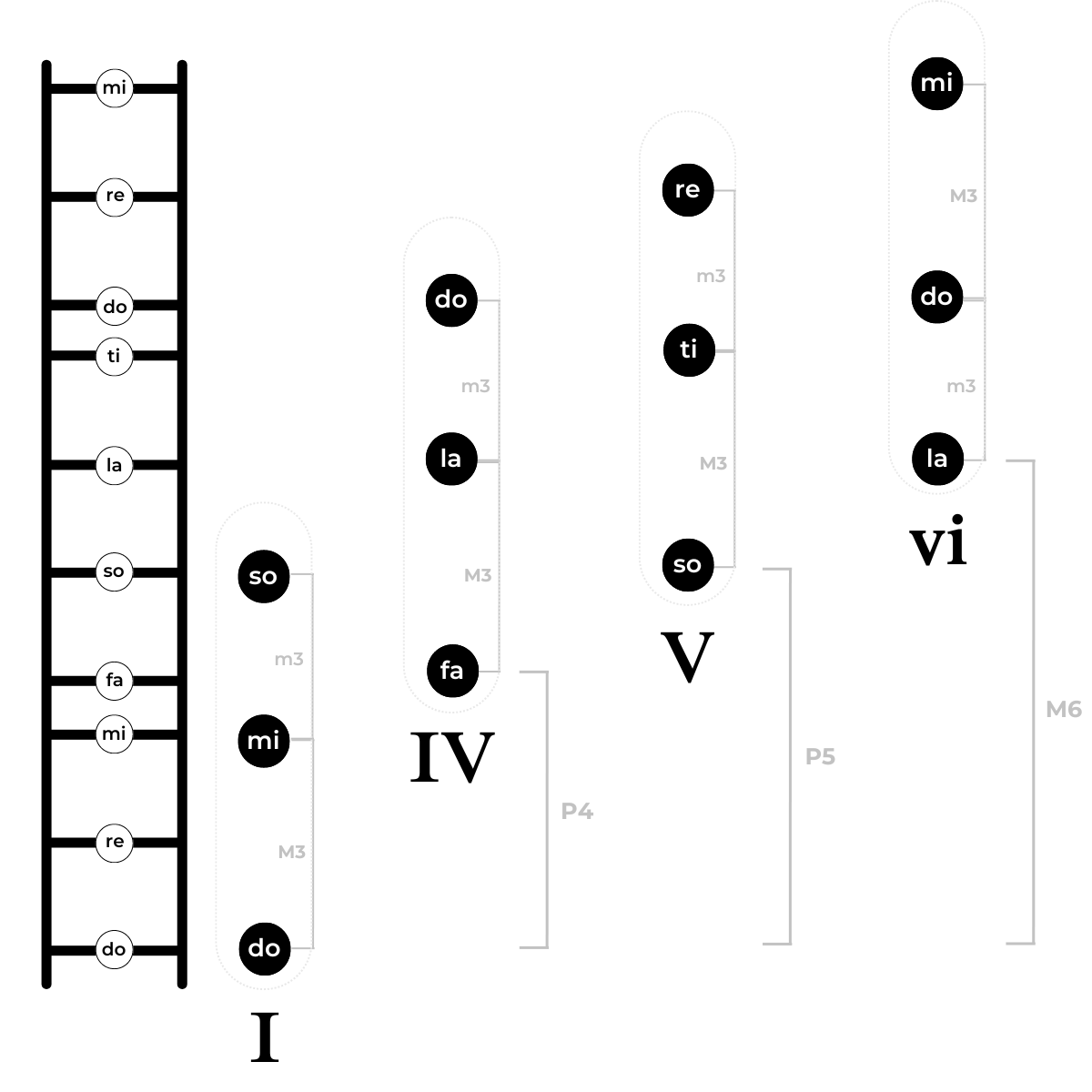
Introducing the vi chord immediately opens up a whole new emotional world in the harmony. The “musical journey” which the I, IV, and V chords can take you on is considerable—but it pales in comparison to a journey featuring the vi (or indeed the ii or iii—but more on those below).
All the exercises mentioned in this chapter, including most notably the three “Instrument Practice” exercises below, can easily be extended to I, IV, V, vi Progressions. You can find a “4-chord songs” list in the Additional Resources.
Other chords in the family
There are three more chords in our Major Key “family”: the ii, the iii, and the vii°.
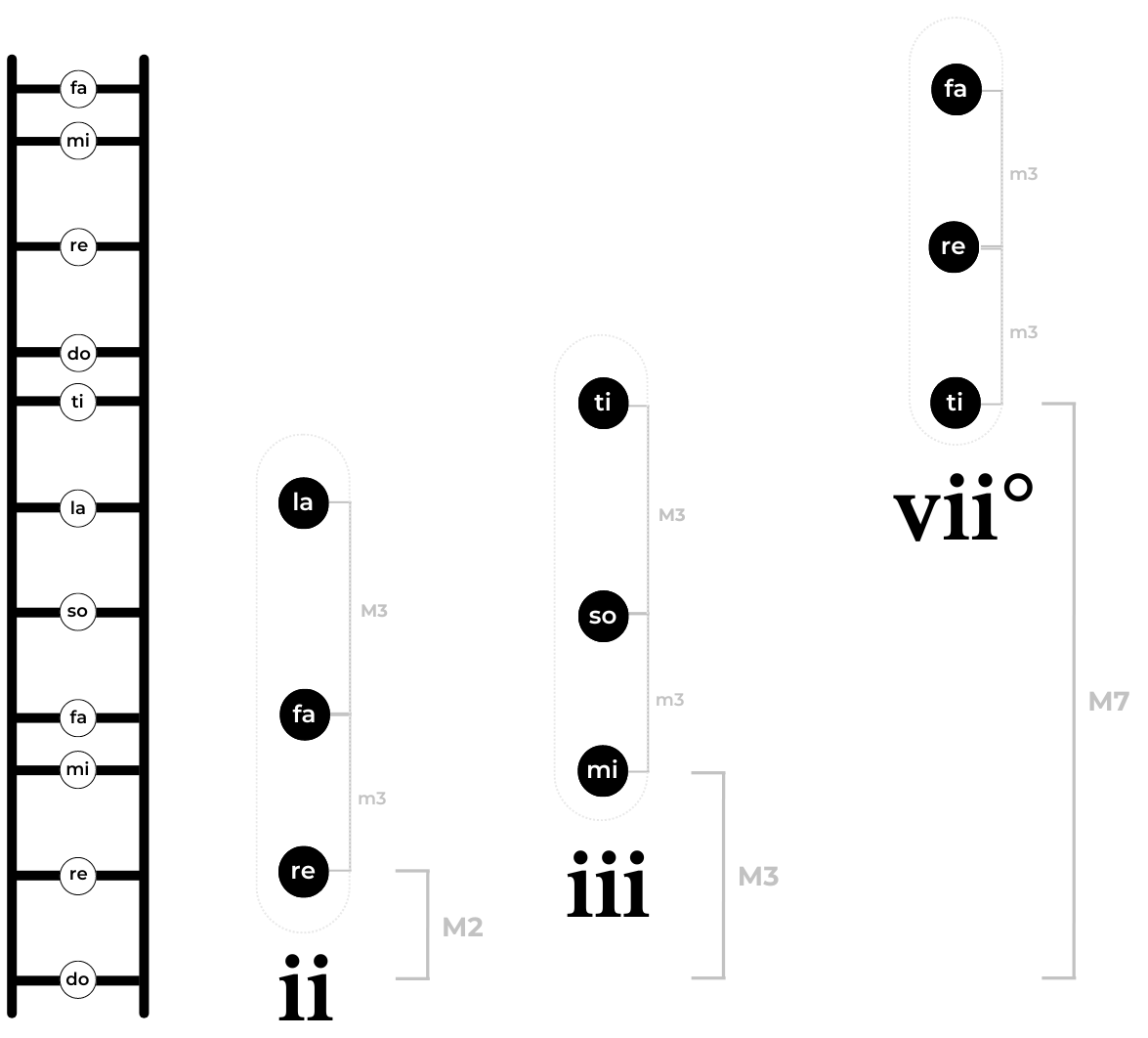
These can be tackled by gradually introducing them as possibilities in your practice exercises, but many musicians will find it more natural to:
- Leverage Solfa skills to spot the degree, and Chords skills to recognise the quality.
- Get familiar with them as they arise in your real musical activities. For example, if you’re using the “Instrument Practice” exercises below, you’ll naturally encounter songs or pieces which go beyond the I, IV, V and vi chords, and those provide a perfect opportunity to explore, experiment, and tune your ear in to what those other chords are doing, musically.
ii-V-Is
Just a quick word about the “ii-V-I” (“two five one”) progression. If a I, IV, V progression is the most common in rock, pop, electronic, country and many other popular genres, then ii-V-I is the progression which most characterises jazz (and jazz-inspired) music.
In jazz it’s more normal to play Seventh Chords than simple Triads, and so in practice this is generally a ii7-V7-I7. As mentioned in the previous aside, this features a Minor 7th, Dominant 7th and Major 7th chord, respectively.
Jazz is known for being perhaps the most harmonically-sophisticated genre, and there’s a deep rabbithole you can enjoy exploring when it comes to jazz harmony and how exactly that seemingly-simple ii-V-I actually occurs in pieces. Where I, IV, V Progressions can be seen as a sequence of Chords, the ii-V-I becomes a building block in its own right, featuring those chords in that order, but with twists such as a minor ii-V-I, modulation between keys, and various extended sequences featuring a ii-V-I.
If you are jazz-inclined, then Ear Training for ii-V-I’s should be a focus for you. One great habit to form is analysing the chord symbols on lead sheets of jazz standards to spot where a ii-V-I is happening, combined with listening intently as you then play that standard. All the other exercises in this chapter can be adapted for Seventh Chords and for a focus on the ii, V, and I chords in place of I, IV, and V.
Minor Keys
So far we have only discussed Chords and Progressions based on Major Keys, and while that is the more common tonality across a wide range of music, there is certainly no shortage of music written in a Minor Key!
In a Major Key, the notion of a “family” of Chords which belong is straight-forward. In Minor Keys, things become a bit more complicated, as there are three types of Minor Scale: Natural Minor, Melodic Minor and Harmonic Minor. On top of that, the Melodic Minor features different notes ascending than descending.
This means that to build Chords by choosing particular degrees of the scale (i.e. the first, third and fifth for Triads), actually produces a much larger “family”, since we have multiple options for several of the scale degrees.
Here are the Triads which result from each of the three Minor scales, in the key of A Minor, for example. For the sake of space we won’t spell out all the Solfa and Intervals and letter names! But you can see at a glance that because the notes of the scales differ, the Triads we build from each scale degree come out differently in each case:

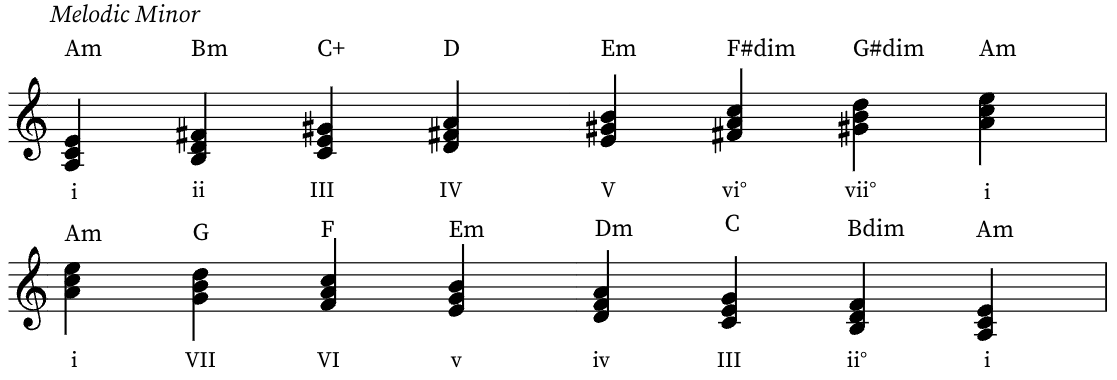

Here is a table showing the possible quality of each chord degree, considering these three types of Minor Key scales:
| Scale Degree | Possible Triad Types |
|---|---|
| 1 | Minor |
| 2 | Minor, Diminished |
| 3 | Major, Augmented |
| 4 | Minor, Major |
| 5 | Minor, Major |
| 6 | Major, Diminished |
| 7 | Major, Diminished |
So you can see, a songwriter or composer has a huge range of options available when writing music in a minor key—and that’s even before considering borrowed chords or any of the more sophisticated Chord Types mentioned above!
This can make Ear Training for minor-key Chord Progressions feel somewhat overwhelming. Fortunately the same fundamental approach still applies: listen for the degree, and listen for the quality.
One of the most useful additional exercises you can try is to experiment with varying the quality of certain chords as you play through progressions. As noted above when discussing borrowed chords, switching one chord in the progression from a Major Triad to a Minor Triad or vice-versa will have a significant effect on the musical journey created.
Try using the earlier exercise of creating your own I, IV, V Progressions, but this time choose chords from the table above. Select a certain quality for each chord you’ll feature, and spend some time playing through sequences using those chords, getting a feel for the musical impact and role of each. Then “toggle” the quality of one of the chords, and listen for how that changes things. Exploring and experimenting like this is a great way to develop your ears, as well as opening the door to creativity with harmony.
To gain an “I can handle anything” level of skill in recognising Chord Progressions is certainly more challenging in Minor Keys than Major—but the skills you develop first in Major Keys will provide a head-start, and from there you can use the exercises in this chapter to continue expanding and refining your ears over time.