


At this point we’ve covered a lot! We’ve unpacked Chord Types and Chord Progressions, and started to explore both their sounds, and the connections to the Solfa and Intervals perspectives on Relative Pitch. If you started to experiment with some of the ideas and exercises above, hopefully you’ve found that Chords, Progressions, and harmony in general, are coming to life in a new way for you.
Even more than with Solfa or Intervals, the world of Chord Progressions is vast. Why? Because ultimately, as mentioned in the introduction it can be a huge mass of notes across multiple instruments, featuring Chord Types beyond the four triads covered here, voicings beyond the simple root position, Progressions featuring the full family and even “borrowed” Chords from outside the family.
But remember the rule of thumb from The Hitchhiker’s Guide To The Galaxy:
Don’t Panic.
The two-fold good news of Relative Pitch which we keep coming back to is:
- A huge amount of music uses just a small subset of all those possibilities.
- If you develop your ear for that small subset, it provides a firm foundation for expanding your skills to everything else—because it isn’t just the most commonly-used building blocks we focus on, but those which everything else tends to be built upon.
We’ve already established that our main building blocks for Chords and Progressions will be the Major and Minor Triad Chords, and Progressions featuring just the I, IV, and V Chords. Why? Because that allows us to master so-called “3-Chord Songs”
In fact, we’ll need only our Major Triad building block for 3-chord songs, but the Minor Triad will quickly become useful too, as we introduce the vi chord and move on to 4-chord songs.
It will also prepare us for the ii and iii chords, at which point we are close to having the full Major Key chord family under our belts.
.
A 3-chord song as we’ll define it is a song which features just three different chords, and specifically the I, IV, and V chords. They can appear in any sequence, and there may be a different progression (i.e. sequence) used in different parts of the song.
To make that concrete, a song with the following Chord Progressions:
Verse: I-IV-V-IV
Chorus: V-I-V-I-V-I
… would be a 3-chord song. However a song with the following Progressions:
Verse: I-V-vi-I
Chorus: vi-V-I-I
… would not, because even though only three different chords are present, they include chords other than the I, IV, and V.
Although using just the I, IV, and V might seem overly limiting, these “3-Chord Songs” are everywhere in music. It’s especially true in popular modern genres such as blues, rock, pop, folk and country, but has its roots in classical music and 3-Chord Songs show up frequently in almost every genre.
For example, an analysis of 1300 popular songs by the wonderful website HookTheory showed the following prevalence of chords being used:
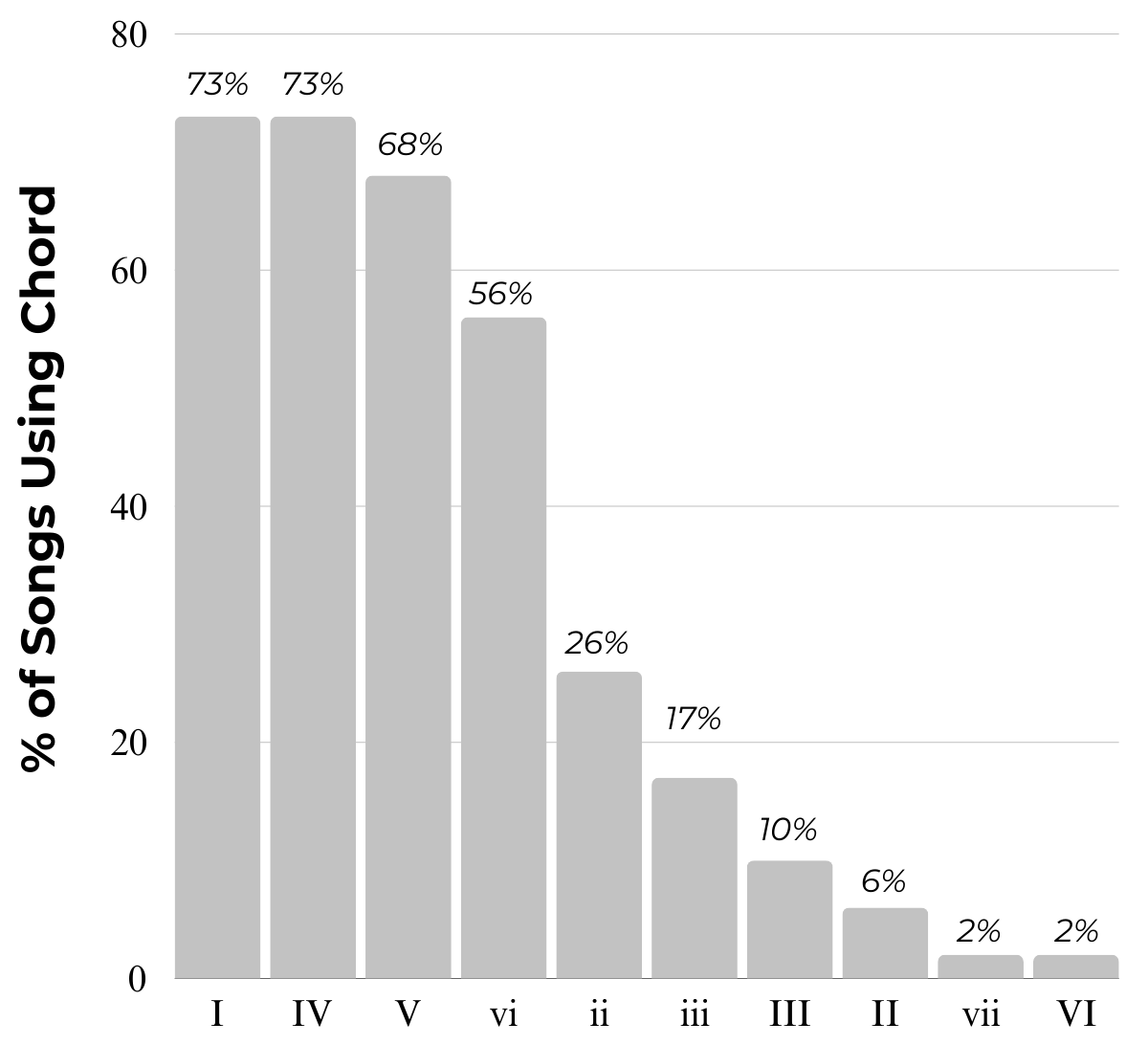
While this doesn’t, strictly speaking, show the proportion using only I, IV, and V, it does powerfully demonstrate the prevalence of the I, IV, and V (and the vi). And many songs do, in fact, use only these three (or four) chords. We’ve included lists in the Additional Resources and will discuss how you can use them for your Ear Training later in the chapter.
It’s a mind-blowing moment for a lot of musicians the first time they discover that such a huge constraint on the harmony is actually present in such a vast catalog of popular and familiar music!
So if we can reliably recognise just the I, IV, and V chord in use, a large repertoire becomes playable by ear, and since these same chords feature frequently even in songs which go beyond these three chords, we’ve got a huge headstart with an even wider range. Most notably by next adding in the vi chord (covered below), which opens up so-called “4-chord songs” with their I, IV, V, vi progressions.
Of course these ear skills won’t just be useful for playing songs by ear. They also empower you to start writing your own 3- and 4-chord songs, improvising more effectively over these progressions, gaining deeper understanding in your Active Listening, and even learning repertoire faster through having a clearer sense of how the harmony is working.
So start with aiming for 3-chord songs.
The Power of Three
As we focus on 3-chord songs, the role of the tonic chord (I) quickly becomes clear. Progressions will often feel like a journey away from the tonic, and back again. It’s no coincidence that many songs and pieces of music will both start and end on the tonic chord. So the trick for us is to get good at recognising when we’re “home” on that I chord, and when our journey away takes us to the IV versus the V.
Why three? Why not start with 2-chord songs?
Well, for one thing, songs with just two chords tend to sound a bit repetitive and same-y, since there’s only ever one possibility for what the next chord will be. Such 2-chord songs do exist, but they’re few and far between—contrasting with the huge number of three-chord songs which demonstrate that those three Chords (and the new possibility of having two options for every chord change) certainly can provide enough variety and interest.
It can also be helpful to notice that unless all three of these chords are present, the key can be much more ambiguous. It comes back to that “inversion pairs” issue with Perfect 4ths and Perfect 5ths from Chapter 10: Intervals, and the illustration above of the possible root note movements in terms of intervals.
If we have only the I and IV chords, or only the I and V chords, how do you know which is which? A progression of I-IV in the key of C Major is a C Major chord followed by an F Major chord. A progression of V-I in the key of F Major is… a C Major chord followed by an F Major chord!
Of course we have other clues as to the tonic and key (see the section in Chapter 8: Relative Pitch on “Finding The Key By Ear”), but hopefully you can see how as soon as we introduce the third of our trio of I, IV, V, the tonic and key become unambiguous. If you spent some time in the sections above playing through various example sequences of I, IV, and V chords, you will have quickly heard how the I stands out as the most stable, at-home, resting place among the three.
With all that being said, when it comes to Ear Training, actually 2-chord “songs” can be very helpful! We touched on this above, introducing the idea of a 2-chord “Cadence”. Practicing with just two chords can be an effective starting place for mastering 3-chord songs.
If we have three possible chords to choose from, then we also have three possibilities for chord changes:
- Between I and V
- Between I and IV
- Between IV and V
Rather than jump straight into practicing with progressions featuring all three chords, it will be much more effective to spend some time tuning our ear in to each of these three possibilities. Once you can hear each of these changes, there’s still a bit of practice required to handle all possible I, IV, V progressions, but you’ll find it much easier to recognise each of the three chords reliably.
The V-I Cadence
If we want to recognise transitions from I to V and vice-versa, it’s valuable to focus first on just the V-I Cadence. Similar to how practicing with ascending intervals helps you recognise the corresponding descending interval (even though they are slightly different), tuning your ear in to the characteristic sound of a V-I Cadence will also help you start spotting the I-V Cadence.
In the Classical music world, Cadences are a big deal, and the V-I is so important it gets its own name: an “authentic cadence” (US) or “perfect cadence” (UK).
Let’s approach practicing this cadence in three ways, which we have already become familiar with above. You can use the Basic Drill, as laid out in “How To Recognise Chord Progressions” above, adapting it slightly in each case.
1. Listening for the Resolution
As mentioned above in the Tip box above, when we’re working on recognising the V chord, using the V7 is a very helpful stepping stone. The V7-I Cadence is even more distinctive than the V-I Cadence. In fact, if you had to pick the shortest possible thing to play, to demonstrate the idea of “resolving to the tonic”, the V7-I Cadence might be your best bet.
Play through some examples now (e.g. C7 followed by F, D7 followed by G, E7 followed by A…) and you will probably immediately hear how clearly this sounds like “coming home”. With just two chords we have immediately established the tonic of the key and identified the I chord.
You can listen for the same trait with a V-I progression rather than a V7-I. It’s not as stark, but once you practice a bit with V7s you should be able to hear the same characteristic “coming home” resolution of the V-I.
2. Listening for the Degree
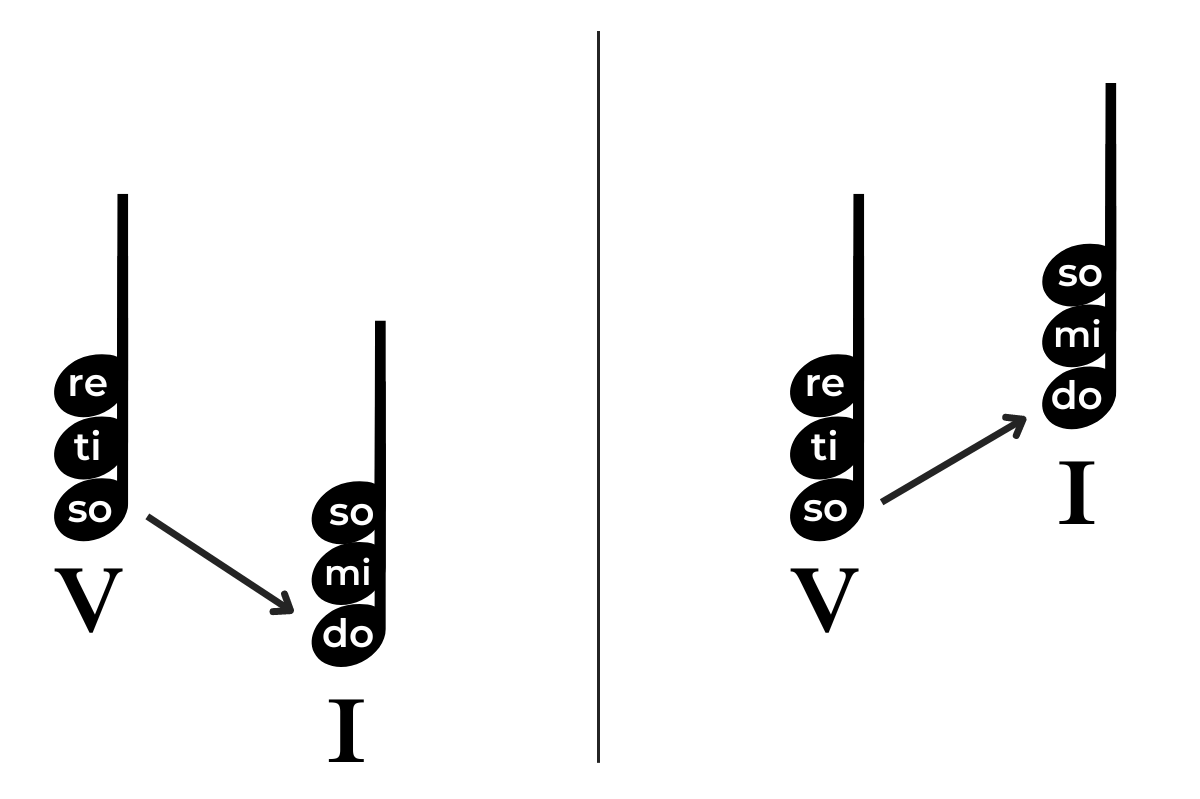
If you’re developing your ear for Solfa too, then it will also be valuable to listen out for the root note of the Chords, and how the V-I Cadence sounds similar to going from so to do or so to do’ :
3. Listening for the Bassline
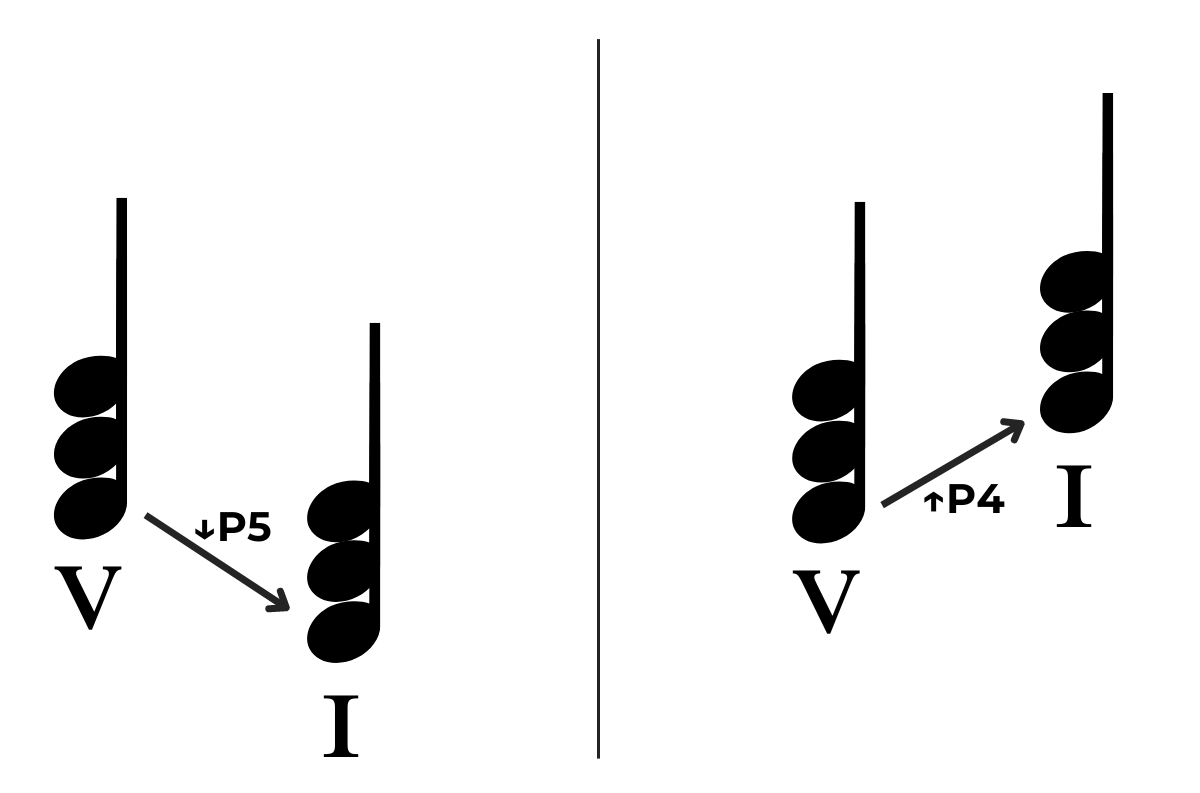
If you’re developing your ear for Intervals too, then you can listen out for how the root note of the Chords move either down a Perfect Fifth, or up a Perfect Fourth.
The IV-I Cadence
The second most common Cadence to end a piece of music is probably the IV-I, and again this can provide a great way in to recognising both I-IV and IV-I cadences.
In the Classical music world the IV-I Cadence also gets its own name: the “plagal cadence”. Informally it’s also often called the “Amen” cadence, because of how many hymns and church music settings end with a final sung “A-men” moving from the IV chord on “Ah” to the I chord on “-men”. If, like me, you’ve spent a lot of time singing or hearing church music, this can provide a very effective “reference song” for the IV-I Cadence!
Like with the V-I, we can practice this Cadence in each of our three ways, using the Basic Drill:
1. Listening for the Resolution
Since we’re “coming home” to the tonic chord, the IV-I Cadence also has a clear sense of resolution, but not nearly as striking as the V-I.
You’ll find that the IV chord also sounds relatively “comfortable” or “at rest”, so while moving to the I still sounds like “coming home”, it can be easy to muddle up the I and IV chords when listening to I, IV, V Progressions.
With the V-I Cadence it was instructive to spend some time tuning in to that resolution. With the IV-I, this aspect only really becomes useful once all three chords are featured. So once you can hear that “it sounds like it’s resolving to the I, but not as strikingly as the V-I”, that’s enough for now.
2. Listening for the Degree
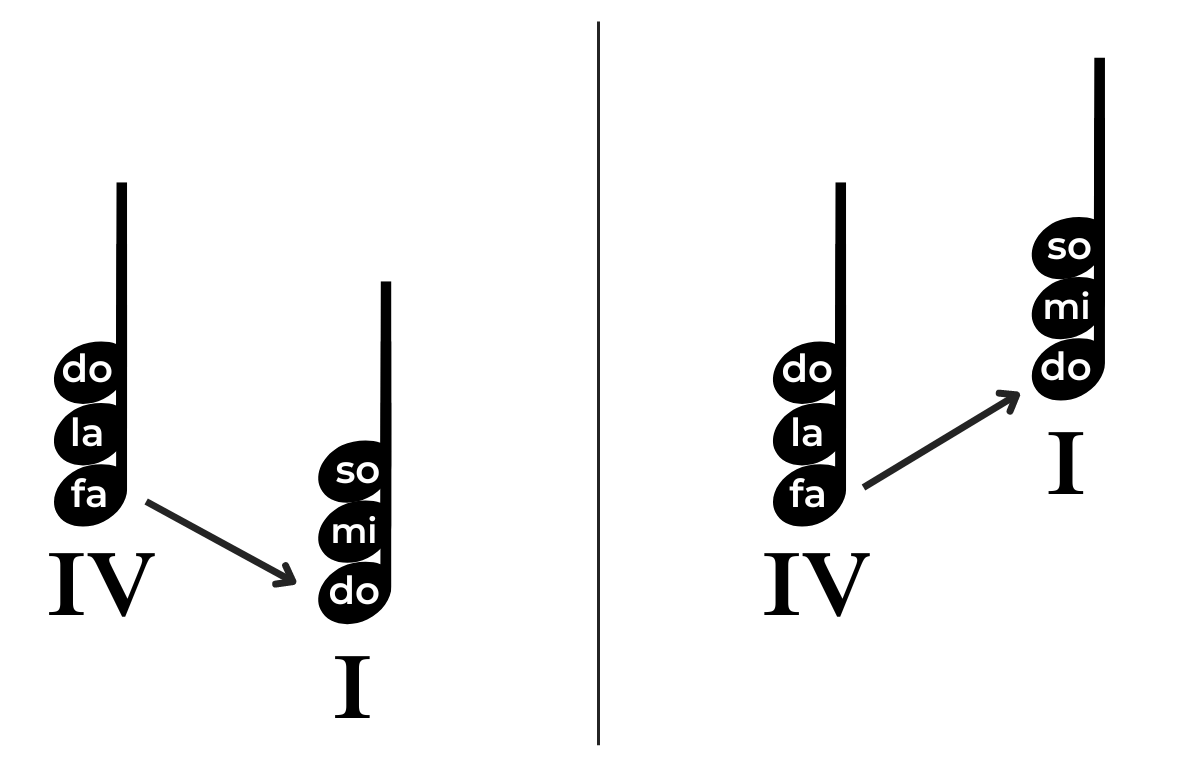
If you’re developing your ear for Solfa too, then it will also be valuable to listen out for the root note of the chords, and how the IV-I Cadence sounds similar to going from fa to do or fa to do’ .
3. Listening for the Bassline
If you’re developing your ear for Intervals too, then you can listen out for how the root note of the chords move either down a Perfect Fourth, or up a Perfect Fifth.
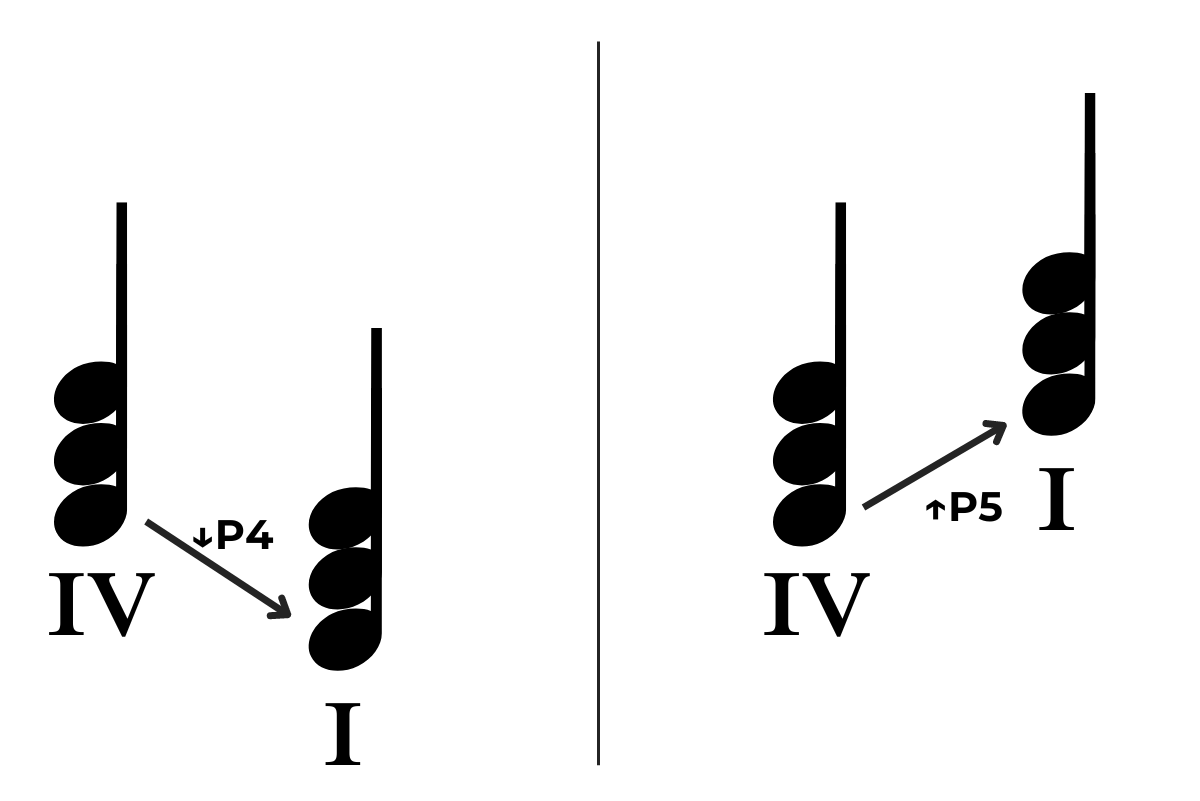
Combining V-I and IV-I Cadences
Before we move on to freely sequencing the I, IV, and V chords, let’s first compare and contrast these two types of Cadence.
We can do this by playing through Progressions which alternate between the I chord and either the IV or the V chord. So no moving between the IV and V for now.
An example might be: I-IV-I-V-I-V-I-IV-I-V
Listen for the chord changes in each direction (i.e. from the tonic to IV or V, and from IV or V to the tonic) and really pay attention to how the transitions between I and IV sound different to those between I and V.
As always with our Basic Drill:
- You’ll want to change key occasionally
- Speak or sing the chord names (as I, IV, V, not letter names) as you play them
- Record yourself practicing, and listen back for further practice. If you omit or delay your spoken/sung “labels”, this can provide a great “quiz” for you to test yourself with after.
Full I, IV, V Progressions
Once you have some confidence with distinguishing the two cases above (between the I and IV, and between the I and V), it should be a small step forwards to allow all three to mix freely. Remember our “80% Rule”: you don’t need to absolutely master each of these steps before moving on to the next, but you want to get to a level of “I can almost always get it right”.
In fact, while we stick with root position triads, you should find that the IV-V and V-IV changes are quite easy to spot, because of the much smaller movement in pitch between them, compared with moving from either to the I.
Practice with the Basic Drill, now allowing the progression to move freely between all three:
EXERCISE: Recognising I, IV, V Progressions
|
Now this is where things start to get really fun, because we can begin exploring with real music too.
The leap from root position triads to “real music” can seem like a big one at first, and while you can bridge it by introducing different voicings to your practicing first, if you’ve been tuning your ear in the way we’ve covered above, you may well be surprised just how much the “I-ness”, “IV-ness” and “V-ness” of chords in real music start to jump out at you.
The trick here is to begin practicing with songs where you know the progression.
So don’t just jump to real tracks and expect yourself to recognise every chord in the progression. Instead, pick a few 3-chord songs, and start speaking/singing the Chords along as you listen, just like we did with the Basic Drill.
EXERCISE: Naming Progressions In 3-Chord Songs
|
You can begin by doing this for tracks where you know the exact progressions used, allowing you to tune your ear (and voice) in to these I, IV, V progressions. Then, when you’re ready, try doing it with a track where you know it features only the I, IV, and V chords, but you don’t know the progressions in advance.
The instructions for this exercise are very simple—but this is an exercise you can fruitfully spend weeks practicing! It is a highly effective complement to all the Basic Drill exercises covered so far, and a great middle stage between those and the Applied Activities you’ll find at the end of the chapter.
So where do you find the 3-Chord Songs to do this exercise with?
One of my favourite tracks to start with is “Louie Louie”. It’s familiar to many people, and the chord progression is absolutely central to its distinctive and memorable sound:

(That’s two lines of two measures each, two chords per measure.)
The classic recording of this track by The Kingsmen is particularly helpful because the chords played by the guitar and keyboard follow the simplest root movement we would expect from practicing with root-position Triads i.e. going up a Perfect 4th from the I to the IV, up a Major 2nd to reach the V, back down a Major 2nd to the IV, back down a Perfect 4th to the I. In Solfa terms, the do fa so fa movement is very clear.
If all you did for a week was sing the chord names as you listen to this song, it would ingrain that I-IV-V-IV progression so firmly in your ear that you’d take a huge leap forwards in recognising I-IV-V progressions in real music.
Another good “reference song” here is the classic 12-Bar Blues:

(That’s three lines of four measures each, one chord per measure.)
This progression is often used exactly as written above, but popular variations include substituting the I7 chord for I at the end of the first and second lines, and moving to the V for the final measure of the progression, creating greater tension before the progression begins again.
This exact same progression has been used across a wealth of blues tracks over the past hundred-plus years. It’s a great choice to improvise over, a fun way to explore Songwriting, and an easy progression to find countless varied examples to practice playing by ear or transcribing with. More on these applications in the exercises below and corresponding chapters later in the book. However you choose to use it, the 12-Bar Blues is a reliable way to get a feel for the “journey” that the IV and V chords can take you on.
Those are just two examples. In the Additional Resources you’ll find a large list of other popular 3-chord songs, and (separately) a list of their progressions. This allows you to use some songs to practice with (knowing the progression in advance) and other songs to test yourself with.