


If you’ve been learning music for a little while, no doubt you’ll be familiar with the concepts of Chords and Progressions. Don’t skip ahead! Because different musicians have such different ways of relating to harmony, it’s essential that we begin by getting on the same page about what we mean by these terms.
What Is A Chord?
We will use the simple definition that “a chord is three or more notes played at once”
Some people would consider a harmonic interval (two notes at once) to be a type of chord. It’s also possible to analyse the chord implied by a series of notes played one after another (for example, an arpeggio or “broken chord”).
For our purposes it will be helpful to keep to this simple definition of “three or more notes played at once”, and consider those two to be special cases.
.
Different combinations of notes will create different chord sounds. As we discussed in Chapter 8: Relative Pitch, it’s common for musicians to come from a background of thinking purely in terms of “letter names”, which can make it seem like there are an overwhelming number of different possibilities. And yet when we listen to music, we know that harmony often sounds quite simple and natural. This is a clue that (just like with Solfa and Intervals) there are actually patterns and relationships at work which can let things sound “the same” to us across a variety of keys and letter names.
In this chapter we’ll look at different types of chord. We’ll add a perspective of both Solfa (i.e. which degrees of the key’s scale are being used to create the chord) and Intervals (i.e. what are the pitch distances between the notes in the chord), and introduce the shorthand which matches how the ear naturally interprets the sounds created by different combinations.
Just like with Solfa and Intervals, the shorthands and commonly-used patterns of note choices don’t limit what can be done with Chords, but they let us rapidly gain a powerful level of ability to recognise and choose chords to suit our musical task. All of the further complexities and possibilities can then be an easy step forwards from there.
Here’s an example, to make that concrete: if you are a jazz musician starting from the world of reading notation, you might already be aware of a dizzying array of four-note “seventh” chords. There are several different types of seventh chords, based on any one of our 12 pitch classes, in various inversions… You may have learned to play 50 to 100 different chords! But if you begin with Ear Training for the chord types and progressions introduced in this chapter, you will establish a strong foundation for understanding Chords and Chord Progressions by ear which already lets you start to recognise the underpinnings of all that complex jazz harmony. Extending your ear skills to four-note chords and all of the different possibilities then becomes a far easier task.
We’ll explore this a bit further in the “Going Further” section below. For now, the main thing to know is that everything we’ll cover forms the foundation of Western harmony. Just like mastering Solfa for the pentatonic scale makes it easy to then master the full major scale and start handling accidentals (chromatic) notes too, if you master the material covered in this chapter, you’ll be set up to succeed with any more complex harmony you might wish to tackle.
What is a Chord Progression?
A Chord Progression is a sequence of chords played one after another.
Once again, the magic of Relative Pitch means that even though any possible sequence of any possible chords could be used, in practice there are patterns and conventions in music which let us focus on the building blocks which will have the deepest and widest-reaching impact on our Chord Progression skills.
As mentioned above when sharing the two big “epiphanies”, there are particular common chord progressions which are used again and again in popular music. This is partly due to the underlying resonances of the notes and chords (i.e. there are meaningful relationships inherent to music itself) and partly because culturally we have learned what sounds “normal” (i.e. the more songwriters and composers used these progressions, the more listeners were trained to expect and appreciate them, influencing the musical choices of the next generation of songwriters and composers).
What’s perhaps most exciting for our purposes is that:
- A. There is a vast number of so-called “three-chord songs” and “four-chord songs” A quick note to avoid any confusion as we continue: these names come from the fact that the songs use just three or four particular chords, rather than referring to the “three chord” (or “iii”) or “four chord” (“IV”) specifically. which use only the chord types and progressions covered in this chapter. This means that a relatively basic ability to recognise Chords and Progressions by ear will take you a very long way.
- Even music which goes beyond those particular chords and progressions will often still make wide use of some or all of them.
| Andrew Says… I remember my jazz ear training classes at the New England Conservatory, attempting to identify individual chords by ear, complete with all sorts of extensions. (G-7♭5♭9, anybody?) Yes, there was something to be gained by learning to reach deep into a mass of notes and pick out enough of the pitches to identify the sound. But when I was done, I wasn’t much better at identifying chords in a flowing musical context. And I wasn’t able to play along by ear or jam on songs on the piano—I needed someone else’s chord sheets for that. This is what I thought “chord ear training” was, until I came to Musical U and discovered Chord Progressions ear training. Suddenly, I had something I could use. Rather than parsing out each individual chord, I was able to identify a whole progression of them—and it was a breeze compared to picking each chord out, note by note! Harmony is not static, it flows through time. So focusing on how chords move made much more sense. Accompanying, songwriting, jamming, and improvising with chord progressions were suddenly so much easier than they had been before. |
Thinking Vertically
Typically, musicians who are familiar with Chords and Progressions think of each chord as a single unit which occurs as a given moment in time. While this is well-suited to our “building blocks” approach, there is another way of thinking about them which helps to open up the relationships between chords and between the notes they’re built from.
In Chapter 5: Active Listening we introduced the idea of listening both “horizontally” (how things change over time) and “vertically” (everything that’s happening at a given moment):

There, we used this idea to set the scene for discussing Texture (the vertical) and Form (the horizontal), but this is also a useful way of thinking about harmony.
In the previous two chapters we used the idea of a Pitch Ladder or Pitch Ruler to analyse how far apart in pitch different Solfa scale degrees or the notes of Intervals are.
Here’s the essentials, if you haven’t read those chapters or would like a reminder:
- The “Pitch Ruler” shows all 12 of the pitch classes (where, for example, C is one pitch class, C♯ is another, D is another, and so on). The keys of a piano (black and white together) or the frets of a guitar correspond to these chromatic steps or Half Steps. We usually show one octave on the Pitch Ruler, with a 13th marker bringing us back to the starting pitch class. For example:

- The “Pitch Ladder” shows just the notes of the scale, and reflects how the notes of a major or minor scale are not evenly-spaced apart. Some are two chromatic steps apart while others are just one chromatic step apart. Here’s a Pitch Ladder for the major scale, with the numbers of the scale degrees shown, alongside a Pitch Ruler, to show you the relationship:
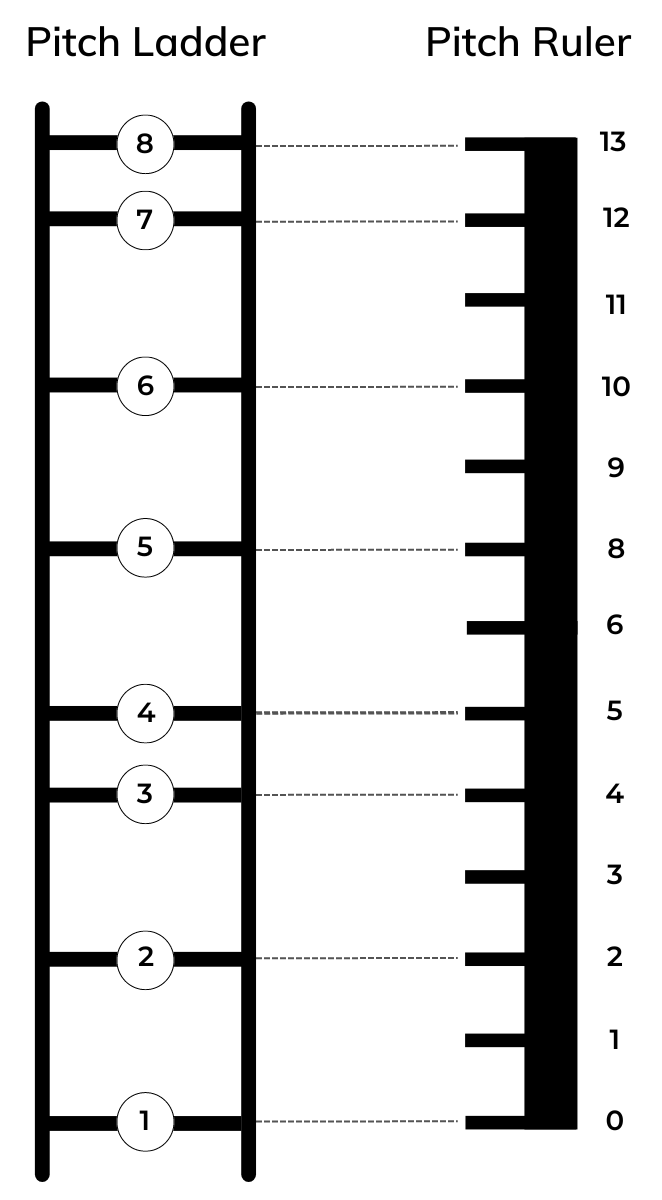
We can now use these same ideas, but introducing a horizontal axis to think about what’s happening harmonically over time.
At any given moment, we can imagine a Pitch Ladder or Pitch Ruler, and where the notes of a chord lie on it. We can then see how those notes “move” over time, as the music moves from one chord to the next, for example:
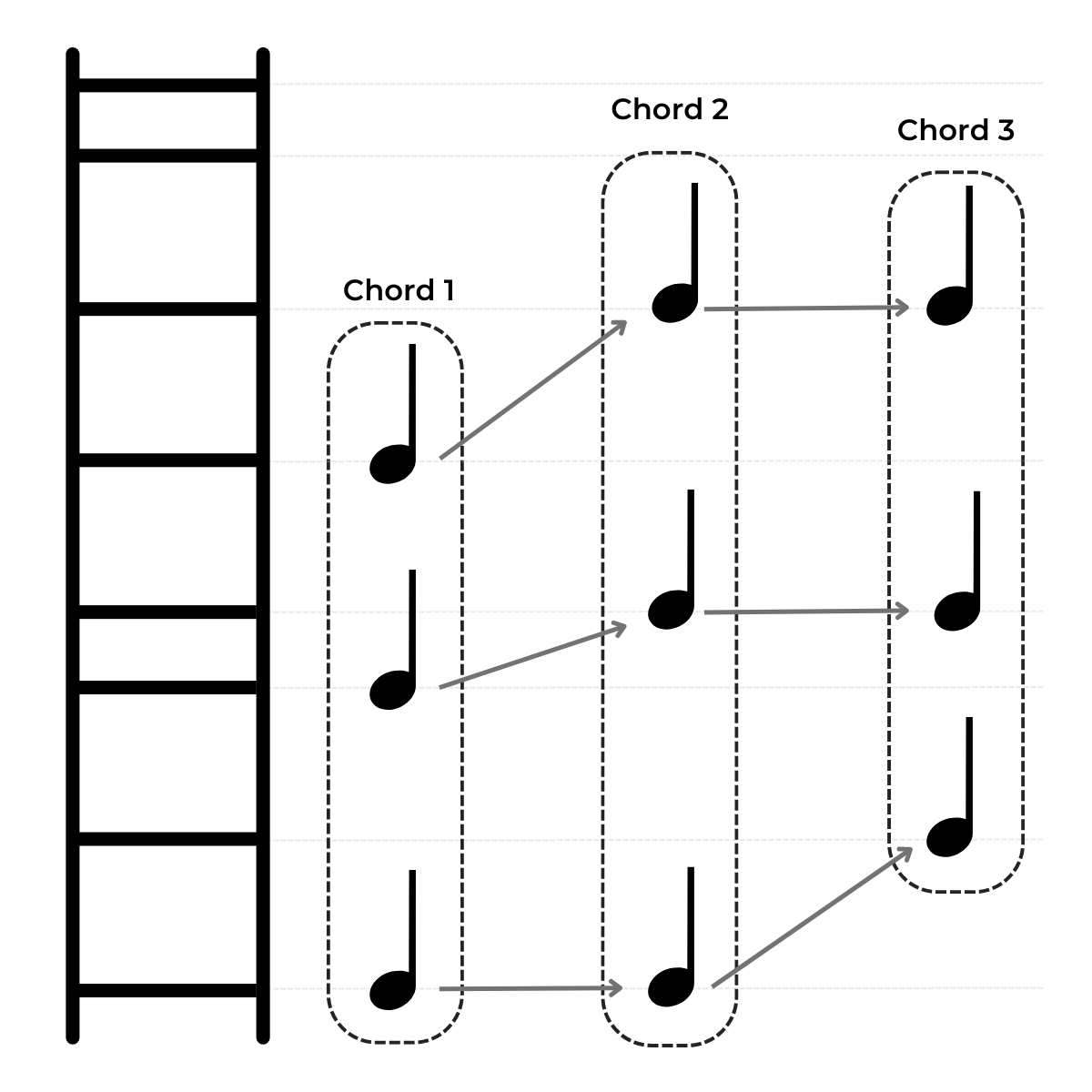
Although it’s not the way musicians normally think about Chords and Progressions, imagining music as existing on a “grid” like this can be extremely helpful, especially for making the connections to our building blocks of Solfa and Intervals.
How Chords and Progressions Work
How Chords Work
We defined a chord as “three or more notes played together”, and so the simplest chord we could use as a building block will be a 3-note chord, which is called a “triad” chord.
Building Chords
Any combination of 3 notes would be a valid chord, but in practice the most commonly-used chords are created by choosing notes from the key’s scale which are each separated by one skipped note.
One way of understanding why we do this is that two adjacent notes from the scale, whether they’re a Whole Step or a Half Step apart, will typically sound quite dissonant when played together, so that would be a rare choice, musically. Given that, the most “compact” chord we might construct would be one where we skip one note in between each note of our chord, like this:
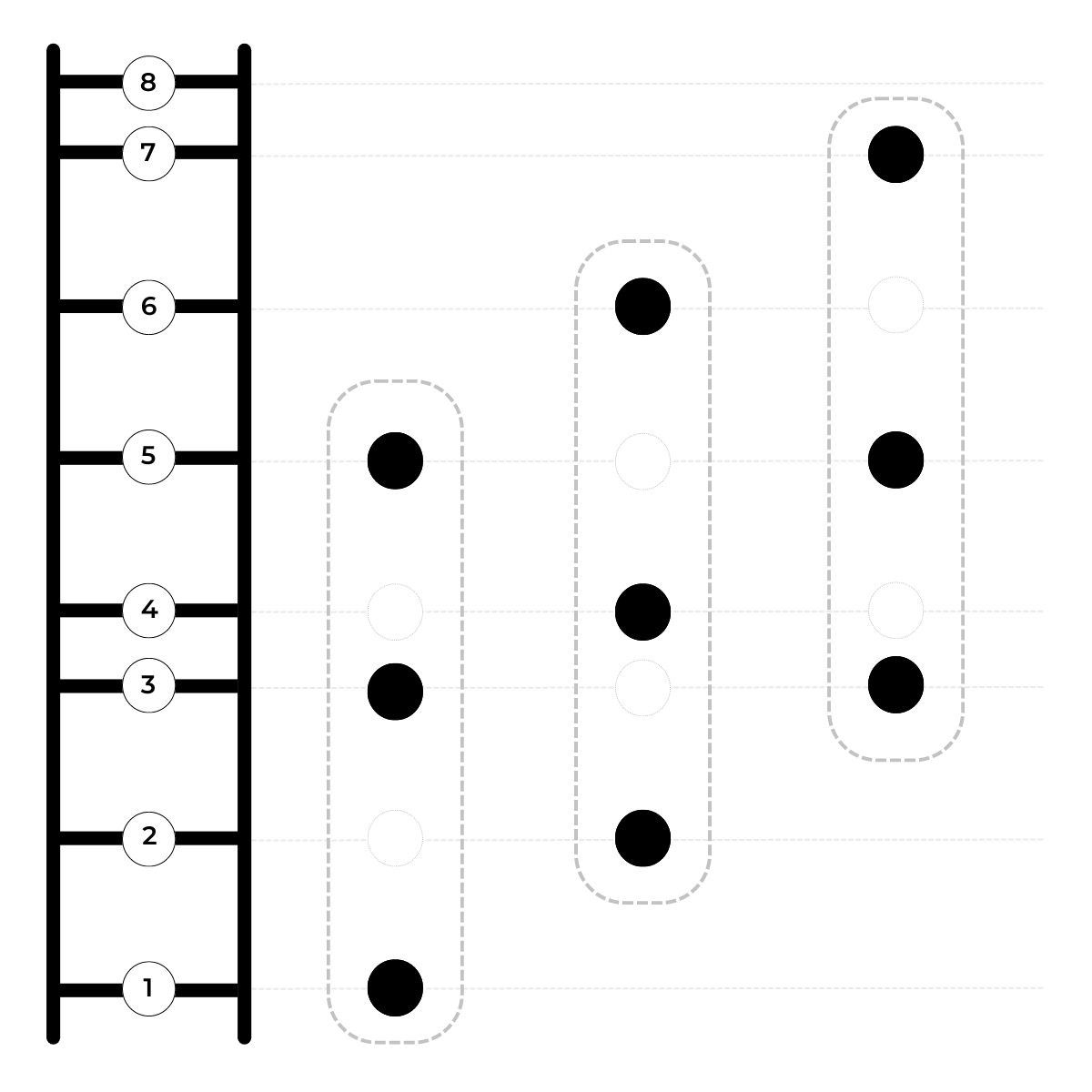
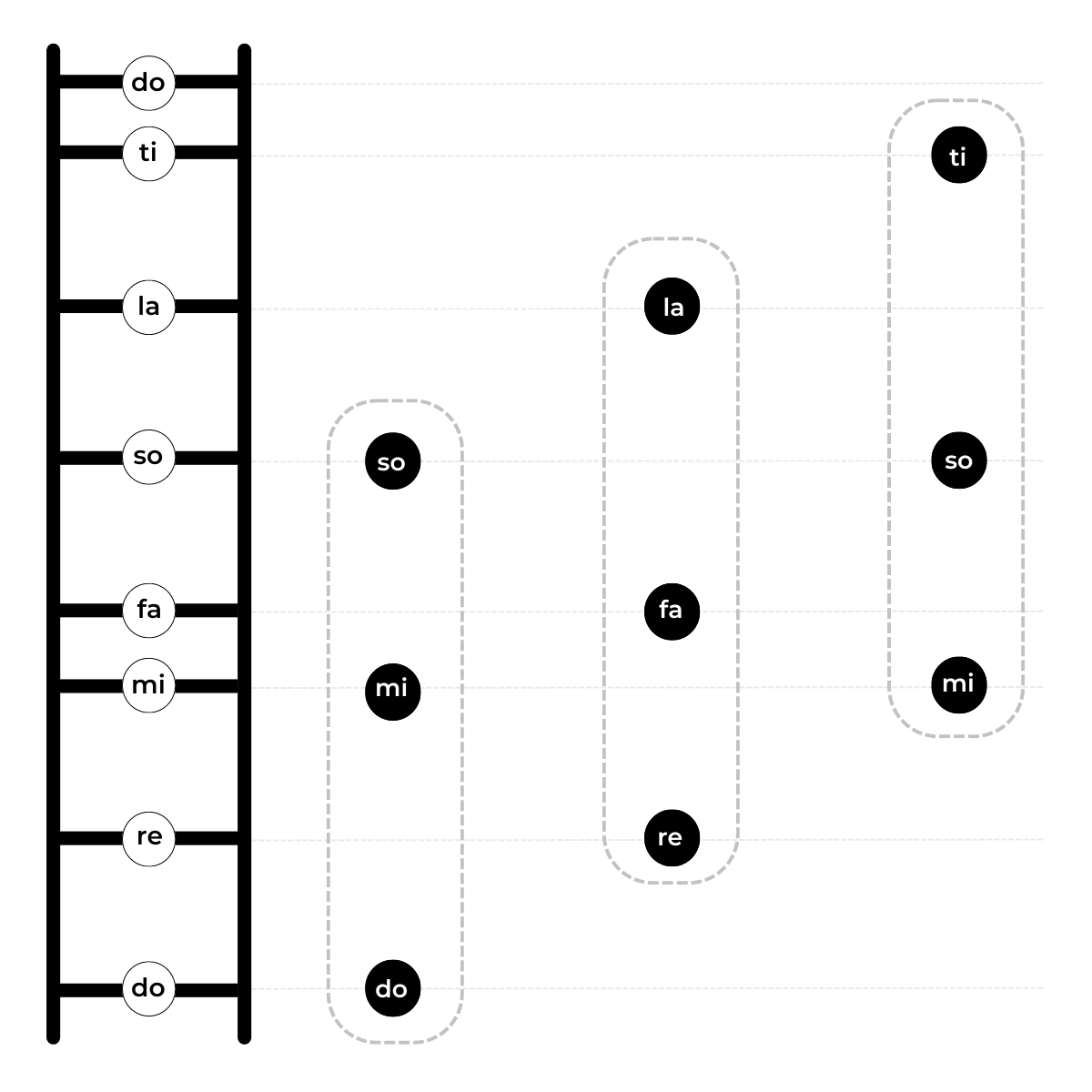
If you’re familiar with Solfa or Intervals, let’s take a look at what that might look like. If not, don’t worry about the details in the diagrams below—the point is just that we’re skipping one note of the scale each time to construct the most compact chords.
In terms of the Pitch Ladder and Solfa that might look like this:
In terms of the Pitch Ruler and Intervals that might look like this:
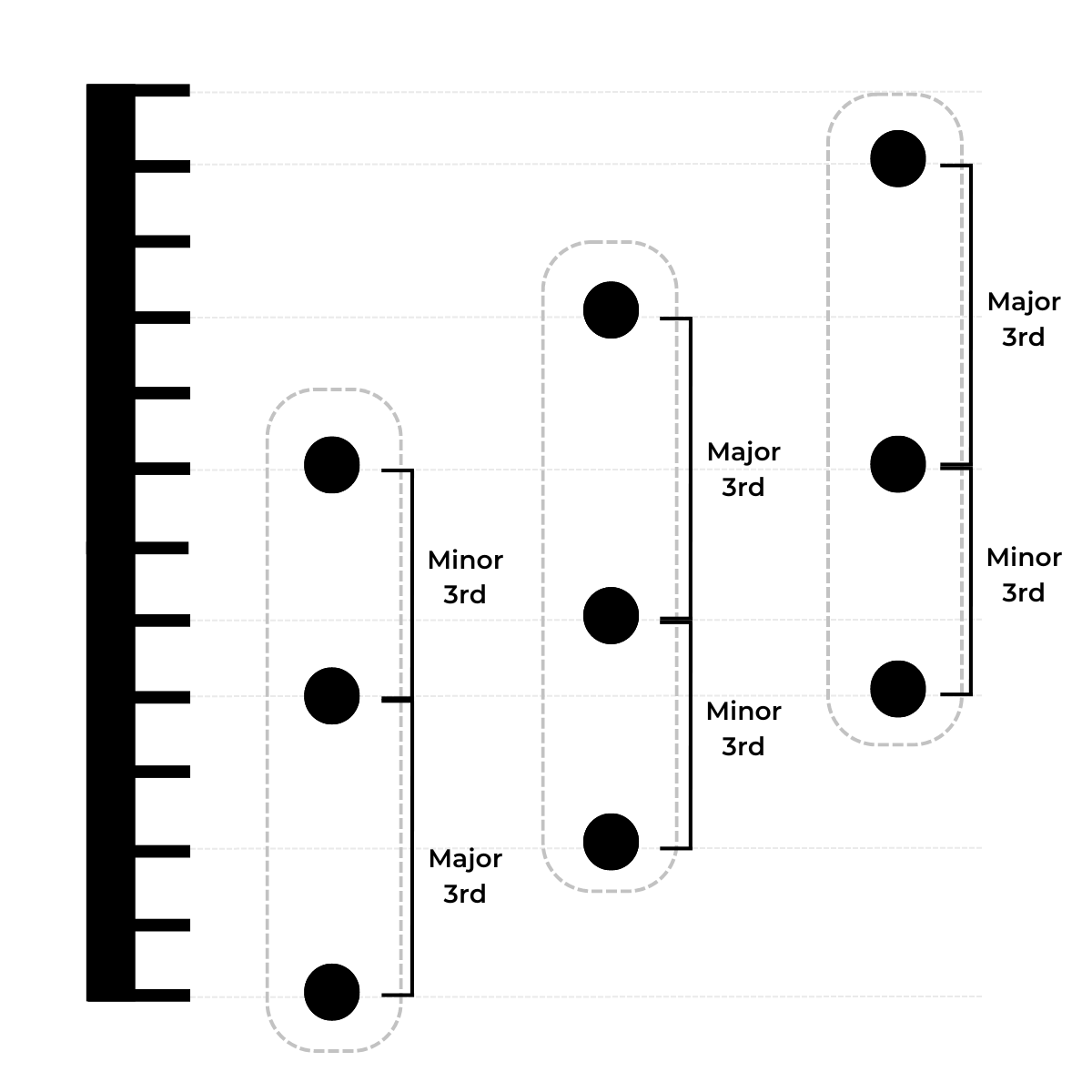
This is sometimes called “stacking thirds” since the chord is built from a Major or Minor Third interval on top of another Major or Minor Third.
If we look at all the 3-note Chords we could construct in this way from the Major Scale, we would get:
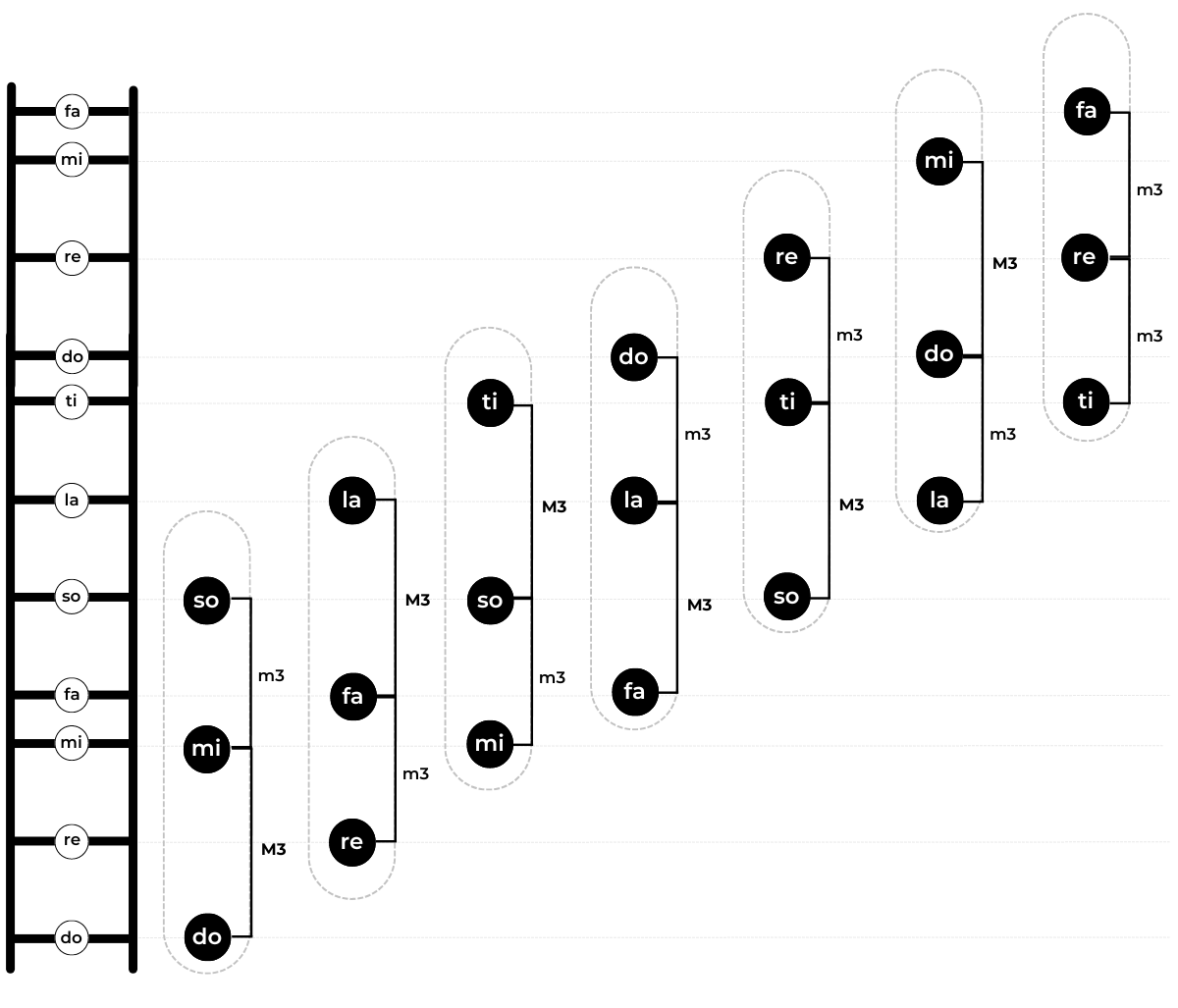
(Again, if you’re not familiar with Solfa or Intervals, you can ignore those details and just focus on how we’re skipping a note from the scale each time, and how many chromatic steps apart the notes are as a result.)
Types of Chord
From Chapter 8: Relative Pitch we know that it’s going to be the relationships between the notes (i.e. the pitch distances) which define the characteristic musical sound, and so we would expect that those chords which have the same internal pitch distances will sound similar.
Whether we think in terms of Intervals, steps on the Pitch Ladder (i.e. Solfa), or simply the number of chromatic steps apart the notes are, we can see that there are three possibilities emerging:
- Major 3rd + Minor 3rd (4 chromatic steps + 3 chromatic steps)
- Minor 3rd + Major 3rd (3 chromatic steps + 4 chromatic steps)
- Minor 3rd + Minor 3rd (3 chromatic steps + 3 chromatic steps)
And although it doesn’t appear in the Major Scale, by deduction we can see there could also be a fourth possible chord type, by stacking two Major Thirds:
- Major 3rd + Major 3rd (4 chromatic steps + 4 chromatic steps)
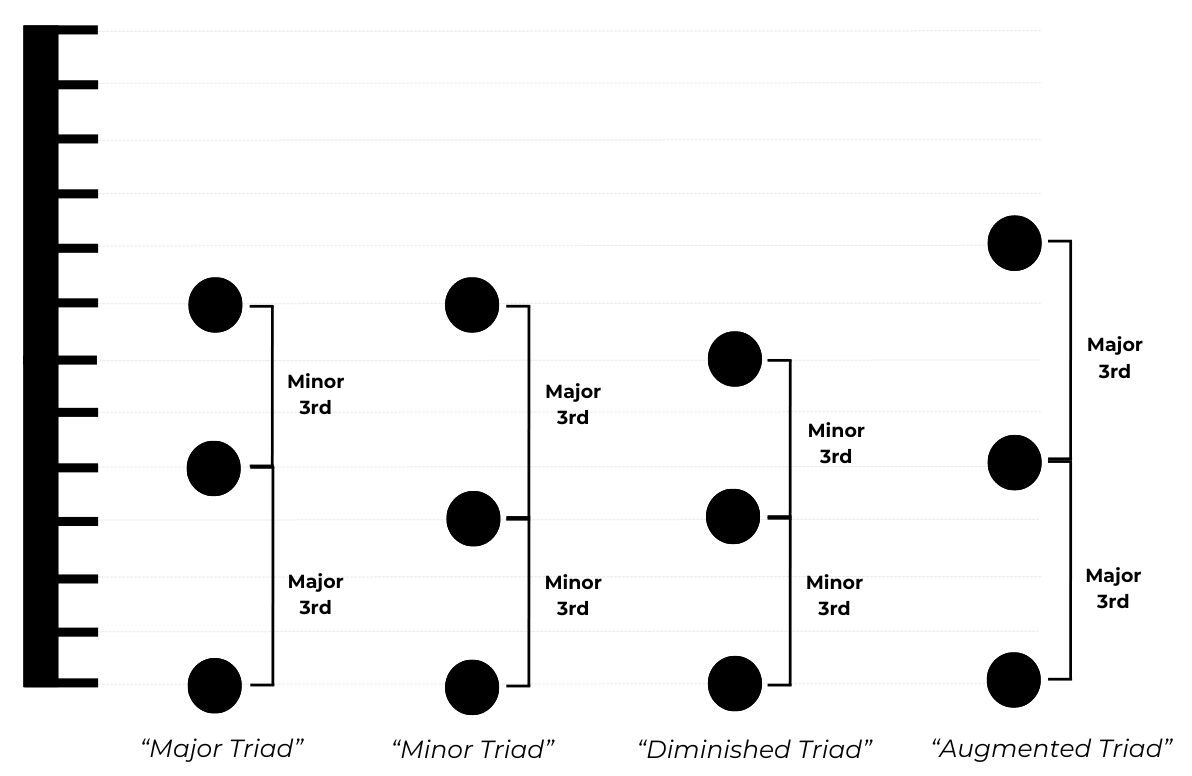
These are the four types of triad chord, and each has a characteristic sound.
This “type” is referred to as the quality of the chord: Major, Minor, Diminished or Augmented. The Major and Minor qualities are related to Major and Minor keys and scales in terms of theory, and they have a shared “major-y” sound or “minor-y” sound. There is similarly a characteristic “diminished sound” and “augmented sound”. This characteristic sound will be part of what we’re listening for when we develop our ear for Chords.
These four types of Triad will be our building blocks for Chords.
In fact, we’ll focus on just the Major Triad and Minor Triad since the other two types are relatively rarely used, and can be explored once you’re confident with Major vs. Minor. Likewise, there are particular four-note chord types which are commonly used, especially in certain genres (e.g. jazz). We’ll explore this a bit in the “Going Further” section below.
The three notes define the chord and we have the shorthand of specifying the root note and the quality (e.g. saying “a C Major” chord rather than needing to spell out “a chord with notes C, E and G”). There’s an additional convention that if the quality isn’t mentioned, the chord is major. For example you’ll hear things like “its a C, F, A minor, G progression” which indicates the C, F and G chords are all major while the A chord is minor.
Voicing Chords
It’s worth noting that a musician is free to choose notes from any octave (register) which match the chord’s pitch classes, including repeating one or more of the notes. This is referred to as how the chord is “voiced”.
For example, here are several ways of playing a C Major chord on the piano keyboard:
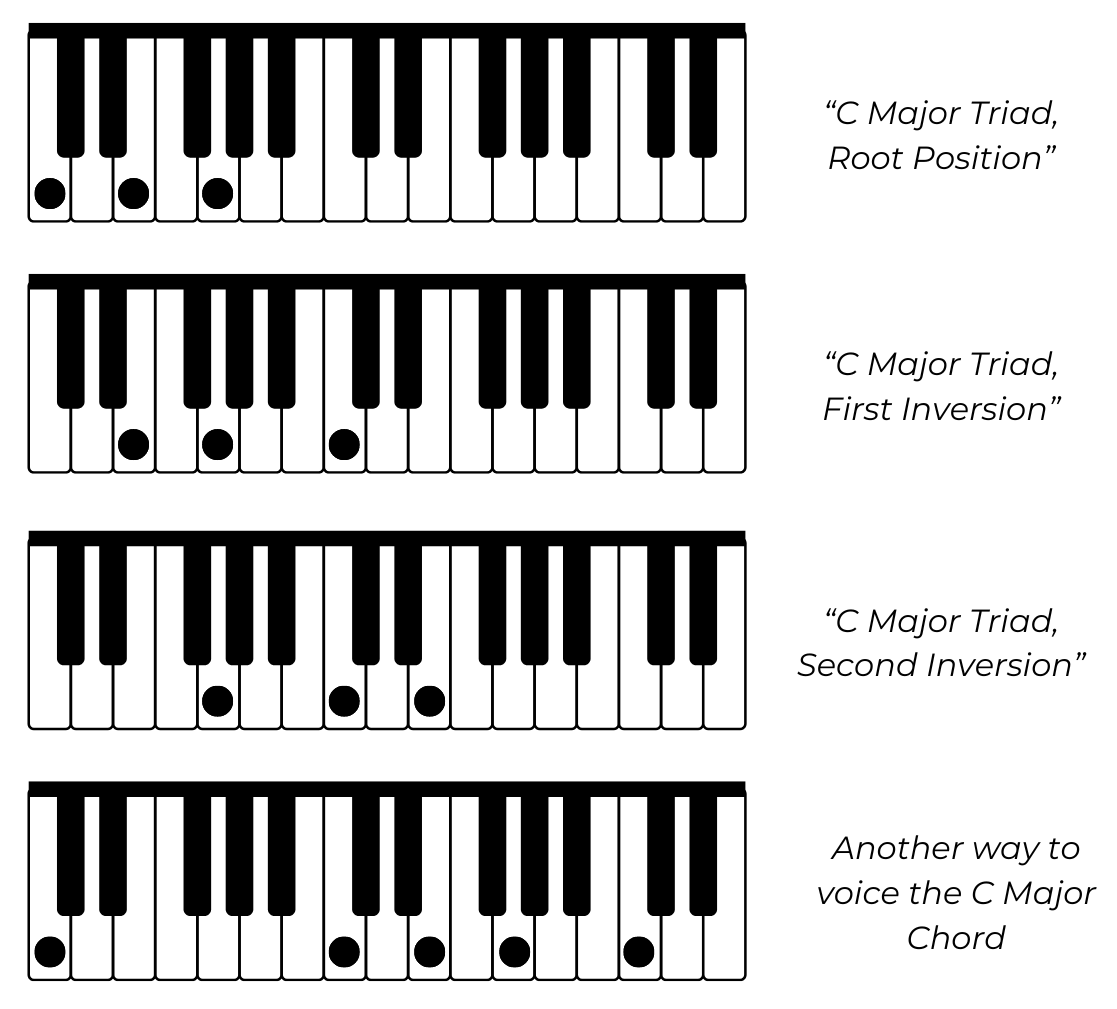
Whichever voicing is used, C would still be referred to as the “root” of the chord. The “root” note is the note the chord is built from, whether that is the lowest note in the voicing or not.
This is another case where we will start simple, focusing on just the “root position triad” chord which uses three notes, with the root note at the bottom and the other two in the same order as they appear in the scale. Although different voicings can certainly make our Ear Training tasks more challenging, the distinctive musical sound and role of the chord is common across all of them. This means that once again, if we focus on the simplest, most common building blocks, we will establish a foundation from which it’s relatively easy to extend our skills to cover all those other cases too.
A Note To Fretboard Fans
If you play guitar, ukulele, banjo, or another fretboard-based instrument, you will probably be used to thinking about chords in terms of shapes: the position of your fingers across the strings and frets to produce a certain chord.
While it is possible to do Ear Training using only these standard fretboard shapes, and that may seem like the convenient option (since it’s what you’re used to playing and it’s the way you plan to play chords if your goal in Ear Training is to play by ear) we recommend still starting from the basic triad chords introduced below. This provides an easier musical sound for you to get your ears around, particularly if you want to leverage Solfa or Intervals to help you.
Above we discussed how chords can come in various “voicings”, and you can consider the standard fretboard shapes as relatively complex voicings. This means that if you go directly to those forms of the chords, you’re skipping a few stepping stones which could provide an easier path to developing your ear for Chords and Progressions.
What will generally work best is to first practice with the simplest 3-note versions of the chords, and then extend from there to your “normal” way of playing the same chords. We’ll cover this in a bit more detail in the “Going Further” section later in the chapter.
With that being said, the approach presented here encourages you to start trying to play by ear and experimenting with real music tracks early on, and so you can certainly start factoring your normal chord shapes into your Ear Training activities before mastering the simpler Triads. The main thing is to be aware that for focused recognition exercises, Triads will provide you with a simpler task than the regular fretboard shapes, and are a step you probably don’t want to skip.
How Chord Progressions Work
We’ve seen above that there is a “family” of Chords which belong to a given Major Key:
While we could refer to these by the Solfa note they’re based on (e.g. “the do chord”), the more common approach is to label them with numbers: using either Roman Numerals (I, II, III, IV, V, etc.) which has its roots in Classical music theory, or using regular numbers (1, 2, 3, 4, 5, etc.) which is often called the “Nashville Numbering System” due to its common usage in the songwriting traditions of Nashville, Tennessee.
Just like we prefer to use the Solfa names for scale degrees to provide a clear, dedicated set of labels which aren’t used for anything else in music, we will choose to use Roman Numerals to identify the Chords in the family. The convention is to use an uppercase numeral for major chords (e.g. I, IV, V) and a lowercase numeral for minor chords (ii, iii, vi, etc.).
| I-IV-V vs. I, IV, V It can be unclear sometimes whether “a one-four-five progression” means a progression featuring the I, IV, and V chords, or a progression with the chords in that particular sequence. We will use a comma to denote a group of chords (e.g. “a I, IV, V progression”) and a dash to indicate a particular sequence (e.g. “a I-IV-V-I progression”). |
Here are the Roman Numerals for the chords in a Major Key:
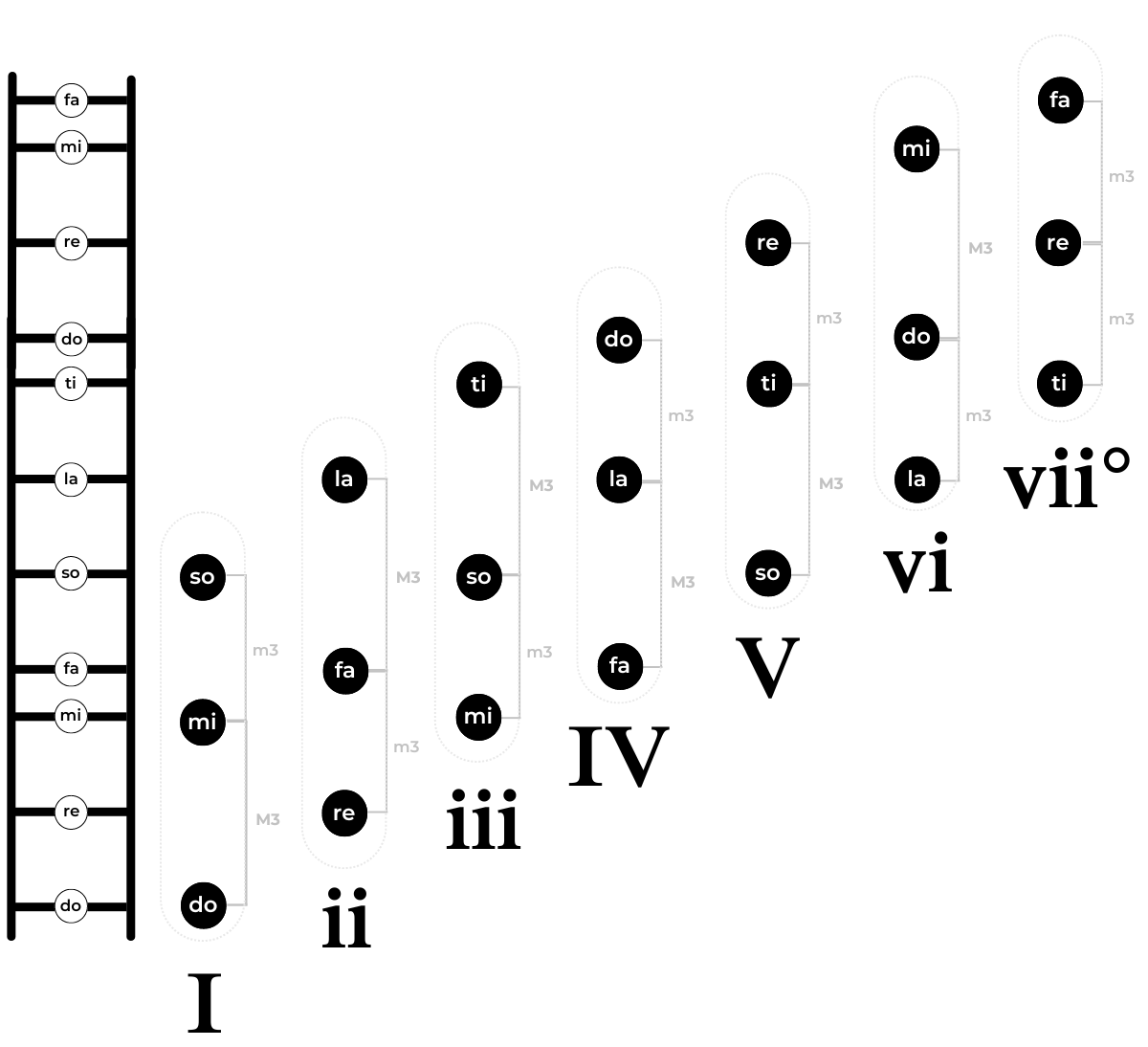
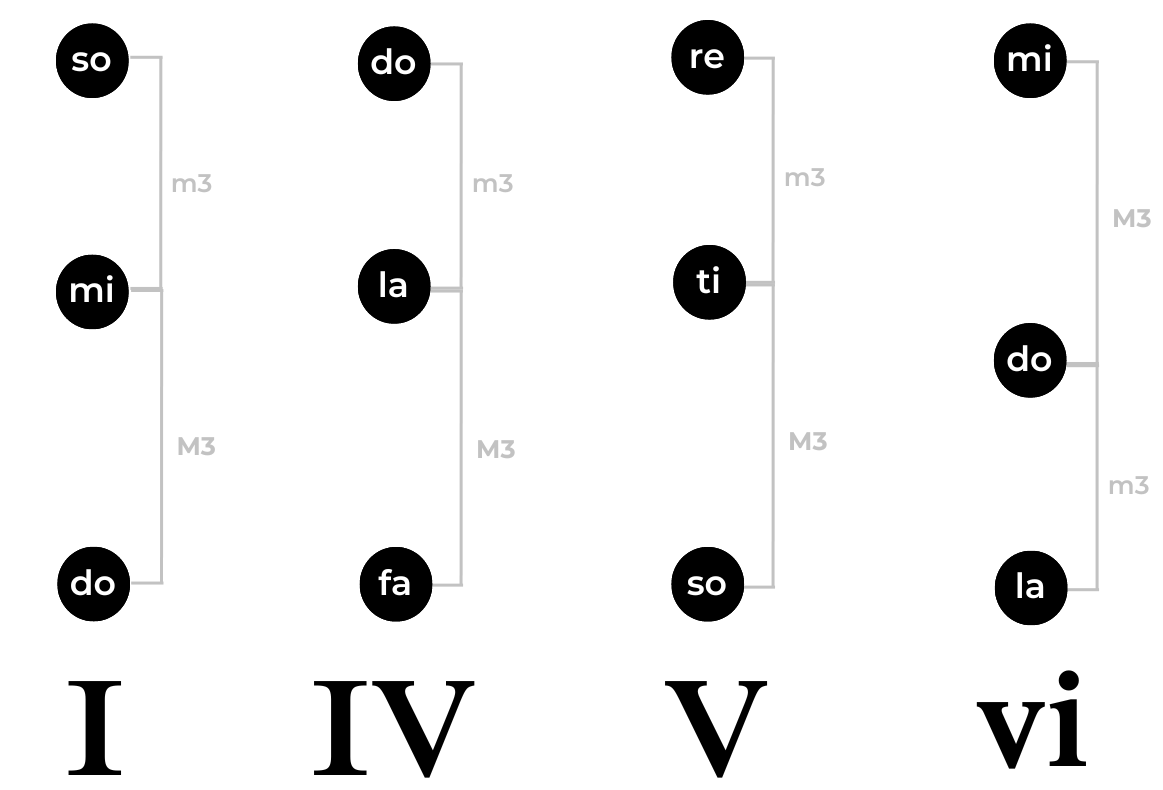
These are our “building blocks” for Chord Progressions: I, ii, iii, IV, V, vi, and vii°. From those, we’ll focus on just I, IV, and V, and then introduce the vi (in “Going Further”):
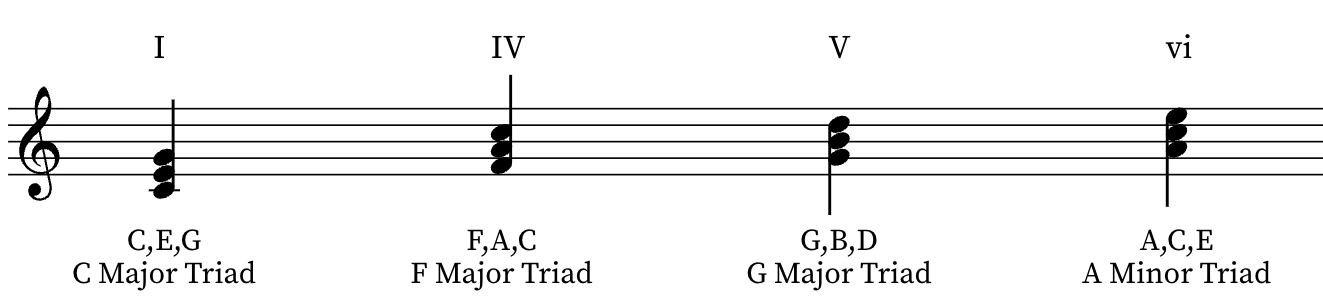
Here’s how those four chords would come out in the key of C Major:
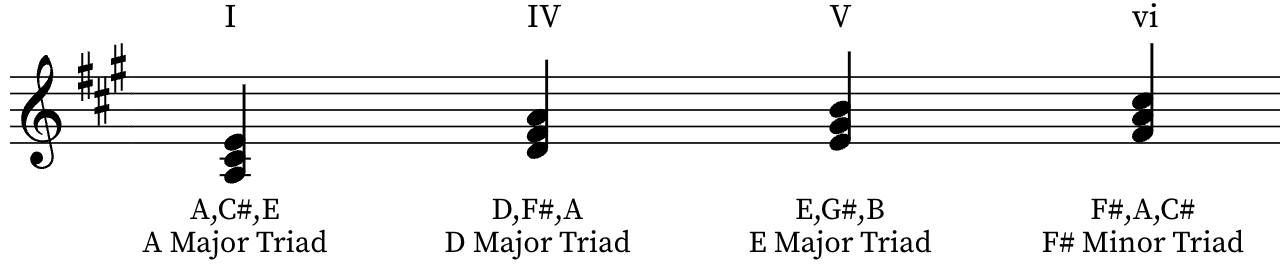
Or the key of A Major:
This reflects how frequently the chords are used across a wide range of musical styles and traditions—and as always, starting from a small number of commonly-used building blocks sets us up well to then introduce further possibilities later.
This means we will practice listening for Progressions which feature first just the I, IV, and V chords. For example, a piece in C Major might have a progression of:
C Major → F Major → G Major → C Major
And a piece in A Major might have a progression of:
A Major → D Major → E Major → A Major
We will learn to hear that these are both, in fact, I-IV-V-I progressions.
| About Functional Harmony You may hear the term “functional harmony” used when discussing the theory of Chord Progressions. Very broadly speaking, that is what we’re talking about here: thinking in terms of which degree of the key’s scale each chord is built on, and using that to understand the musical effect. However, as the name implies, functional harmony is very focused on the musical “purpose” or “function” of each chord, and tends to very quickly get into intricate theoretical analysis, with multiple schools of thought on how to analyse music and what the “correct” answers might be. It’s a fascinating topic, but one which risks pulling us away from focusing on the sounds of the chords and into a prescriptive view of music theory rather than a descriptive one. For that reason we won’t use that term here, but you might find it helpful to know that very roughly speaking, if musicians refer to the “function” of a chord, or use terms like “subdominant chord” or “dominant chord”, they are talking, broadly, about this same approach to understanding harmony. |
Connections to Solfa and Intervals
For several years at Musical U, we taught Chord recognition and Chord Progression recognition as distinct skills from Solfa or Intervals. This worked, and you can continue through the rest of this chapter without having studied or done Ear Training for either of those, and successfully start recognising types of Chords and different Progressions.
Then we created a 10-day introductory Ear Training course Ear Training For Beginners, 2019. where we taught the basics of all three in rapid succession. It was the first time we saw clearly the true power of Convergent Learning. By waking up their ears to all three perspectives on Relative Pitch at the same time, students were able to make much faster progress than we’d seen before.
Because it worked so well, we doubled down on this approach when designing the Autumn Season of the Living Music program, really immersing students in all three together and making explicit the connections between them. This proved to be the most effective approach yet.
It was remarkable to see how often an apparent issue or sticking point with one skill was actually resolved through doing work on another. For example, when Major Thirds vs. Minor Thirds were proving tricky in the context of Intervals, switching focus to Major vs. Minor Chords suddenly unblocked things. Or when it was difficult to hear a I-IV-V progression, spending some time with do, fa and so in Solfa quickly tuned the ear in to what it had been trying to hear.
Again and again, that “simmering stew” of Relative Pitch Ear Training coalesced into something much greater than the sum of its parts.
So while you could focus solely on Chords and Progressions, and get good results, I would highly encourage you to explore Solfa and Intervals too. It may seem like taking on too much at once, but the beauty of Convergent Learning is that we can trust our musical mind to figure things out “under the hood” and develop the same core sense of Relative Pitch using all three perspectives.
So let’s look more closely at how Solfa and Intervals relate to the Chords and Progressions introduced above and how each can reveal more about what’s going on, musically.
Solfa and Intervals for Chords
If our main building blocks for Chords are the Major and Minor triad chords, what does that mean in terms of Solfa and Intervals?
Let’s look at Intervals first. We’ve seen above that triad chords can be constructed by “stacking thirds” and there are these four possible combinations:
| Bottom interval | Top interval | Type of triad |
|---|---|---|
| m3 | m3 | diminished |
| m3 | M3 | minor |
| M3 | m3 | major |
| M3 | M3 | augmented |
Showing the Major and Minor Triads visually, we can see that in both cases, the interval from the bottom note to the top one is a Perfect Fifth:

Although it’s enlightening to think about “stacking thirds” (particularly when going further, to four-note “seventh” chords—more on that later), in fact from an Ear Training perspective it’s more helpful to think about our Major and Minor triads as being “a Perfect Fifth, with either a Major or a Minor Third”.
To give a concrete example, a C Major triad has the notes C, E, G, while a C Minor triad has the notes C, E♭, G. Just one note differs between the two. Yet as we’ll discover in the listening exercises below, changing that single note by just a Half Step makes a huge difference!
Side Note:You may remember that in Chapter 8: Relative Pitch we talked about how the terms “major” and “minor” are used for keys, scales and chords, but there isn’t a full, universal correspondence between the three. This is an example where it’s helpful to notice that this difference of a Major Third versus a Minor Third can be seen as corresponding to how a Major Scale contains a Major Third between its first and third notes, while a Minor Scale contains a Minor Third between its first and third notes. This gives the same “major-y feel” to a Major Scale and Major Triad, and “minor-y feel” to a Minor Scale and Minor Triad, which is helpful from an Ear Training perspective, getting that sense of tonality. However, since there are also Minor Triads belonging to a Major Key and found in a Major Scale (just like there are Major intervals found within a Minor Key and Scale), we must remember to let that idea of “tonality” remain a bit broad, and be useful from a perspective of “characteristic sound” rather than trying to fixate on pinning down strict music theory equivalences. |
When we listen for chord types and aim to distinguish Major from Minor Triads, this “Major Third vs. Minor Third” difference is what we’ll be honing in on. You can probably already see why Convergent Learning works so well! The better we get with our interval recognition skills, the easier it is to hear the differences between chord types, and vice-versa.
So what about Solfa?
Well, there things become a bit more complex, but also more powerful. Remember that with Solfa, we are always thinking about the context of the key. With Intervals we are analysing only the relationships between the notes of the chord, and so we can group together all “Major Triads” and all “Minor Triads”, since the intervals are identical, regardless of the note chosen to base the chord on.
With Solfa, we’re thinking about the relationships of each note to the tonic (“home”) note. This means that we actually have various possibilities for our Major and Minor Triads.
Let’s look at all the Triad Chords in the Major Scale, in terms of Solfa. Each row of the table below represents one of the Triad Chords. Choosing each note of the scale in turn as our bottom note, we’ll skip a note to find our middle note, and skip a note again to find our top note, then label the type of Triad which results:
| Bottom Note | Middle Note | Top Note | Type of Triad |
|---|---|---|---|
| do | mi | so | Major |
| re | fa | la | Minor |
| mi | so | ti | Minor |
| fa | la | do | Major |
| so | ti | re | Major |
| la | do | mi | Minor |
| ti | re | fa | Diminished |
So when we take a Solfa view on chord types, we are listening not just for the relationships between the notes, like we do with Intervals—but instead we are taking account of the context of the key by identifying each note with its Solfa identity. This reveals both the type of the chord and its role in the chord family of the scale.
For example, we hear “fa, la and do together” and know not only that it’s a Major Chord, but also that it’s the IV chord, specifically.
Hopefully you are starting to see the power of having multiple perspectives on Relative Pitch. Doing Ear Training “purely” for Chord Types is made profoundly more effective and illuminating when we also bring an Intervals perspective and a Solfa perspective.
It does normally take a while to wrap your head around all of the different connections and equivalences. Don’t be overwhelmed! Remember that we are taking an Integrated Ear Training approach, so you’re not expected to master and memorise all of the “facts” presented here before moving on. As long as you understand the basic concepts of how we can think about Chords in these various ways, that will be enough to continue into the “Practice” and “Apply” material below and start gaining real, practical skills.
Remember also the “Beginner’s Mind” and “Loose Grip” Mindsets from Chapter 2: Mindset. Trust that immersing yourself and taking a playful, curious, exploratory attitude will pay dividends.
Solfa and Intervals for Progressions
How do Solfa and Intervals help us with recognising different types of chord progression?
When it comes to Chord Progressions, the main thing we are wanting to recognise is the degree of the scale that each chord is based on. We will take for granted for now that the chord type will match what we’d expect from the key’s family i.e. the “one” chord will be major, the “six” chord will be minor, and so on, as seen in the diagram above of the Major Scale chords.
As we’ve already seen above, Solfa is a perfect fit for this! If we are trained in recognising scale degrees with Solfa, we need only practice tuning in to which note is the “root” of the chord.
Taking a Solfa view on Chord Progressions means that if, for example, we’re listening for the order of I, IV, and V chords in a 3-chord song, we are listening out for when the chord is based on do, fa, or so. There are a couple of ways to do that, which we’ll cover in the “Getting Started” section below.
What about Intervals?
Well, with Progressions we also want to hear the movement from one chord to the next, and so Intervals can be a valuable aid in comparing the root note of one chord to the root note of the next. Again, we’ll need to practice “tuning in” to that root note among the various notes that might be present, but then we can use our interval skills to follow the movement of that root note up and down in pitch over time.
Taking the same example of trying to hear I, IV, and V chords, we would be listening for when the root note moved up or down by a Major Second (IV-V or V-IV), a Perfect Fourth (I-IV or IV-I), or a Perfect Fifth (I-V or V-I). We’ll look at this in more detail as we continue.