


As you saw in the list above, there are 13 types of interval and they come in three different forms (ascending, descending and harmonic). That’s a lot!
So how do you know what to focus on, to begin with? Fortunately, you don’t need to worry about mastering them all. In fact, just half of those 13 types are the most important.
Here’s what we recommend, and why:
- Start by learning Major and Minor 2nds, because they are the steps the other intervals are built from and they’re the most common interval used between notes in melodies.
- Learn Major and Minor 3rds because they’re important for chords and harmony (and also common in melodies).
- Learn Perfect 4ths and 5ths because they’re important for harmony, and especially for chord progressions (as you’ll see in the next chapter).
- These intervals can also be combined to help you handle the larger 6ths and 7ths (for details, see the “Interval Tips and Tricks” section below)
The Perfect Octave is important too, but most musicians find that comes fairly easily. It can bring up challenges with singing (e.g. Matching Pitch in a different octave to the note you hear) but in terms of just recognising the interval, its melodic forms have a clear character (“a big leap to a note that sounds kind of the same”) and the harmonic form is easy if you’ve got the hang of Perfect 4ths and 5ths (which are otherwise the most common source of confusion).
Study all three forms: ascending, descending and harmonic. It’s normally best to practice with the different forms of one type of interval fairly close together in time. For example, you don’t want to ignore all the harmonic forms for weeks until after you’ve mastered them all in melodic form. It’s normally easier if you practice with the harmonic form soon after the melodic forms, or vice-versa.
Naturally, it is helpful to eventually learn every type of interval, but focusing on the types listed above will help you get practical results from your practice as soon as possible.
If these types of interval (m2, M2, m3, M3, P4, P5) are to be our focus, this gives us a natural milestone to aim for, which also helps provide some meaningful context for practicing with those intervals.
We can find our Major and Minor 2nds, Major and Minor 3rds, Perfect 4th, and Perfect 5th intervals contained within the major pentascale: the first five notes of the major scale
Note that this is different from the pentatonic scale we recommend as a milestone for learning Solfa: that is do, re, mi, so, la where the pentascale would be do, re, mi, fa, so.
While it would be neat to use the same scale as a target milestone in both cases, we’ve found that the pentatonic is better-suited to the song-based learning in Solfa, and the pentascale best for the set of intervals it features.
On top of that, getting familiar with both scales sets you up for great success tackling the most common Chord Progressions, as we’ll see in the next chapter.
.
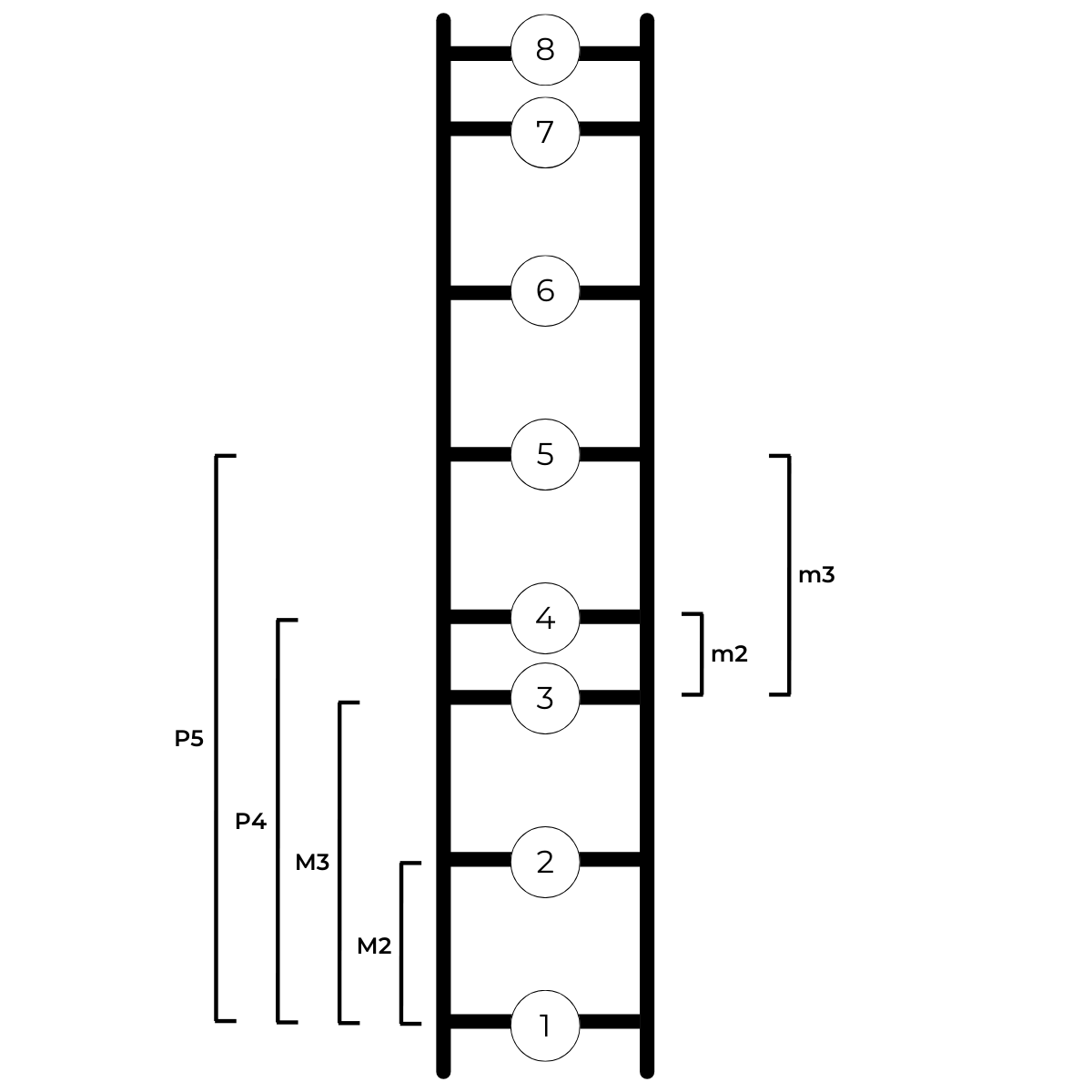
We can take this a step further and find multiple instances of intervals within the pentascale:
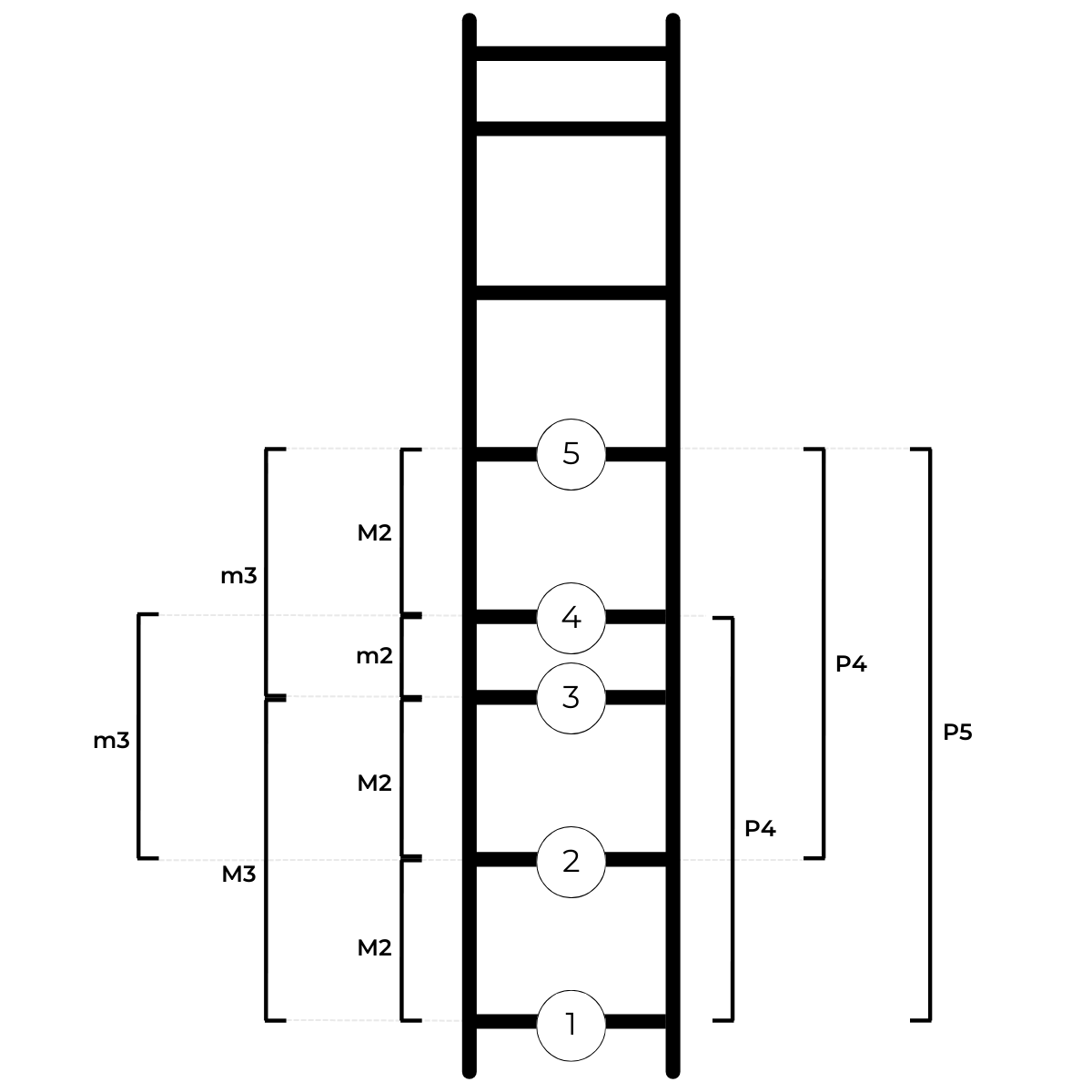
Here’s the same thing shown on the staff for the C Major pentascale:
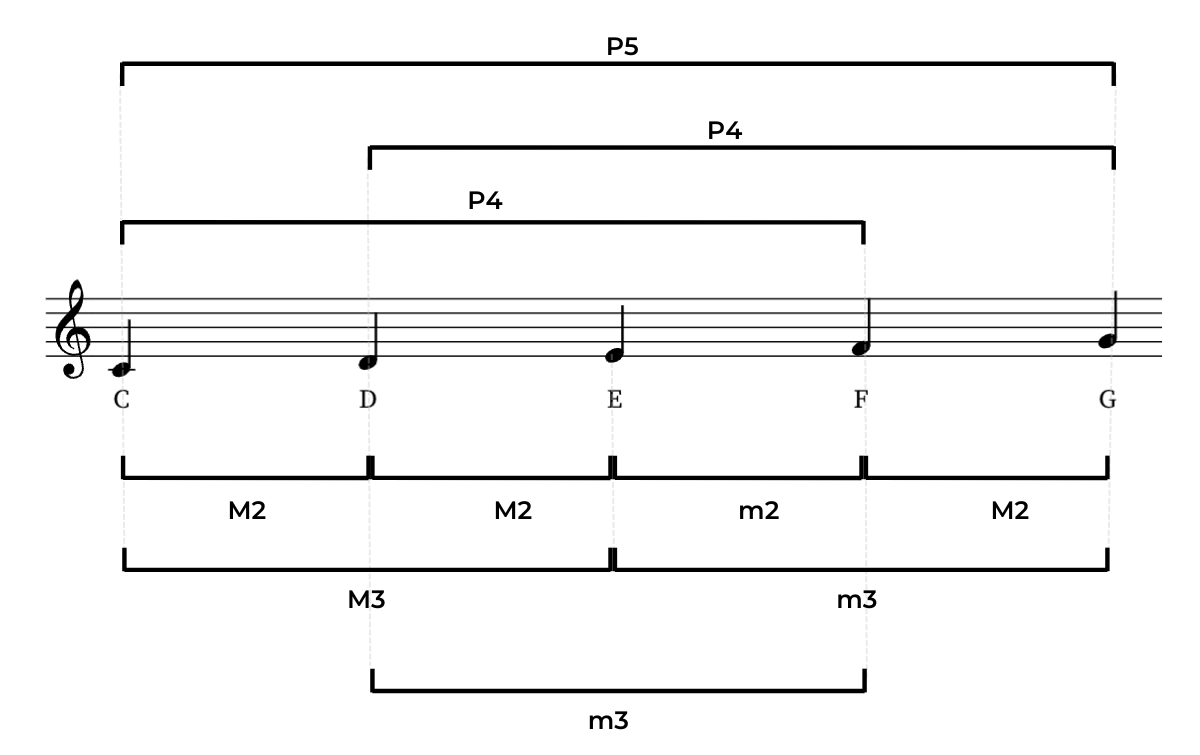
Note: As we continue, we’ll show some intervals on the staff like this. If that notation isn’t familiar to you, you can simply focus on the letter names beneath the notes. We will use C as the root of each individual interval shown, and the tonic of the pentascale, but this is purely for clarity and consistency. All these patterns and distances could be based on any note.
Having this encapsulating scale will be a great help later on for our applied activities such as improvising, as it provides a Playground (see Chapter 15: Improvisation on Expansive Creativity) for experimenting with these types of interval.
How to Practice
Let’s start getting to know each of these interval types. As you read through the following sections which introduce each type of interval, you can use the Basic Drill to start familiarising yourself with their sounds, according to the “How to Use the Basic Drill” and “How to Recognise Intervals” sections above.
I would highly recommend having your instrument handy, and starting to play examples of the intervals to listen to. You can count in chromatic steps to find the second note of the interval. For example if you choose C as your starting note for an ascending Major Third, you would count up four chromatic steps to find the second note. You can also use the Additional Resources which provides examples for you to listen to.
As we go through each type of interval, listen to various examples (by choosing different starting notes in the Basic Drill) and use the “Listen with a Question in Mind” technique from Chapter 5: Active Listening to explore questions like:
- What words would you use to describe the harmonic form?
- Can you hear those same characteristics or different ones in the melodic forms?
- More broadly, what do you notice is different between the harmonic, the ascending and the descending forms?
- How does the sound compare to the other intervals which have the same quality? (e.g. Minor 2nds vs. Minor 3rds)
- How does the sound compare to the intervals which have a different quality? (e.g. Minor 2nds vs. Major 2nds)
- Do any of the forms sound more “complete”, “closed” or “resolved” than the other forms? (You might like to revisit the notes above on hearing “resolution” in intervals.)
- Do the melodic forms remind you of the start of any particular melody? (you can start assembling your own list of reference songs!)
It’s a good idea to jot down your own notes as you go through. This will assemble a great collection of “clues” you can start using to familiarise yourself with each type of interval and spot it in future.
As a sneak peek of the Play-By-Ear Process we’ll cover in Chapter 14: Playing By Ear, I would also recommend using Audiation and Singing throughout. For example, after you play an interval, sing it back. As you start getting familiar, you might like to try audiating or singing the second note of the interval before you play it, which will start to develop your ability to produce intervals as well as recognise them.
Perfect Unison
What is the smallest possible interval in music? From our discussion above about the chromatic scale and Pitch Ruler, you might reasonably say “a Half Step”, “Semitone” or “Minor Second”. But the smallest possible interval is in fact one which has no pitch distance between the two notes i.e. the same note played twice.
We refer to this as a (Perfect) Unison. We use this same word “unison” more broadly in music to mean “multiple instruments playing the same notes together”—we say they are “playing (or singing) in unison”.
Here is the Unison interval played harmonically and melodically with root note C:

Back when I created the original interval ear training app (from which Easy Ear Training and later Musical U were born), I deliberated over whether to even include Unisons. It was so obvious it felt like cheating! I ended up including them, for the same reason we’re including them here: there’s no harm in having a “gimme” no-brainer included when you’re first getting started with interval recognition :)
On a more serious note (pun intended!) there’s value in recognising Unison as an interval in its own right, since any time we’re listening for movement in pitch (for example in Playing By Ear, Improvisation or Songwriting) it’s important to always remember that “staying on the same note” is a valid—and common—musical choice.
| Zac Says… While probably the easiest to recognize in an ear training quiz, many members, including myself, have found Unisons to be one of the most challenging to recognise and label in melodies in songs, especially when there are chord changes. I’ve heard multiple members say something like “I don’t know why, but it’s harder when the note stays the same.” I had a Next Level client who literally never played the same note twice in their improvs, and by introducing Unisons into their improv they started sounding much more musical. I would say that the Unison is one of the most musically-useful intervals. |
Minor 2nd
The Minor 2nd is the smallest minor interval found in Western music, and the smallest possible pitch distance between two different notes: just a single chromatic step. This interval can also be referred to as a “Half Step” or a “Semitone”. Many musicians recognise it as the end of an ascending major scale (moving from ti to do’ in Solfa terms).
As we learned above, in isolation it has a very harsh, dissonant sound. The famous tension-inducing Jaws movie theme is just alternating between two notes a Minor 2nd apart. However, it also exists naturally in the major scale, between the third and fourth notes (mi and fa in Solfa) and the seventh and eighth notes (ti and do’ in Solfa).
Example from root note C:

It’s primarily the absence of Minor 2nds (by omitting the fourth and seventh notes, fa and ti) which gives the pentatonic scale its universal, “safe”, comfortable sound, as we discussed in the previous chapter. As soon as we have those Minor 2nds in the mix, a far greater level of musical tension becomes possible.
Try playing a melody you know well, but shift one (or more) of its notes up or down a Minor 2nd. If these happen to be the ones which take you to another note of the scale, it will sound like an alteration, but a fairly “normal-sounding” one. In most cases though, you’ll find yourself outside the scale, and things will suddenly sound very tense indeed!
So we can see, there is great power in these dissonant-sounding Minor 2nds, which makes them both fairly easy to spot, and highly useful in our own creative music-making.
Major 2nd
The Major 2nd is the smallest major interval found in music, corresponding to a distance of two chromatic steps. Many musicians recognise its ascending form as the first two notes of the ascending major scale—the do and re in Solfa terms. This interval can also be referred to as a “Whole Step” or a “Tone”.
Example from root note C:

Together, Minor and Major 2nds are the building blocks with which we construct major and minor scales. Our Pitch Ladder, with its uneven rungs, is using either a Minor 2nd or a Major 2nd for each rung. Each of our Solfa notes is either a Minor 2nd or a Major 2nd away from its two neighbours.
| TIP: This fact, that the notes of a scale are all either a Minor 2nd or Major 2nd apart, gives rise to a little musical nugget that musicians often love to discover: Any time you guess a note (for example when Playing By Ear) or choose a note (for example in Improvisation),, you are only ever one Minor 2nd away from a note of the scale. For practical purposes, that means if you guess and it sounds wrong or dissonant, try nudging it up or down a half step, and you’ll land on a note that feels “good” or comfortable again. With a bit of flair you can even consider this a creative embellishment, since these “half-step slides” into target notes are frequently used, especially in blues and jazz music! |
Compare the Major 2nd with the Minor 2nd in particular. What differences can you hear, in terms of size/distance, consonance and dissonance, resolution, descriptive words?
Minor 3rd
If we stack a Major 2nd and a Minor 2nd, corresponding to a distance of 3 chromatic steps in total, we create a Minor 3rd. The Minor 3rd can be found as the interval between the first and third notes of a minor Scale, and as the bottom part of a minor chord Specifically a root-position triad i.e. the first, third and fifth notes of the corresponding scale, in ascending pitch order. This is what we might consider the simplest or the “prototypical” form of a minor chord. The term “minor chord” could also refer to inversions (moving notes into different octaves), and chords with more than three notes being played, where the intervals would vary. . Many musicians recognise its ascending form as the start of a minor arpeggio.
In our pentascale, Minor 3rds occur between the second and fourth notes (re and fa in Solfa) and the third and fifth notes (mi and so in Solfa).
Example from root note C:

Major 3rd
The next-biggest major interval found in music is the Major 3rd, corresponding to a distance of 4 chromatic steps in total. That’s like stacking two Major 2nds. Many musicians recognise its ascending form as the start of a major arpeggio.
The Major 3rd appears in our pentascale between the first and third notes (do and mi in Solfa).
Example from root note C:

Compare the Major 3rd with the Minor 3rd in particular. What differences can you hear, in terms of size/distance, consonance and dissonance, resolution, descriptive words?
Perfect 4th
The Perfect 4th corresponds to a distance of 5 chromatic steps. Its Perfect quality puts it in a group with Perfect Unisons, Perfect 5ths and Perfect Octaves.
Perfect 4ths appear in our pentascale between the first and fourth notes (do and fa in Solfa) and the second and fifth notes (re and so in Solfa).
Example from root note C:

Compare the Perfect 4th with the two types of Major interval we’ve covered so far. Then with the two types of Minor interval. What do you notice about the character, mood, or overall sound of each? You might like to focus on the harmonic forms.
Perfect 5th
The Perfect 5th corresponds to a distance of 7 chromatic steps. It’s another Perfect interval, like the Unison and Perfect 4th.
The Perfect 5th appears in our pentascale between the first and fifth notes (do and so in Solfa).
Example from root note C:

Compare the Perfect 5th with the Perfect 4th and Perfect Unison, in harmonic form. Then see how does their sound compare to the Major and Minor Intervals?
Remember to also use other Active Listening questions like those listed above, to now explore and experiment with all seven types of interval you’ve encountered.
_________________________________________________________
Side Note: Inversion Pairs
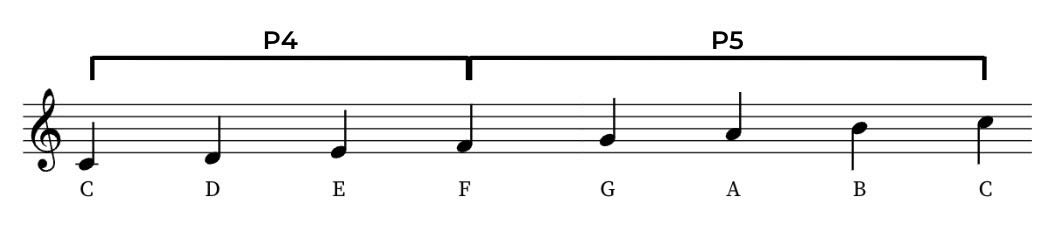
The Perfect 4th and Perfect 5th can be tricky to distinguish. Not only do they both have the same quality, they are also quite similar in size. More than that though, they are actually quite closely related! A glance at this diagram will show you how:
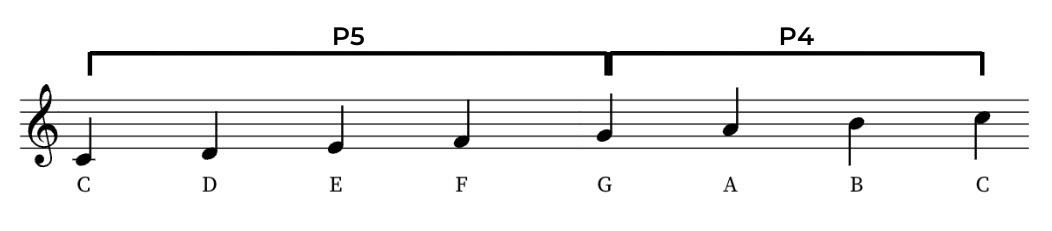
Going up a Perfect 5th from C takes you to G, and going up a Perfect 4th from G takes you back to a C. Similarly, if we instead went up a Perfect 4th from C we’d land on F, and a Perfect 5th up from F would take us right back to a C:
Here’s the same thing shown on the Pitch Ladder for both cases:
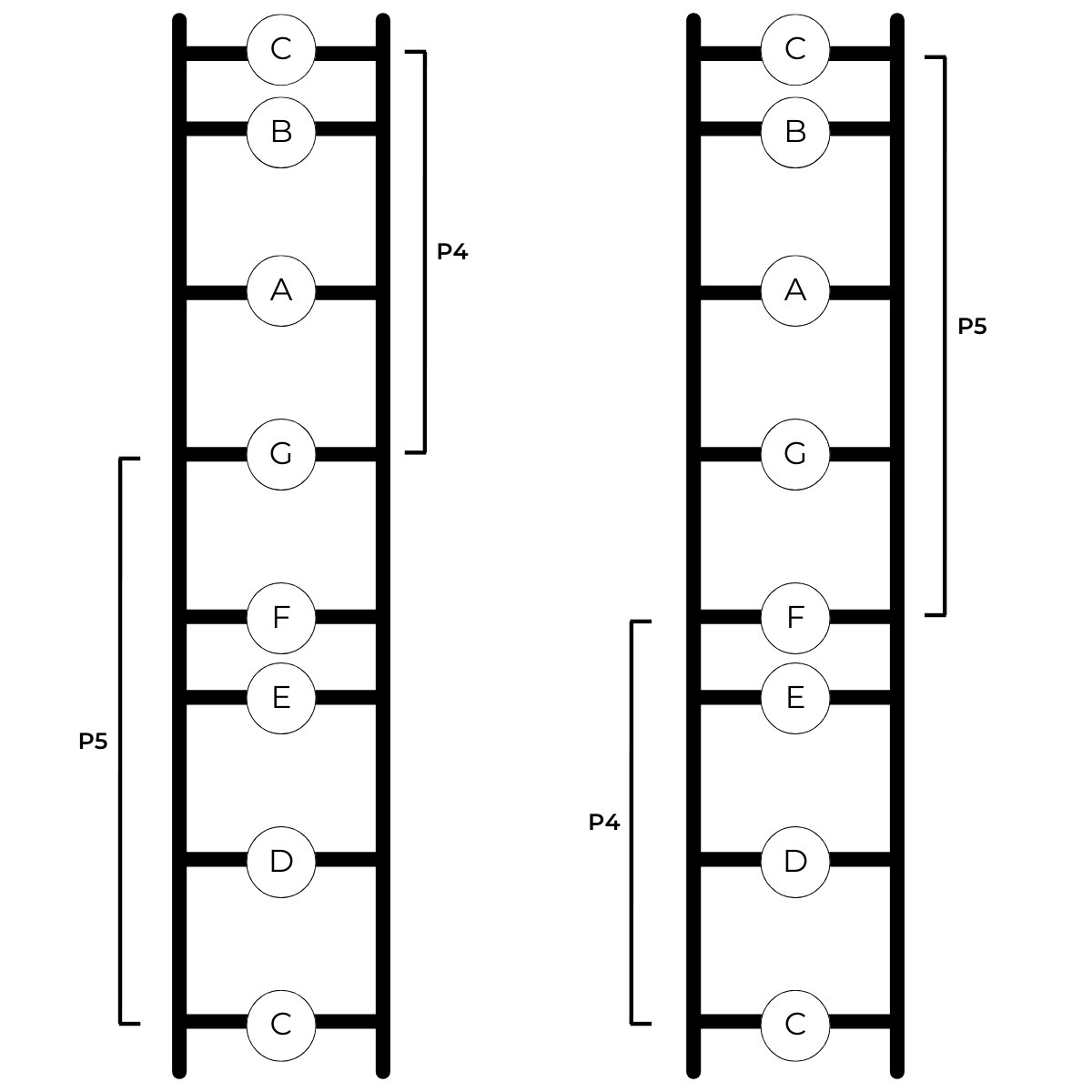
This works, no matter what starting note we choose: stacking a Perfect 4th and a Perfect 5th gives us a Perfect Octave, bringing us back to the same pitch class we started from.
To put that another way: a Perfect 4th up from a given note takes you to the same note as going down a Perfect 5th, and vice-versa (just in a different octave).
This is called an “inversion pair”: going upwards by one interval takes you to the same note name as going downwards by the other. So we can see that the Perfect 4th is the inversion of the Perfect 5th and vice-versa.
All Intervals have an inversion pair:
- Perfect Unison / Perfect Octave
- Minor 2nd / Major 7th
- Major 2nd / Minor 7th
- Minor 3rd / Major 6th
- Major 3rd / Minor 6th
- Perfect 4th / Perfect 5th
- Tri-Tone / Tri-Tone(!)
So what does all this mean for our Ear Training?
Since Fourths and Fifths both have that very resonant sound of the Perfect interval quality, are close together in terms of degree (i.e. they’re roughly the same pitch distance as each other), and are an inversion pair, they can be particularly tricky to tell apart by ear.
This is one case where the “resolution” approach can be very helpful.
As mentioned when introducing that idea earlier, this way of listening for intervals is not generally taught. It emerged as a significant discovery for us with our members in the Winter Season of Living Music, where the Circle of Fifths provided a whole new and exciting gateway into Ear Training. Not only did it illuminate the “tonicity” of Major and Minor intervals for them, the “ingoing vs. outgoing” way of looking at Perfect 4ths and 5ths also had a huge positive effect on their interval recognition skills.
Even without exploring the wonders of the Circle, you can make good use of this different perspective on what characterises interval types. As you practice with the intervals (e.g. P4 vs. P5) simply listen to the sense of movement, and whether they seem to ask or answer a question. You might also hear this as “opening” vs. “closing”, “resolved” vs. “unresolved” or “complete” vs. “unsettled”.
_________________________________________________________
Summary
You have begun to familiarise yourself with the seven most common intervals. As you started listening, playing and singing these types of interval, it’s likely you found some things very clear and striking. For example, you might have found the “start of a major scale” touchpoint made melodic Major 2nds immediately familiar to you. Or you might have found the difference in quality (Major vs. Minor vs. Perfect) with harmonic intervals was easy to hear.
At this stage, don’t expect yourself to be reliably recognising the different types of interval. As we continue into additional exercises and activities, you’ll want to limit the number of types and forms you work on at once. However, this full set corresponding to the pentascale is a great milestone to have in mind, and hopefully you’re already getting a sense of how interval recognition will become possible for you.
| More Tips And Tricks Over the years we’ve gathered quite a variety of tips and tricks to assist with learning interval recognition, covering ways to accelerate and ease the overall process, as well as specific tips for each interval type. You’ll find this available to you in the Additional Resources. |