


Later in the chapter we’ll suggest what to initially aim for as you start learning Intervals, as well as various activities you can do to develop your skills. First, let’s get started with the “Basic Drill” exercise, and how you can recognise intervals.
How to Use The Basic Drill
Remember that our Basic Drill is simply “listen to some examples of different types of building block, and for each one try to recognise which type it is.”
As you’ll remember from Chapter 8: Relative Pitch, this Basic Drill is the single exercise most commonly used in traditional ear training.
The most widespread method for learning interval recognition is through some kind of “quiz”. That can take the form of a practice audio track which you listen to, an interactive app (mobile or web-based) which plays examples, or a musical friend who’s happy to take turns playing examples for each other.
For us, with an Integrated Ear Training approach, this kind of “drill” still has its place, helping us both to assess our abilities and to gradually develop them, in conjunction with various additions, modifications and other activities. Doing the Basic Drill need not be strictly “Head and Hearing”, in the traditional way. Use your Heart to tune in to the feeling or emotion of the sounds, and work with your instrument (Hands), not just pre-recorded examples or quizzes.
So how do we use the Basic Drill for Intervals?
EXERCISE: The Basic Drill For IntervalsSelect your source of examples (pre-recorded tracks, an app/quiz, or playing on an instrument yourself or with a friend) and then:
Repeat steps 2-5 with various examples being given. Over time vary the choices in step 1 to gradually develop your interval skills. |
In its simplest form, this process risks quickly becoming dull and leaving you prone to getting stuck. Here are some tips for keeping it interesting and effective:
- Don’t only do this! Make sure to also use the other exercises below.
- Start simple, by always using the same root note for the examples (e.g. C). This gives you a more direct comparison between subsequent examples, and allows your musical brain to have a sense of a key. In this way we can sidestep the issue mentioned in the introduction to this chapter, that Intervals can be challenging because our brain always wants musical context. Once you can reliably distinguish different types with the same root note, start varying that root note each time.
- Incorporate your instrument. For example, try playing back each example after giving your answer. If you’re using a fixed root note as mentioned above, you can save the step of finding that note on your instrument each time (though that’s a valuable exercise in itself!)
- Sing back each interval after you hear it. Not only does this connect you more deeply with the sound of each interval, it also develops your Vocal Control and ability to produce each interval when singing. It can also provide a handy stepping stone for harmonic intervals: if you’ve got the hang of ascending/descending, singing each note of the harmonic form lets you turn it into an ascending/descending interval and recognise that. Over time you can skip the actual singing by audiating instead. Eventually you won’t need the stepping stone at all.
- Vary the instrument sound. Depending on your source of examples, this may be an easy thing to do or not. Many musicians find that their own instrument’s sound is the easiest to work with, but it can be enlightening to try with examples on a different instrument. For example, wind instrument timbres can make Perfect intervals particularly challenging because of the way the harmonics of those instruments line up. Sometimes just switching instrument, for example from piano to guitar, reveals different sound characteristics which you can then tune in to and hear across other instruments. This can also be seen as a form of Contextual Interference (see Chapter 6: Superlearning), waking up your brain more fully than if you always use the same timbre for examples. Using a Digital Audio Workstation (DAW) or composing software can be great for easily producing interval examples with a variety of instrument timbres.
| Practice Tracks We’ve prepared a set of interval training MP3s in the Additional Resources which you can use both passively (just listening and tuning in to the sound of different intervals) and actively (with gaps left for you to give your answer before hearing the answer spoken). |
How To Recognise Intervals
Equipped with our Basic Drill, how do we make sure that our “answers” aren’t pure guesswork? Let’s look in more detail at the three main ways of recognising intervals mentioned above: reference songs, characteristic sounds, and resolution.
1. Reference Songs
If you asked 100 musicians how interval recognition works, I’d be willing to bet at least 90 would say “you learn a song for each interval, like ‘Here Comes The Bride’ for a Perfect Fourth.”
It’s part of the unfortunate status quo regarding Intervals and Ear Training that generation after generation has been taught what is essentially a temporary stepping stone, as if it’s the full solution. So it’s not that this “reference songs” approach is bad, it’s just extremely limited. As a result, musicians who think it’s the only way to learn intervals, just get frustrated and disappointed even faster.
The basic idea is a simple one: our musical brain is particularly good at remembering melodies, and you’ve already spent years or more likely decades building up a “mental songbook”. So why not leverage that, by learning which interval the first two notes of various familiar melodies correspond to?
For example, since you can probably already recognise the first two notes of the Star Wars theme tune, or sing it back on demand, learning that this interval is called a “Perfect Fifth” should let you recognise Perfect Fifths, right? Well, kind of.
The huge and real benefit of the reference songs approach is that it does genuinely get you up and running quickly. Once you assemble your list of songs corresponding to each interval, that can be enough to get you passing some interval quizzes right away.
There are, however, three huge drawbacks:
- 1. This method is particularly unusable for real musical tasks. Try using reference songs to identify each interval in turn during a melody, or when improvising, and you’ll quickly realise you simply can’t take 2-3 seconds to figure out the corresponding reference song each time!
- This method is particularly vulnerable to musical context. We’ve already said that this is a weak point of Intervals overall, but while the “characteristic sounds” method covered below has some resilience to the context in a melody or harmony, the reference songs method is almost completely unusable. It’s just too hard to audiate “Here Comes The Bride” or “Star Wars” while listening to a completely different piece of music. On top of that, the reference songs will come with their own implied tonic, which may or may not match up with the tonic of the music you’re listening to. This is the same “a Major 3rd sounds different going up from the first note of the scale than from the second note” problem mentioned earlier.
- This method is not directly usable for harmonic intervals (both notes together). You can transform a harmonic interval into a melodic one by singing or audiating its two notes in turn, and then use your reference songs to identify it—but while that might get you through an intervals quiz, it again falls apart with most real musical tasks.
There’s also the fact that for 12 types of interval (we’ll ignore the Unison since it’s generally pretty obvious—just a repeated note!) you actually need a song for each of the two melodic forms, ascending and descending. That means coming up with a list and familiarising yourself with 24 reference songs, at least!
So while we do encourage making use of this method at Musical U, I would recommend seeing it as:
- An easy way to bootstrap your interval recognition skills and get started quickly, and
- A way to prove to yourself, immediately, that you do “have what it takes” to recognise intervals.
For these two reasons, it is worthwhile to explore the reference songs method a bit at first. You may find that certain ones do prove useful to you long-term.
So what songs should you use? Well, if you do a web search for “interval songs” or “interval reference songs” you’ll turn up plenty of suggestions. The traditional ones can be a bit dull—lots of Christmas carols, nursery rhymes, and examples from old music you may never have heard of. The good news is you certainly don’t need to limit yourself to those standard examples! You are free to use any song which starts with the interval as your reference song for that interval. In the Additional Resources you’ll find an extensive list of modern options for interval reference songs.
Everybody has different musical tastes, so if you find yourself lacking songs for certain intervals, try to figure out your own. This is a great exercise in itself:
EXERCISE: Find Your Own Interval Reference Songs
|
Alternatively, you can start from your 10 favourite songs and figure out what the corresponding interval is for each.
You can also make up your own interval reference songs, which can be a fun creative exercise. For example, the way I finally cracked distinguishing Perfect 4ths from Perfect 5ths was to make up a quick little ditty that went:

(Showing note letter-names, with Solfa beneath, and lyrics at the bottom.)
Now, although that notation may look a little complex, it’s really just singing back and forth between a Perfect 4th and a Perfect 5th, from the same root note each time. The brackets on top show the little section which can be repeated, again and again, alternating back and fourth between P4 and P5.
Once I could reliably sing this, any time I heard an interval and wasn’t sure which of the two it was, I could just sing my little ditty and listen for which of the two top notes matched the one I’d heard. Clearly that’s a slow process—but it worked, and it let me bootstrap my P4 vs. P5 recognition quite effectively.
Another useful source of interval reference songs is anything you’re familiar with through your instrument practice. For example, many musicians know the sound of the start of a major scale very well, which can be used as the reference song for a Major Second. They may also be practiced in playing arpeggios (broken chords) which can act as references for Major and Minor Thirds. Guitarists used to tuning their instrument using adjacent strings may find that the sounds of Perfect Fourths and Perfect Fifths are already familiar to them from that. Trumpet players used to pitching notes which are a Perfect Fifth or Perfect Octave apart by changing their embouchure may find that well-ingrained musical memory serves as a reference song for those interval types.
After exploring some online lists and trying some of these exercises you should be able to compile your own personal list of interval reference songs for the ascending and descending form of each of the 12 intervals.
2. Characteristic Sounds
The more resilient method for recognising intervals is to familiarise yourself with their characteristic sounds. Initially this can be done in a conscious way, using descriptive words for their distinctive sounds. Over time this can become a more instinctive, Heart-based ability, tuning in to the indescribable “feel” of each interval. You can also listen for how consonant or dissonant the interval sounds.
Descriptive Words
An example of using descriptive words is the classic oversimplification used for keys, scales, chords and intervals that “‘major’ sounds bright and happy, ‘minor’ sounds sad, dark, mysterious or gloomy”.
Here are some common words used to describe different types of interval:
| Interval Type | Descriptive words |
|---|---|
| Minor Second | tense, clashing, awkward, uneasy, scary |
| Major Second | friendly, comfortable, smooth |
| Minor Third | sorrowful, dark, somber, mysterious |
| Major Third | bright, cheerful, uplifting, strong |
| Perfect Fourth | grand, complete, resonant, stable, triumphant |
| Tri-Tone | uncertain, scary, uncomfortable, threatening |
| Perfect Fifth | grand, complete, resonant, majestic |
| Minor Sixth | dark, somber, mysterious |
| Major Sixth | airy, light, uplifting, warm |
| Minor Seventh | jazzy, juxtaposition, prominent, soulful |
| Major Seventh | tense, leading, yearning, incomplete |
| Perfect Octave | large, same-y, grand, complete, resonant |
It’s important to note that this is very subjective! And it can be affected strongly by the musical context, as well as the Form of the interval. So I would always encourage you to discover for yourself which words seem best to describe each type of interval, and which are useful to you.
Consonance and Dissonance
You can also listen for consonance and dissonance. These ideas are extremely important to the way we hear music, both melodically and harmonically.
Consonance describes sounds that have a sense of rest. Parts of music which seem stable and don’t leave your ear wanting closure or relief are described as “consonant” sounds.
Dissonant sounds may be best described as “active” ones. They are not bad-sounding (as is sometimes suggested). Rather, they are the sounds that create forward musical motion and harmonic direction.
In Western music, dissonant sounds “resolve” to consonant ones. This is analogous to the rising tension and its eventual release in drama, such as a TV show or movie.
We can hear musical intervals as having varying degrees of consonance or dissonance:
Consonant ← → Dissonant
PU, P8, P5, P4, M3, m3, M6, m6, M7, m7, M2, m2, TT
The most dissonant-sounding intervals are the Minor Seconds (hence its use in the Jaws theme!) and the Tri-Tone (once called “The Devil’s Interval”). You can hear a “crunchy”, “spicy”, dissonant, or active nature in these intervals.
The Perfect Intervals have an open and clear sound. The Thirds and Sixths have a “sweeter” sound.
You can combine these traits with your overall sense of the size of the interval to help you narrow it down. For example, hearing a consonant “sweet-sounding” interval you can judge whether it’s smaller (so probably a Third) or larger (so probably a Sixth).
Generally these kinds of described properties are easiest to hear with harmonic intervals (both notes together). It can be a bit harder to hear them with the melodic forms.
And, not to keep beating the same drum, but it’s important to note that these properties can be easy to hear in the context of an ear training quiz or exercise, where you don’t have other musical context bringing its own “mood”, and when you can directly compare e.g. Major Thirds with Minor Thirds and only need to distinguish between those two versions.
This can become a fairly usable and robust method though, mostly because of the “under the hood” Pitch Ruler calibration that’s occurring as you practice recognising intervals in this way.
3. Resolution
There is one lesser-known but valuable approach to recognising intervals, which we cover extensively in our training on the Circle of Fifths at Musical U, but is rarely taught. This is to consider the tonicity of each interval.
We introduced the idea of tension above, that dissonance “wants” to resolve to consonance, musically. This goes hand-in-hand with the idea of the tonic as our “home” note that the music generally wants to return to, giving a sense of completion.
Each interval can be seen as tending to resolve either downwards (like its lower note is the tonic) or upwards (like its top note is the tonic).
If we consider the major scale, we can see that the Major intervals appear going upwards from the low tonic, while the Minor intervals appear going downwards from the high tonic:
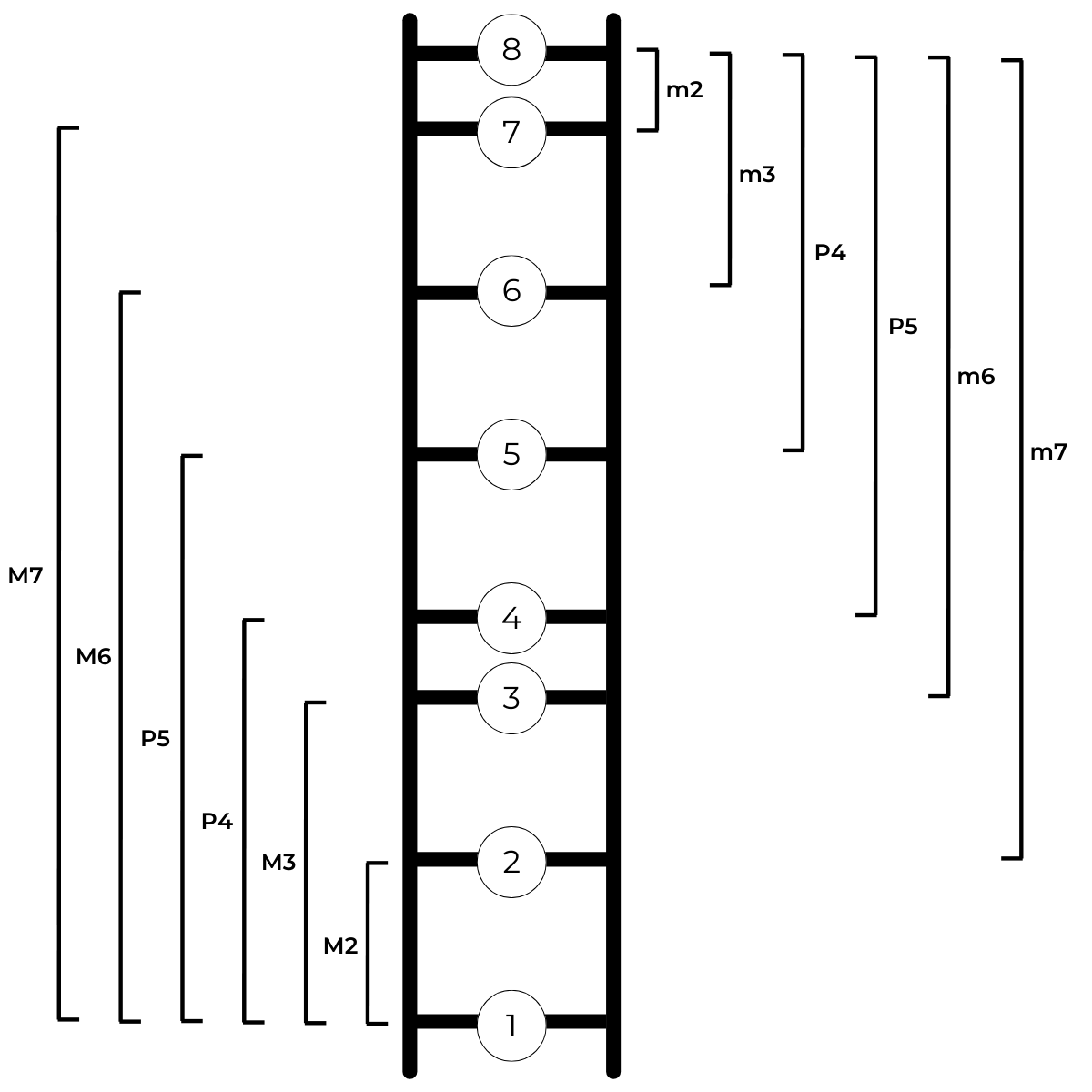
The result is that:
- Ascending Major intervals tend to have an “opening” feeling (like they are beginning a journey away from the low tonic), while descending Major intervals tend to have a “closing” feeling (like they are completing a journey back to the low tonic)
- Ascending Minor intervals tend to have a “closing” feeling (like they are completing a journey back to the high tonic), while descending Minor intervals tend to have an “opening” feeling (like they are beginning a journey away from the high tonic)
- Perfect Intervals tend to have an open, resonant sound (especially the harmonic versions) They do also have a tonicity, which is where the connection to the Circle Of Fifths (based on Perfect Fourths and Fifths) comes in, but this is less apparent than with the Major and Minor Intervals. .
This is quite a different way of listening to intervals, but our members have found it can be enormously helpful for aiding recognition, as well as giving new insight into what’s happening musically when we use different kinds of interval.
| Zac Says… Sometimes members find this idea of interval “resolution” challenging to understand. They have found success by being very relaxed, singing the intervals, and focusing on how they “feel” rather than how they sound. Sing back and forth slowly between the intervals’ notes and notice how the “opening” and “closing” feelings show up in the body. Other ways members have described the “opening” feeling is like a “blooming” or “blossoming”—there is a need to continue. The “closing” feels like “settling”, “restful”. |