


In Chapter 8: Relative Pitch we said that Relative Pitch is all about recognising the relationships between note pitches in music, letting you understand at a conscious level what your brain and ears already understand subconsciously about how music works.
The Solfa approach focuses on the relationship of any given note to the tonic note of the key.
With Intervals we focus on the relationship between any two notes. Coming back to our “Pitch Ruler” analogy See “The Relative Pitch Solution” in Chapter 8: Relative Pitch. , learning to recognise Intervals is really about calibrating and connecting with our internal ability to judge pitch distances. By learning to recognise different distances (analogous to the different numbers of centimetres marked on a ruler) we can use those building blocks to identify notes relative to any other note.
This is why my own interval skills let me progress rapidly when I started with Solfa: I already had a good ability to judge pitch distances from the tonic, as a subset of my interval skills. This is also where the advantages and disadvantages of Intervals arise…
Solfa vs. Intervals
If the power of Solfa comes from its focus on relationship to the tonic, mirroring how music itself works, then the power of Intervals comes from being independent of that—but this is a double-edged sword.
At first, intervals might seem like the most fundamental building block of music. After all, if intervals allow us to judge the pitch distance between any two notes, surely Solfa is just a subset of that—and we’d be better off always thinking in terms of intervals?
There is an element of truth to that. But when’s the last time you listened to music that had just two notes? :) Even the simplest music we listen to every day features melodies and harmonies comprised of many notes, and our brains are always seeking to put the musical sounds that we hear in context. As soon as we hear a note, we’re subconsciously and instinctively listening for the notes that come before it, after it, and around it, to construct mental models of our musical experience.
This is why traditional Ear Training for Intervals so quickly becomes challenging and frustrating for musicians, and why it’s possible to get very good at recognising intervals during an Ear Training exercise or to ace the quiz in an app, but still struggle to actually do anything useful with that in our musical lives.
If you only focus on Intervals, what you quickly discover is that when faced with a real piece of music, you essentially need to de-contextualise a pair of notes in order to recognise them. This takes quite a bit of mental effort, as our brains are naturally seeking for ways to make sense of all the sounds together as a stream of music (i.e. a musical context).
To give a concrete example: you might get very proficient at distinguishing the types of interval called a Major Third and a Minor Third, and never confuse them during Ear Training practice. But in a real musical context, a Major Third above the tonic sounds quite different to a Major Third above the second note of the scale! So if you’re trying to play a melody by ear, or improvise using those Major and Minor Thirds, you can quickly get confused and struggle.
The result is that a musician who has focused solely on Intervals will often find even simple, slow melodies move too quickly for them to “think through” all the intervals they’re hearing. This problem is compounded if they are relying on the popular “reference songs” method for recognising intervals, which we’ll discuss below.
It is possible to get to a usable skill level with Intervals, by practicing to the point where you don’t need to consciously think through recognising each one, and instead rely on your now-instinctive “Pitch Ruler”. But it’s a long and slow-going journey to get there.
“Alright,” you might be thinking, “we should just use Solfa then?” Well, as mentioned above, this independence of Intervals from context isn’t just a disadvantage—it can also be an advantage.
Not only can interval Ear Training accelerate your mastery of Solfa (through the power of Convergent Learning), it also provides liberation from the scale. In the previous chapter we discussed chromatic Solfa for handling accidentals, which is one way to handle notes which lie outside the scale. But Intervals provide a powerful way to handle this too.
For example, supposing you’re working out a melody by ear and most of the notes are comfortably jumping out to you as their solfa note names, but then there’s one which falls between re and mi. If you’ve mastered chromatic solfa you might be able to recognise this as me, but if you’ve been learning Intervals you might also easily spot that it’s a Minor Second above the re you already recognised. In fact, this is typically how a Solfa-focused musician will handle chromatic notes. They may label them with the corresponding solfa name, but rather than learning to recognise all the chromatic scale degrees directly, they’ll rely on hearing “it’s a bit above/below that Solfa note I know well, so it must be…”, essentially recognising the interval of a Minor Second, even if they’re not thinking in those terms. A strong ability with Intervals lets you handle all kinds of leaps in pitch which go outside the scale, in a direct way.
Intervals can also unlock greater creativity, as you’ll discover in some of the suggested exercises in this chapter. If Solfa is powerful because it matches “the way music normally works” then you can probably see how fascinating it can be to experiment with improvising or writing music using Intervals, which don’t necessarily obey those conventions at all!
These two advantages—accelerating your Relative Pitch skill development through Convergent Learning, and providing a versatile way to handle notes beyond the comfortable Solfa framework—make Intervals a valuable addition to your Relative Pitch toolkit.
How Intervals Work
An interval is simply the distance in pitch between two notes. Since the pitches we use in music aren’t completely arbitrary, there is a finite number of distances we’re likely to hear.
A note’s pitch might vary, for example if the musician slides up to or down to the note’s notional pitch, or applies vibrato to waver the pitch up and down around the note’s pitch. Even then though, the note has a single specific pitch associated with it. In traditional score notation we’d show this by its vertical position on the staff. In guitar tablature it would be indicated by the string and fret number to be played.
Similarly, one can technically use various tunings other than concert-standard “A440”, changing the pitches of all the notes being used—but even then we still identify a finite set of note pitches to be used in the music.
This means that within an octave (from one named note to the same-named note in a higher register, such as from Middle C to the next C above it) there are just 13 note pitches, and 13 possible distances within that range. We measure these in Half Steps, also known as Semitones, Minor Seconds, or chromatic steps. The diagram below shows those 13 units marked on a vertical line on the right, and the 13 possible distances (from 0 Half Steps through to 12) with brackets on the left:
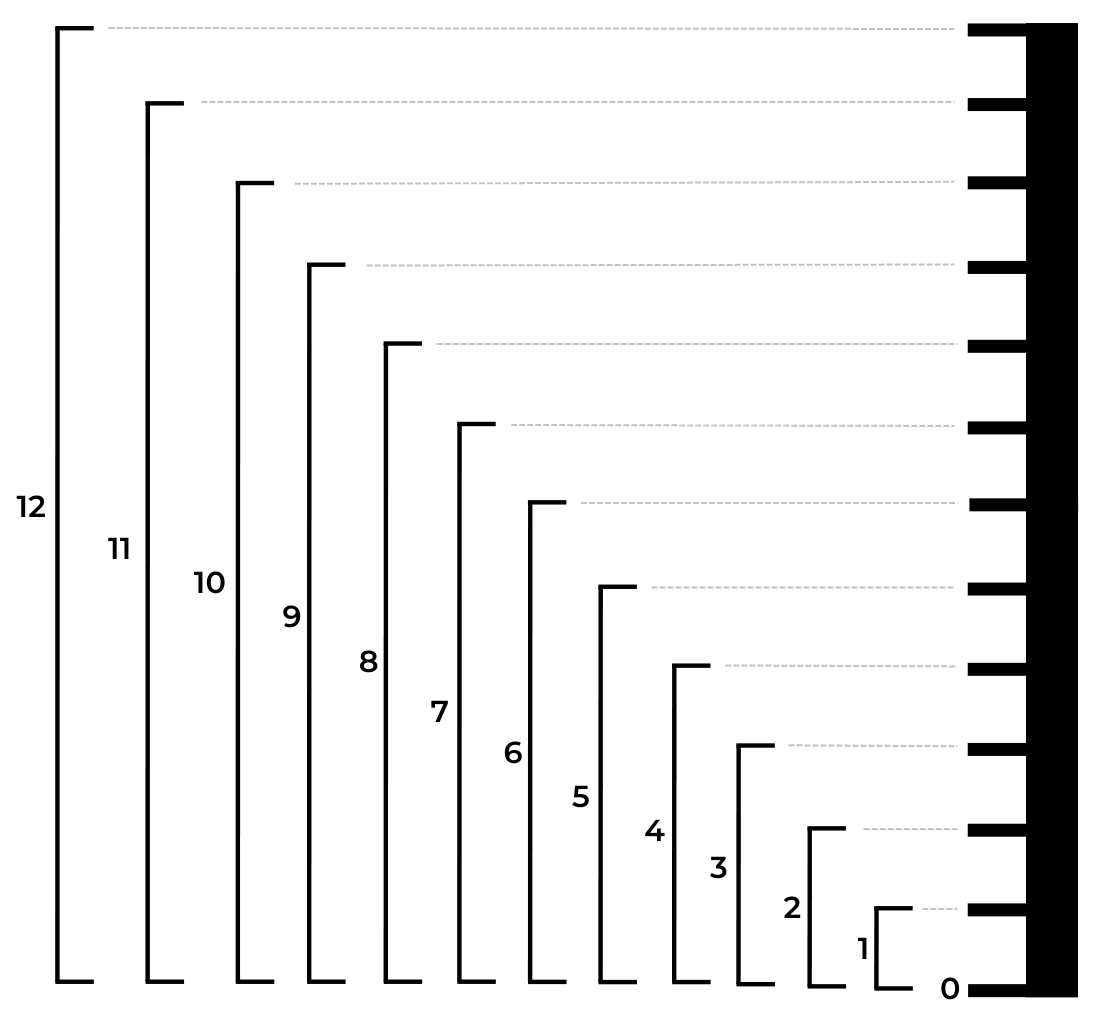
These different distances are our building blocks in the Intervals approach. Naturally it is possible to jump further than an octave in a single leap, but it’s relatively rare that you’d need to handle that by recognising that as a single interval. In practice, as we’ll see in “Compound Intervals” below, you would use your recognition skills for the same distances shown above, and note that you’ve also jumped up or down an octave.
Forms of Intervals
Since an interval is a pair of notes, there are three possible forms of an interval:
- Ascending (the second note is higher in pitch)
- Descending (the second note is lower in pitch)
- Harmonic (the two notes are played at the same time)
As a shorthand we can refer to both ascending and descending intervals as “melodic”. So if we say an interval is melodic it means the two notes are sounded one after the other, and if we say it’s harmonic it means the two notes are sounded together
Note this doesn’t necessarily imply a connection to a melody or to harmony, in the broader musical context.
While we will most often use melodic intervals when dealing with melodies, and harmonic intervals when dealing with chords, the terms “melodic” and “harmonic” refer purely to whether the two notes are played together, or successively.
We might, for example, sing melodic intervals when analysing a chord to identify the intervals present. Or we might sing the tonic note while hearing a melody, and use our harmonic interval recognition skills to identify the melody notes based on the harmonic interval we’re creating between them and the tonic.
So the terms stem from “melodic intervals create a two-note melody, and harmonic intervals create a two-note harmony” rather than “melodic intervals belong to a melody and harmonic intervals belong to harmonies”.
.
Whatever the form of the interval, we refer to the lower-pitch note of the pair as the root note of the interval.
Types of Intervals
The pitch distances shown in the diagram above above constitutes our set of building blocks, but it proves useful to also give them names.
The names of the different “types” of interval are simply a shorthand for different pitch distances. For reasons relating to the underlying music theory, instead of saying “this note is 1 unit of pitch from that one”, “that interval is 3 units of pitch”, etc. we actually name intervals according to two characteristics: degree and quality.
The degree is a simple numbering from one to seven, for the seven distinct notes in a major or minor scale which spans an octave.
The quality of an interval is a word, most commonly “major”, “minor” or “perfect”, but can also be “augmented” or “diminished”.
The combination of these two characteristics results in interval type names like “Major Third”, “Perfect Fifth”, “Augmented Fourth”, “Diminished Seventh”, and so on.
This way of naming intervals brings some of the advantages of relating things to the scale, without tying us to it:
- The quality names are helpful as a way of grouping similar-sounding intervals.
- There is some connection between “major” intervals and “major” keys, scales and chords, and between “minor” intervals and “minor” keys, scales and chords. We’ll explore this a bit more as we continue. It’s not a direct correspondence, so it’s best just to see this as a connection rather than an equivalence, and also a hint that the sounds of intervals with those qualities may be reminiscent of the sounds of the keys, scales and chords with those qualities.
- Strictly speaking, you can think of “major” indicating the larger of the two types of interval for a given degree, and “minor” indicating the smaller (e.g. Minor 2nds are smaller distances than Major 2nds). We’ll explore this (as well as “augmented” and “diminished”) more below.
- The “Perfect” quality gets its name from the frequency ratios of the pitches, which for Perfect intervals are all neat, exact mathematical ratios. It’s not a coincidence that these intervals all have a particularly broad and resonant sound.
On first encounter, the names of different types of Intervals can seem intimidating, overwhelming, and even arbitrary. Remember that “a rose by any other name would smell as sweet”, and fundamentally intervals are defined by the distances in pitch. The names are just a shorthand which proves convenient and meaningful in various ways. Also keep in mind our general rule-of-thumb with Ear Training, which is to start small. You needn’t learn or memorise all the names, nor learn to recognise the corresponding intervals by ear, all at once! We’ll provide specific guidance in this chapter on getting started.
Below is the full list of names for the most common interval types you’ll encounter. The number is how many “pitch units” each one represents. These units are known as “semitones”, “half steps” or “minor seconds”, or as we’ll use below “chromatic steps”.
Some intervals have different names in different countries or traditions—choose whichever you prefer or is familiar. Some actually have multiple names from a music theory perspective (for example the Tri-Tone can also be referred to as an “Augmented Fourth” or “Diminished Fifth”) but for recognition and listening skills you don’t need to worry about that.
We’ll also list the abbreviation we use for each in brackets after the name.
Here are the most common interval types:
- Perfect Unison (U)
- Minor Second (m2) a.k.a. Semitone (ST) or Half Step (HS)
- Major Second (M2) a.k.a. Tone (T) or Whole Step (WS)
- Minor Third (m3)
- Major Third (M3)
- Perfect Fourth (P4)
- Tri-Tone (TT) a.k.a. Augmented Fourth (A4) or Diminished Fifth (d5)
- Perfect Fifth (P5)
- Minor Sixth (m6)
- Major Sixth (M6)
- Minor Seventh (m7)
- Major Seventh (M7)
- Perfect Octave (P8)
With Perfect Unison and Perfect Octave it is common practice to omit the word “Perfect” and call them simply “Unison” and “Octave”, because it can be safely assumed that Intervals of these degrees have that particular quality only. You’ll also find this done with other interval types where either the “Perfect” is implicit because the other forms are so unusual (Fourths and Fifths), or where the Major/Minor quality is unimportant or ambiguous (for example talking about a melody “moving in Thirds”, or building chords by “stacking Thirds”).
There’s a lot of music theory behind intervals. You can go deep into where they come from, how they relate to keys, scales, chords, and progressions, how to invert intervals, how intervals are used in harmony, composing and arranging, and so on.
One common rabbit-hole is worrying about the “spelling” of intervals. For example, trying to memorise that a Perfect Fifth above a C is a G, and a Major Third below a C is an A♭, how to work out the interval name from a pair of note names etc.
This is a useful skill at times, particularly if you’re working a lot with traditional notation (e.g. trying to sight read music in choir, or transcribe based on intervals). However, don’t make the mistake of feeling you need to memorise the spelling of every interval in every key to progress with interval recognition.
With the approach we recommend, of working in Relative Pitch and “translating” to/from a particular key, you don’t need to learn any further theory to start benefitting from Intervals. For now, just learn the names of each interval type listed above (which you can do gradually as you start practicing with limited numbers of the types).
| Interval Spelling If you do want to dive into the “spelling” of Intervals, you’ll find two guides in the Additional Resources which will get you up to speed and provide you with several helpful shortcuts. |
Intervals and The Pitch Ruler
Up until now, we’ve used the analogy of a mental “Pitch Ruler” as a way of understanding how our sense of Relative Pitch (and corresponding Ear Training) work. Just like we did when introducing the Pitch Ladder in the previous chapter, it can be helpful to actually turn this idea into a visual aid. This gives us a way to visualise both notes and Intervals in relation to one another.
Each notch on the Pitch Ruler represents one of the 12 defined pitch classes found in the Western music system. The 13th pitch repeats the first to complete a full octave:

In the course of history, Western music evolved to add “extra” pitches to the original seven pitches of the major scale. These pitches were said to add “colour” or “chroma” to the music. Eventually, the system evolved into a total of 12 equally-spaced pitches. So the 13-note Pitch Ruler is usually referred to as “The Chromatic Scale”:

Note: The diagram above starts and ends with the pitch class of C, but there is no “correct” note to start this ruler from. You can begin and end on any one of the 12 chromatic pitches.
The Pitch Ruler and Our Instruments
Most of the commonly-played Western instruments have the ability to play all twelve pitches of the chromatic scale. These are called “chromatic instruments”, and include keyboards, guitars, ukuleles, and most of the usual band and orchestra instruments.
There are a few common Western instruments that still reflect the original seven-pitch system. These “diatonic” instruments include the diatonic harmonica, Appalachian dulcimer, some harps, the Celtic whistle, and a variety of diatonic accordions and concertinas.
The design of the piano keyboard, with its mix of white and black keys, reflects both. The 8 white keys in each octave correspond to a C Major diatonic scale, and the black keys add the additional 5 notes of the chromatic scale.
Since so many of our instruments are organised according to the chromatic scale, thinking in terms of the Pitch Ruler can be very convenient for “translating” our musical perception of intervals into notes we actually play on our instruments.
Here’s a great way to get familiar with the sound of these chromatic steps (a.k.a. Half Steps), which you may have already practiced in Chapter 4: Singing as part of the “Sing Half Steps And Whole Steps” exercise:
EXERCISE: Play And Sing The Chromatic Scale
|
Regular practice with this exercise will greatly improve your Vocal Control (see Chapter 4: Singing) and make it easier to reliably recognise and produce the various building blocks for Solfa, Intervals and Chords. You are refining both your mental “Pitch Ruler” and your ability to express its various notes with your voice.
Intervals on the Pitch Ruler
Any interval can be represented on the Pitch Ruler, with the distance between the two markings corresponding to how far apart or close together the pitches are musically.
Let’s look at two intervals on our Pitch Ruler, the Major 2nd and the Perfect 5th:

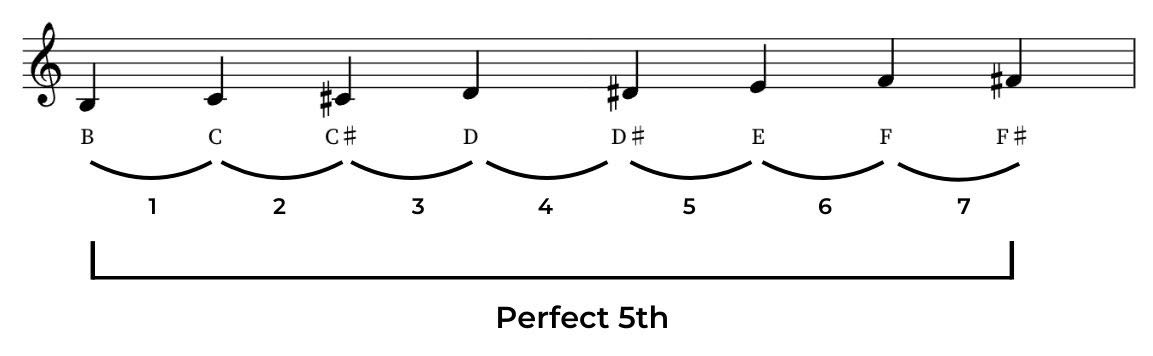
You can see clearly that the two pitches of the Perfect 5th are further apart. You may have noticed that the Major 2nd spans two chromatic steps, and the Perfect 5th spans seven chromatic steps.
How could this knowledge be useful for something like playing by ear? Well, for example, suppose you play a B and you hear that the next pitch you want is a Perfect 5th higher. You can count 7 chromatic steps up on your instrument (for example, seven frets up on your guitar or seven keys to the right on the piano) and find that the note you seek is an F♯:
We can also see this as a way to make our Pitch Contour more granular, by pinning down the specific chromatic steps the series of notes is moving between:

The Pitch Ruler is so clear and systematic with its neat, evenly-spaced pitches that you may be wondering, “Why don’t we base all our ear training and music theory on this chromatic scale?”
Well, it might look good on paper, but the big issue is that we don’t hear music in this way. Let’s return to the Pitch Ladder introduced in the previous chapter as a way to visualise Solfa, and see how the two relate.
The Pitch Ladder
Although we have 12 pitch classes in our system, it’s very rare that a given piece of music will make use of all twelve. For example, as we saw in Chapter 8: Relative Pitch, much of Western music uses pitches exclusively from the major scale. To represent these pitches, we can use a Pitch Ladder:

Now, let’s compare our Pitch Ladder to the Pitch Ruler:

As you can see, all the pitches on the Ladder line up with pitches on the Ruler. In the Pitch Ladder though, not all pitches are spaced equally apart, and some pitches shown on the Ruler are not found on the Ladder. This is because the major scale does not use all 12 pitches, just a select seven (plus the octave) that form the scale, and these seven pitches are not all equal distances apart.
The Pitch Ladder more accurately represents how our brains organise music, and so is more closely related to what we are actually hearing. That’s why together, the Pitch Ruler and the Pitch Ladder can be a powerful combination.
We said earlier that the names we use for intervals, in terms of “degree” and “quality”, bring certain advantages. The Pitch Ladder is a helpful way to start understanding this.
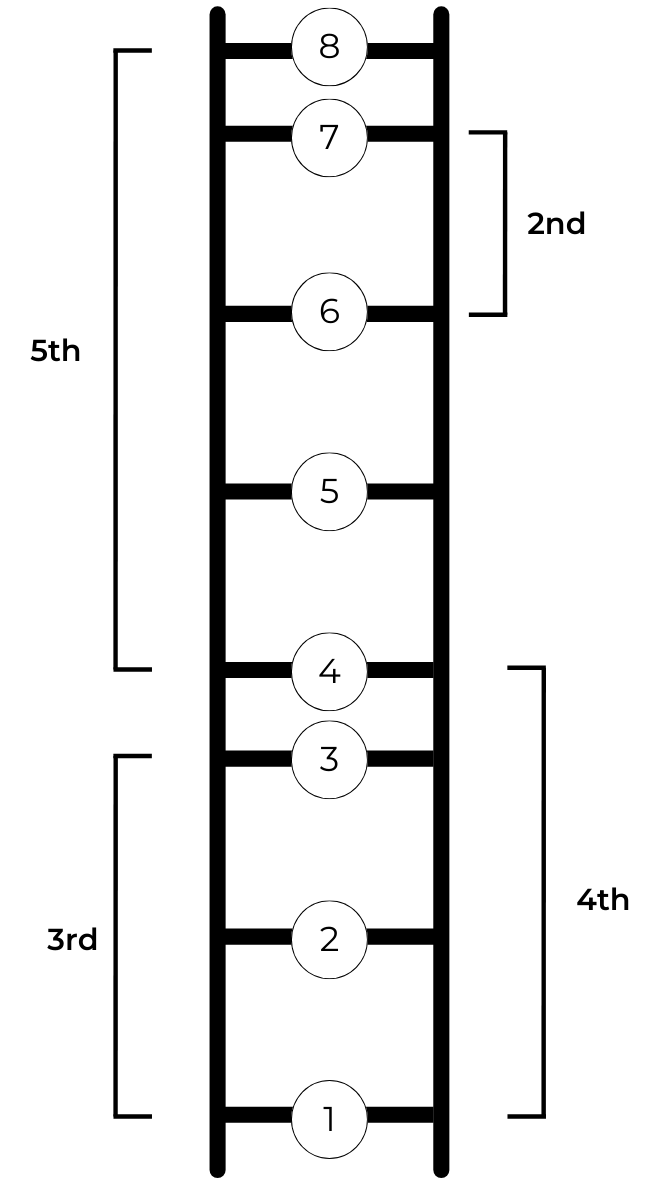
The “degree” is the number part of the interval’s name and refers to the distance between the pitches on the Pitch Ladder. When we count the distance, we include both the beginning and the end pitches:
If you measure intervals with the unequal steps of the Pitch Ladder, it is possible to have two intervals with the same number, but which are not the same distance as measured with the Pitch Ruler:
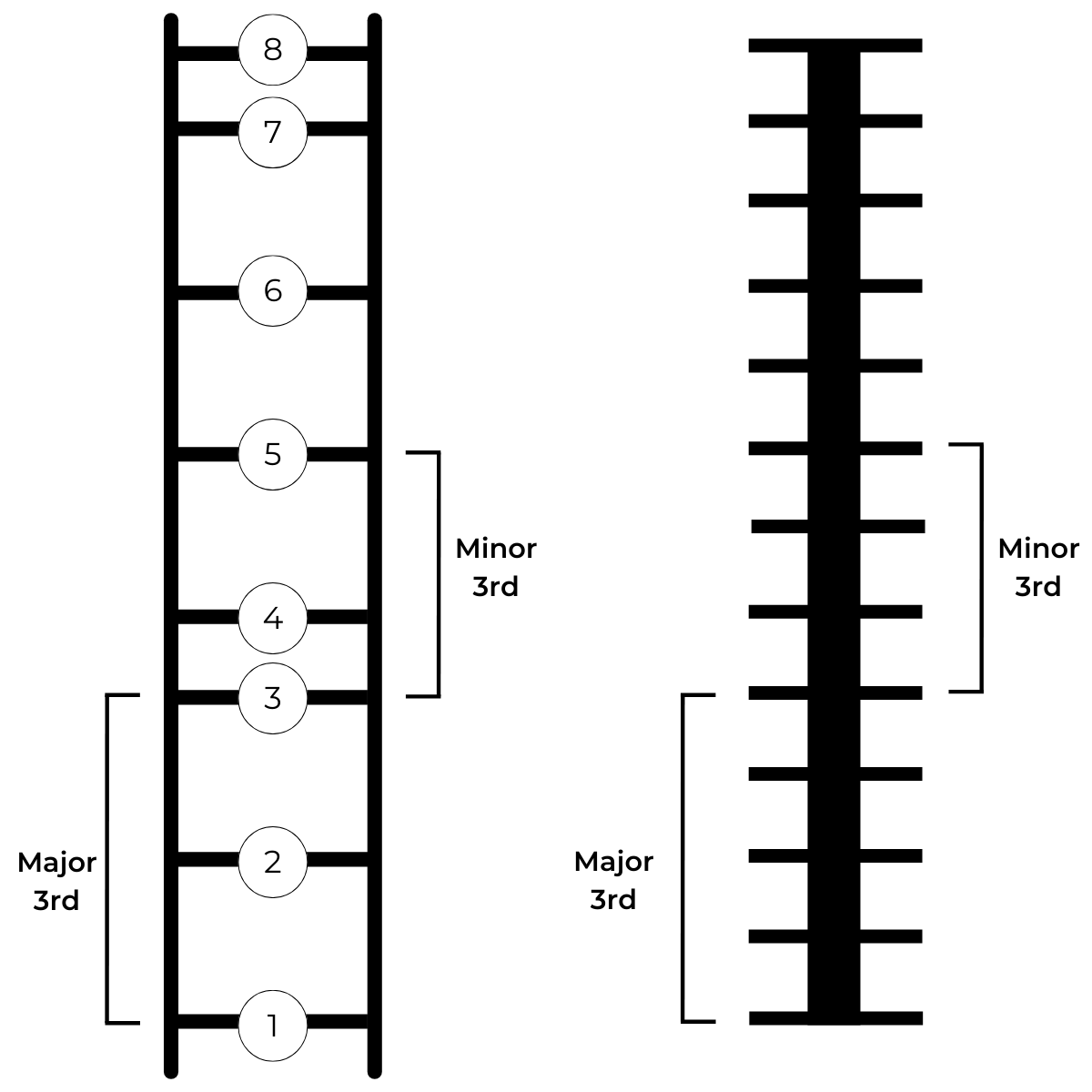
We therefore add the “quality” label to differentiate between the “bigger” and the “smaller” version of each interval. As a reminder, the words used to describe quality are Major, Minor, Perfect, Diminished, and Augmented.
So you can see that although the types of interval are fundamentally defined in a purely numeric way (as the number of chromatic steps apart two pitches are), by naming them in terms of degree and quality, we also glean some useful information about how far apart the notes are in terms of the scale.
We can also make the connection with Solfa names:
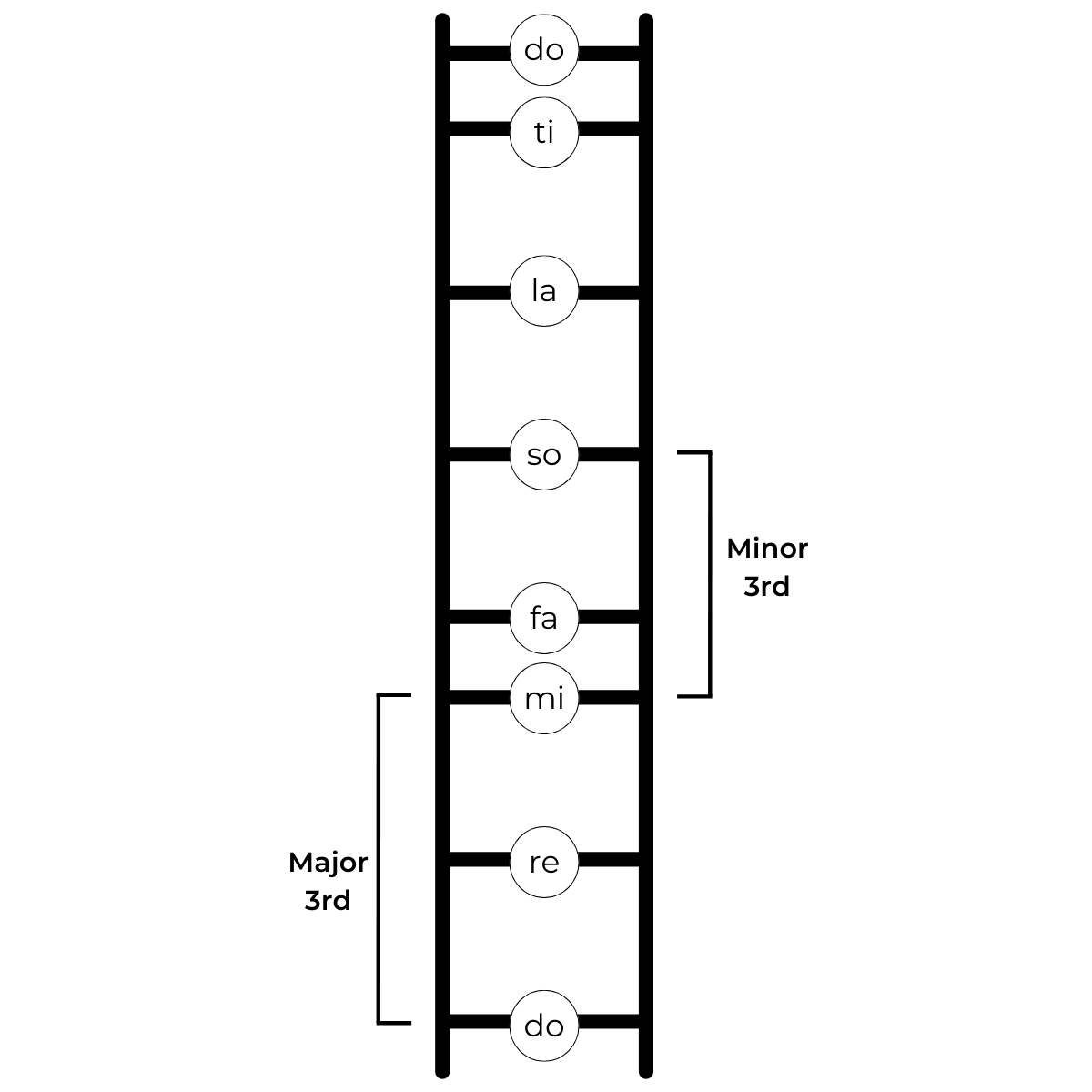
For example, learning that the interval from do to mi is a Major 3rd, while the interval from mi to so is a Minor Third. Even though both are a “Third” (because both are three notes apart on the ladder), the underlying pitch distance is actually different. This gives us a different perspective on the pitch relationships within the scale.
We already met one exercise in the previous chapter which can help you forge the connections between these two approaches: singing up to each Solfa note from do, and naming the corresponding interval (e.g. “do, re, major second, do, mi, major third, etc.”). We’ll introduce further exercises below to help you continue to explore this.
Compound Intervals
Compound intervals are intervals larger than an octave. It tends to be jazz musicians who talk about these the most, as they’re often thinking in terms of extended chord voicings which use them.
Most musicians don’t need to worry about compound intervals. Firstly, because recognising compound intervals doesn’t arise all that often, for most musicians in most genres. Secondly, because when it does arise, you can typically use your interval recognition skills for the types listed above to recognise those bigger intervals too (because they sound similar, just in a different octave).
For example, suppose you want to recognise “ninth” chords in jazz standards, which feature not just the root, third, fifth and seventh notes, but also the ninth. Your interval Ear Training has equipped you to recognise what quality of 3rd, 5th and 7th are featured—do you now need to learn to recognise Major and Minor 9ths? The answer is no, not really—because the interval of a Ninth takes us to the second degree of the scale, in the octave above. As a result, you can use your skill with Minor and Major 2nds to distinguish between the two types of ninth chord directly. That’s not to say that no practice will be required to distinguish ninth chords—just that you don’t need to add another type of interval to your interval Ear Training. You can directly focus on that specific task, drawing on your abilities with the intervals up to an octave.
Recognising Intervals
Now that you’re familiar with how Intervals work and the essential theory, let’s move on to the Ear Training side of things. Learning to “recognise intervals” means that when you hear a pair of notes in music you know the name of the type of interval between them, which indicates how far apart the notes are in pitch. When people talk about “interval ear training” they are referring to this process of learning to recognise intervals.
There are two ways that your brain learns to recognise different types of interval:
- By hearing the characteristic sound of the interval. For example, “major” intervals tend to sound happier and brighter than “minor” intervals. That’s an over-simplification, and something we’ll unpack more below! There are also other aspects which can make intervals distinctive, for example some have a clashing, uncomfortable sound, while others sound comfortable and at rest. The “reference songs” method also falls into this category: you are listening for an inherent, recognisable aspect to the sound of the interval, in this case whether it sounds like the beginning of a particular song’s melody or not.
- By directly estimating the distance in pitch. For example, even without training most musicians could tell you that the notes of a Major 6th are further apart than the notes of a Major 2nd. You can refine this ability to judge pitch distances by practicing interval recognition.
These two approaches work together. At different stages of your training and in different circumstances you’ll use one skill more than the other.
For example, the characteristic descriptive words tend to be helpful when first starting out, but mostly for harmonic intervals. Reference songs can be helpful when first starting out, but mostly for melodic intervals. Judging pitch distances can be hard for adjacent types of interval (e.g. Major 3rd vs. Minor 3rd) but this skill gets stronger with practice and is ultimately the more useful and instinctive version of the skill.
Most of interval Ear Training focuses on the first approach, since this is a clear, conscious process. The second approach happens automatically along the way. Generally when you consciously try to “use intervals” for a musical task, you’ll be drawing on approach #1, and that will be our focus when we talk about learning interval recognition below. However it’s worth knowing that approach #2 is happening “under the hood”, calibrating your mental Pitch Ruler and helping you to judge pitch distances instinctively.
Using Intervals
Since we’ll follow an Integrated Ear Training approach, the exercises recommended below and in the following chapter on Chords and Progressions will include applying your new interval skills to real musical tasks. It’s therefore worth briefly covering how Intervals can be used:
- Chords: Intervals help you recognise different types of chord (e.g. C Major vs. C Minor vs. C Seven) because you start to hear the pitch relationships between the notes of the chord. Each pair of notes in the chord forms an interval and you can learn the intervals which each type of chord is built from. For example, if you know that a “major triad” chord consists of a Major 3rd with a Perfect 5th, when you hear a 3-note chord and your interval skills let you recognise a Major 3rd and Perfect 5th, this reveals to you that it’s a major triad chord.
- Chord Progressions: Intervals are also helpful for chord progressions (sequences of chords), because they let you hear the movement of the base (“root”) note of the chords. For example, to recognise a C-F-G progression in the key of C you might hear that it sounds a bit like a Perfect Fourth (C up to F) and then a Major Second (F up to G). Or that the final chord sounds like a Perfect Fifth above the first one (C up to G).
- Improvisation: Intervals help you to improvise by letting you understand the music you imagine in concrete terms. You know how the second note relates to the first, and the third to the second, so that when you want to actually play those notes, you can. You know how far above or below each note the next one should be. As already discussed, it can be tricky to do this fast enough to be practical, so in practice most musicians would be combining their raw interval skills with knowing the notes of the key and/or Solfa.
- Playing By Ear: When you listen to music with interval-trained ears you hear in a much more structured and precise way. This means that you can apply your interval recognition skills to work out the notes you’ve heard. You can then write them down or play them on your instrument. To play exactly the notes you heard, you generally do need one known note to base all your other relative judgements on. For example, you might identify the key of the song (as covered in Chapter 8: Relative Pitch), or just dabble on your instrument along with the recording to identify one note to serve as your known reference note. Once that one note is known, all the rest follow from the intervals between them.
- Audiation and Musical Memory: As with all our Relative Pitch building blocks, Intervals help to refine the pitch precision of your Audiation as well as your musical memory. By learning to more accurately and reliably distinguish between different distances in pitch, you are able to form a more detailed and precise mental representation of the sounds of a song or piece. Additionally, you can consciously use your skills to help you remember. For example, knowing that your next entry in a choir piece begins a Major 3rd above the note you last sang helps you to then pitch that note correctly when you sing it.