


When you start thinking in terms of Relative Pitch, rather than specific keys, scales or letter names of notes, it’s liberating. You start to realise how much your ear is already understanding intuitively about how music is put together, and with some dedicated Ear Training you begin to be able to identify the specific pitches of notes.
Then… there’s a sticking point. Because there’s no “do” key on a piano keyboard, nor standard fingering for a “Major Third” on clarinet! If you want to actually play what you heard, if you want to bring an imagined (audiated) melody out into the world for others to hear, if you want to jot down your compositional ideas in traditional notation… suddenly you need to plunge back into that world of letter names, sharps, flats, and key signatures.
Depending on the circumstances, you may know the key, or it may be easy for you to find it out. That is perfectly fine, especially when you’re first starting out with Ear Training. You can have great fun developing your ear with the building blocks and exploring Playing By Ear, Improvisation, Songwriting and more, without ever learning to recognise the key by ear.
For that reason, you may wish to skip what follows, and dive straight into those other chapters. You can rely on “finding out” the key rather than “figuring out” the key. You have my enthusiastic permission to do so :)
However, if you want ultimate ear-based freedom in music, you will also at some point need to learn to find the key by ear.
Fortunately, that process doesn’t need to be laborious. In fact, there’s a simple 3-step process you can follow to identify the key of any music by ear, which we’ll cover in the remainder of this chapter.
Before we dive into that process, let’s cover a bit of background theory on keys, tonics and scales. Not only because these may be unfamiliar terms for you—but because we’ve found that even if the terms are familiar, often musicians have quite a fuzzy understanding of exactly what is meant by each and how they relate. Here’s what you need to know…
Keys, Tonics and Scales
Key is one of those music topics that can really get people in a muddle. Depending on your musical background, you might actually think of key as something quite different to another musician.
If you’re like I was for a long time, you might think of key as just meaning “the key signature”. At the start of a piece of music in traditional score notation, we have a set of sharps and flats that tell us how to modify the notes in that piece. So in the key of D Major, for example, you always have to remember that each F is F♯ and each C is C♯.
Or if, say, you’re a bass guitar player, you might think of key as just being a note. You know your riff starts from a certain note, and that is your “home note”. Then if you’re going to play a pentatonic solo, you’re going to start that pentatonic scale from a certain fret and string corresponding to that note. You know that if you need to shift to another key, you’d have to move that whole pattern on the fretboard, so you might think of “the key” as just being a note.
As another example, supposing you’re a jazz musician who plays solos on the sax. You might think of key as being a “set of notes that you’re allowed to use”. This certain set of notes will sound good when you’re picking different notes to play for your solo.
On top of these differing perspectives on key itself, the key is very closely related to two other concepts in music: the tonic and the scale. These three things are not the same, but they’re very closely related. Let’s look at each in turn.
The Key
A key is a set of notes, with one of them being identified as the “tonic”.
When we talk about keys, tonics and scales, we generally don’t worry which octave (or “register”) a note is in. So we don’t mind whether a note is sung down in a baritone range or high up in a soprano range, whether it’s played down low on the E string of a bass or way up top at the top of the guitar fretboard, or in which of the seven octaves of the piano keyboard it’s played. As long as it’s the same letter name, we’re going to consider that the same note when discussing the key.
So a key is a collection of note pitches, and one of them is identified as the tonic. That is our full definition. But there are certain conventions in Western music that mean that we have some useful shorthands for the details. Some things sound “good” or “normal” to our ears, and so songwriters and composers tend to follow those conventions (at least, most of the time!).
You may know that in Western music we have twelve “chromatic” pitches in each octave: C, C♯, D, all the way up to B. These are sometimes referred to as the different “pitch classes”, so that all C’s on a piano keyboard, or all C’s across the guitar’s strings and frets belong to a single “pitch class” of C.
We’re going to pick a subset of these twelve pitch classes to be in a key. But we don’t pick at random!
Conventionally, a musician or composer is going to pick seven of them, and is going to pick a certain pattern of notes that go well together. So even though a key could technically have any number of notes and choose any combination of those twelve chromatic options, in practice, there are conventions that mean it’s not any arbitrary set of possible notes, and we don’t have to specify every single one of them to define a key.
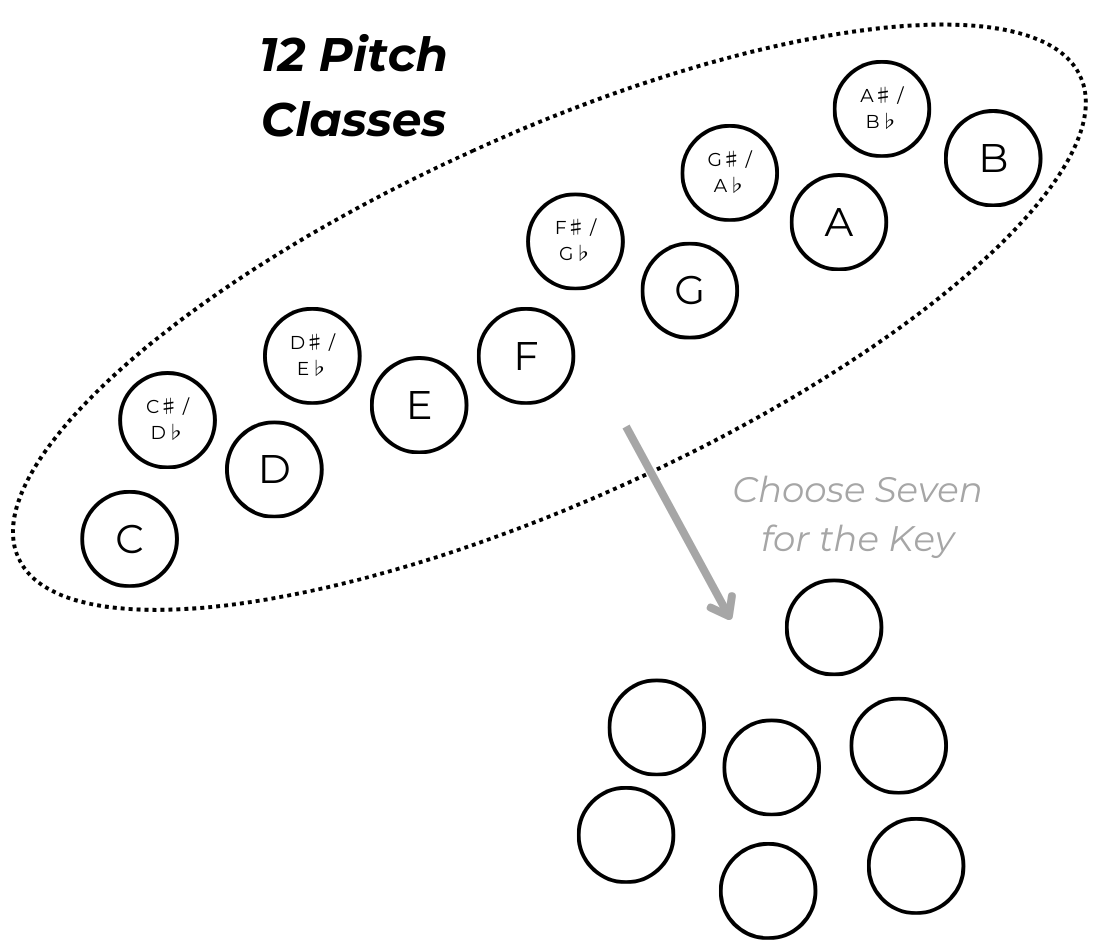
That means when it comes to finding the key by ear, we’ve already got a big shortcut, because we don’t need to figure out each and every one of the notes to know what key we’re in. As we’ll see as we continue, we need to find the tonic and we need to determine the tonality.
The Tonic
We’ve said that a key is a collection of notes, with one selected as the tonic. So what exactly is that “tonic”?
It just means the note which is the most musically significant of all the notes in our key.
The tonic might be C, it might be F♯, it might be D♭—any single note from the collection we’ve chosen for our key. Remember, we’re ignoring octaves, so if our tonic is C then any time we play any C we’re playing the tonic.
The tonic can also be called the “root note” or the “home note” of the key, because it’s the note which everything centers around, musically. With the earlier example of a bass guitar player who thinks about key as just one note, it’s the tonic they’re thinking about. The tonic is quite often the very first note of the melody and it’s almost always the last note, to bring the music “home”. The chord built on top of the tonic note is very often the final chord of a piece of music too. These are handy pointers when finding the tonic by ear, as we’ll discuss more below!
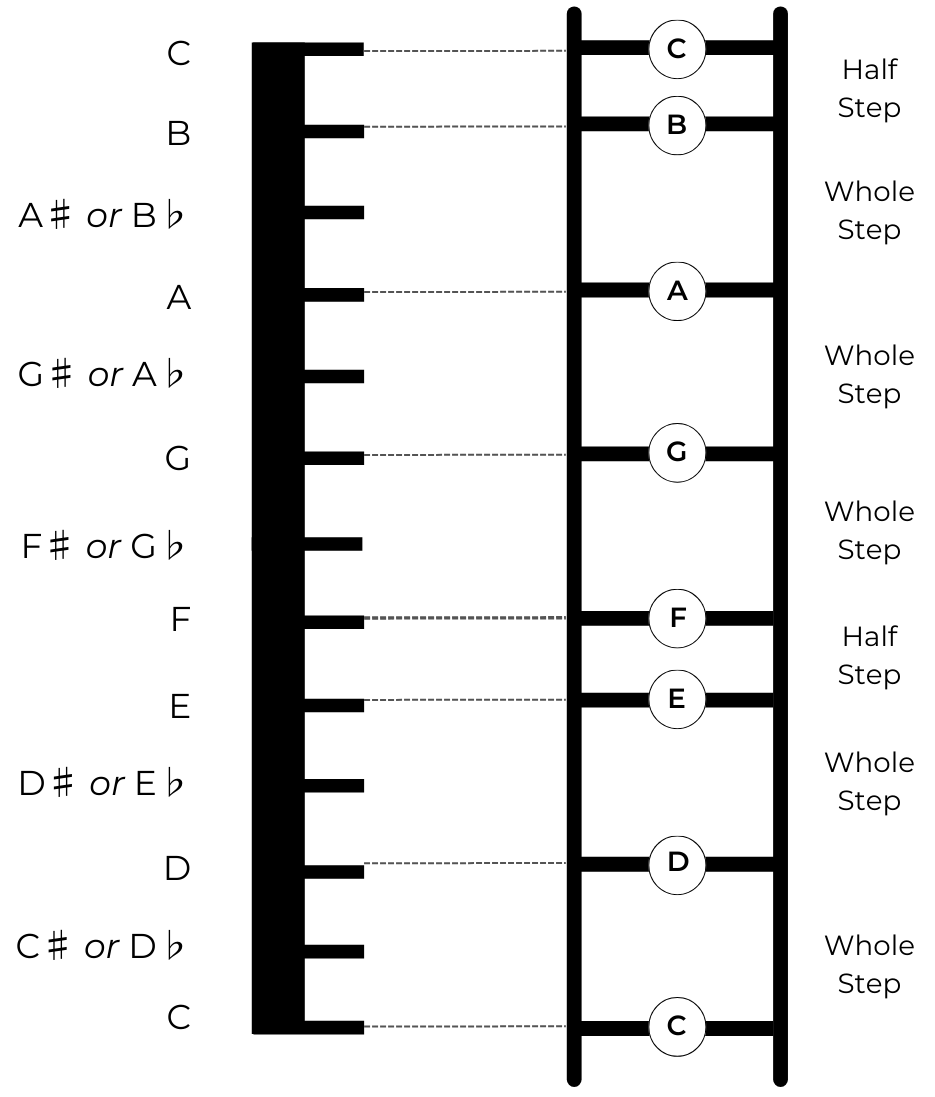
Let’s put it in concrete terms. Supposing the notes you chose for your key were C, D, E, F, G, A and B, and that you chose C as the tonic. That’s a choice you have when deciding “what key is this?” That particular case would create the key we call “C Major”.

If instead, you took the exact same set of notes, but said that A was the tonic, that would actually define a different key. It would create a different feel in the music if you started using A as the tonic. So the tonic is a crucial part of what defines the key.
The Scale and Tonality
A scale is simply a set of notes, in order of pitch (ascending or descending).
If we took our notes from the key and arranged them in order, starting with the tonic at the bottom (and normally repeating it at the top), it would create the corresponding scale:
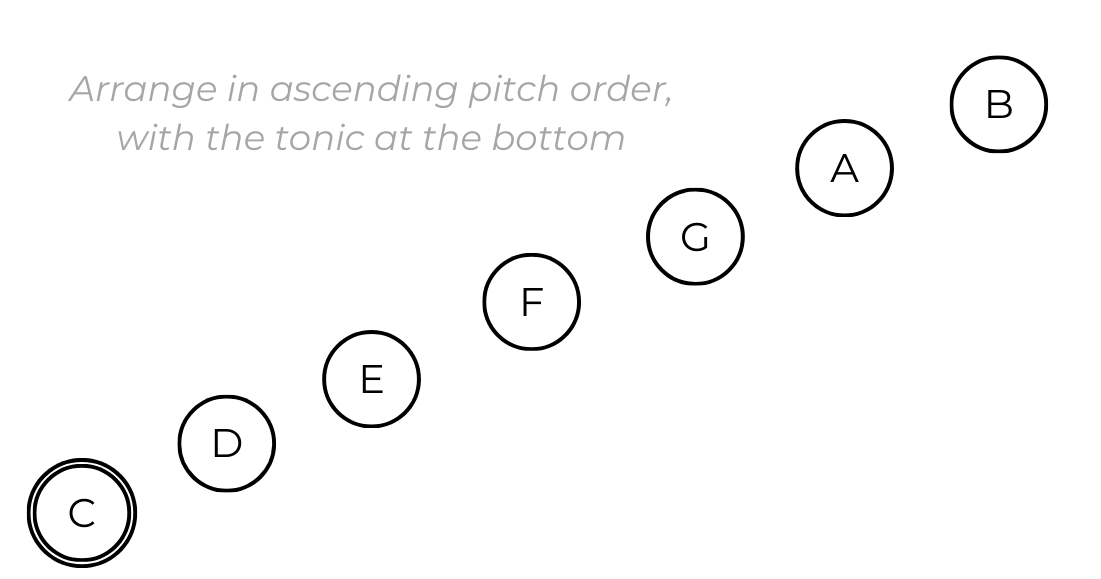
Note that we haven’t introduced any new information or choices there. All we’ve done is taken the decisions we already made about our key (a set of notes, with one chosen as the tonic) and we’ve arranged them in order.
Now where this gets interesting is that this is where the “shorthand” mentioned before comes in. In Western music, typically the collection of notes a composer or a songwriter will have chosen actually correspond to one of two types of scale: “Major” or “Minor”.
Those are just two labels which refer to the pattern of pitch distances between these notes—the “building blocks”used. As we continue in the subsequent chapters, we’ll see the details of this pattern in terms of Solfa and in terms of Intervals.
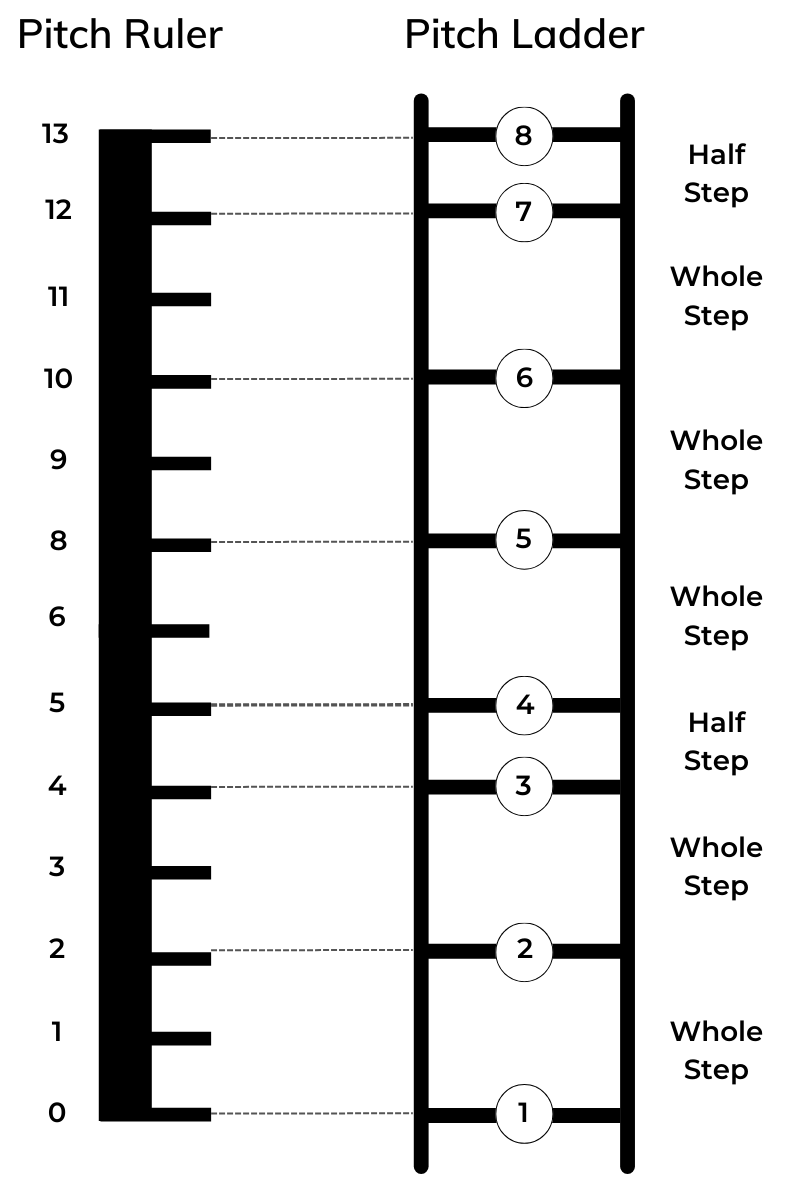
All you need to know for now is that some of the pitch distances between the notes are going to be bigger (“Whole Steps”, corresponding to two chromatic steps), and some are going to be smaller (“Half Steps”, corresponding to one chromatic step), and the pattern of these bigger and smaller steps creates what we call either a “major scale” pattern or a “minor scale” pattern You may be familiar with playing multiple types of minor scale on your instrument: “melodic minor”, “harmonic minor” or “natural minor”. When we’re talking about the scale corresponding to a key, it’s specifically the “natural minor”. We’ll explore this a bit more in Chapter 9: Solfa. .
When the pattern is “Whole, Whole, Half, Whole, Whole, Whole, Half”, that’s a major scale. If you play that pattern of steps from any note (i.e. any tonic), it sounds like a major scale. It has a certain sound to it.
This is shown visually below. All twelve chromatic pitches within the octave are shown on a “Pitch Ruler” on the left (repeating the first to complete the octave) and the pattern of Whole and Half Steps for the Major scale on the right.
We’ll be unpacking this a lot more in the following chapters, but it may help you to see it visually sooner rather than later!
And here’s what it would be for our example of choosing the notes C, D, E, F, G, A and B, with C selected as the tonic:
Similarly, there’s a pattern for a minor scale: “Whole, Half, Whole, Whole, Half, Whole, Whole”. If you start that pattern from any note, it’s going to sound like a minor scale with its own distinctive musical character and sound.
Since the set of notes in a key will generally follow one of these two patterns, we can simplify our definition of key by taking advantage of this shorthand. Instead of specifying each and every note in the key, we can simply say it’s “Major” or “Minor”. We call that the “tonality”.
So then we can simplify our definition as “a key is a combination of a tonic note and the tonality”.
It might be “C Major”, it might be “E♭ Minor”, it might be “A Major”, and so on. Those are all different possibilities for “tonic plus tonality”, which is how we’ll define a key.
Using The Key
So why is all of this useful to us? Well, if we want to translate our Relative Pitch understanding of the notes being used in music we hear into specific letter names (to play on an instrument, or write down in notation) we can immediately see why knowing the key is a powerful shortcut.
Instead of needing to try to “translate” each and every note individually from Relative Pitch to its Absolute Pitch equivalent (i.e. the letter name), we can simply find the tonic note, and determine whether the tonality is major or minor. Then we immediately know all the notes which will be featured in the music. Barring the occasional out-of-key note, something we’ll discuss in subsequent chapters.
For example, if we’ve listened to a melody and determined the Solfa names of each note, if we also figure out by ear that the key is “C Major” we can immediately re-label each of the notes with their corresponding letter names, based on the C Major scale.
So now that we’re clear on the concepts of key, tonic, scale and tonality, how do we figure out the key by ear?