


Given the strong reactions some people have to the term “ear training”, as well as the wide variety of activities people refer to with that term, it’s worth starting with a clear definition.
Back in 2009, the very first article we published on our public website (then EasyEarTraining.com, now Musical-U.com) asked and answered this very question. I was already aware of some of the confusion and frustration surrounding this topic, so I intentionally began with a very broad definition:
“‘Ear training’ is, most simply, anything somebody does to improve the way they hear.”
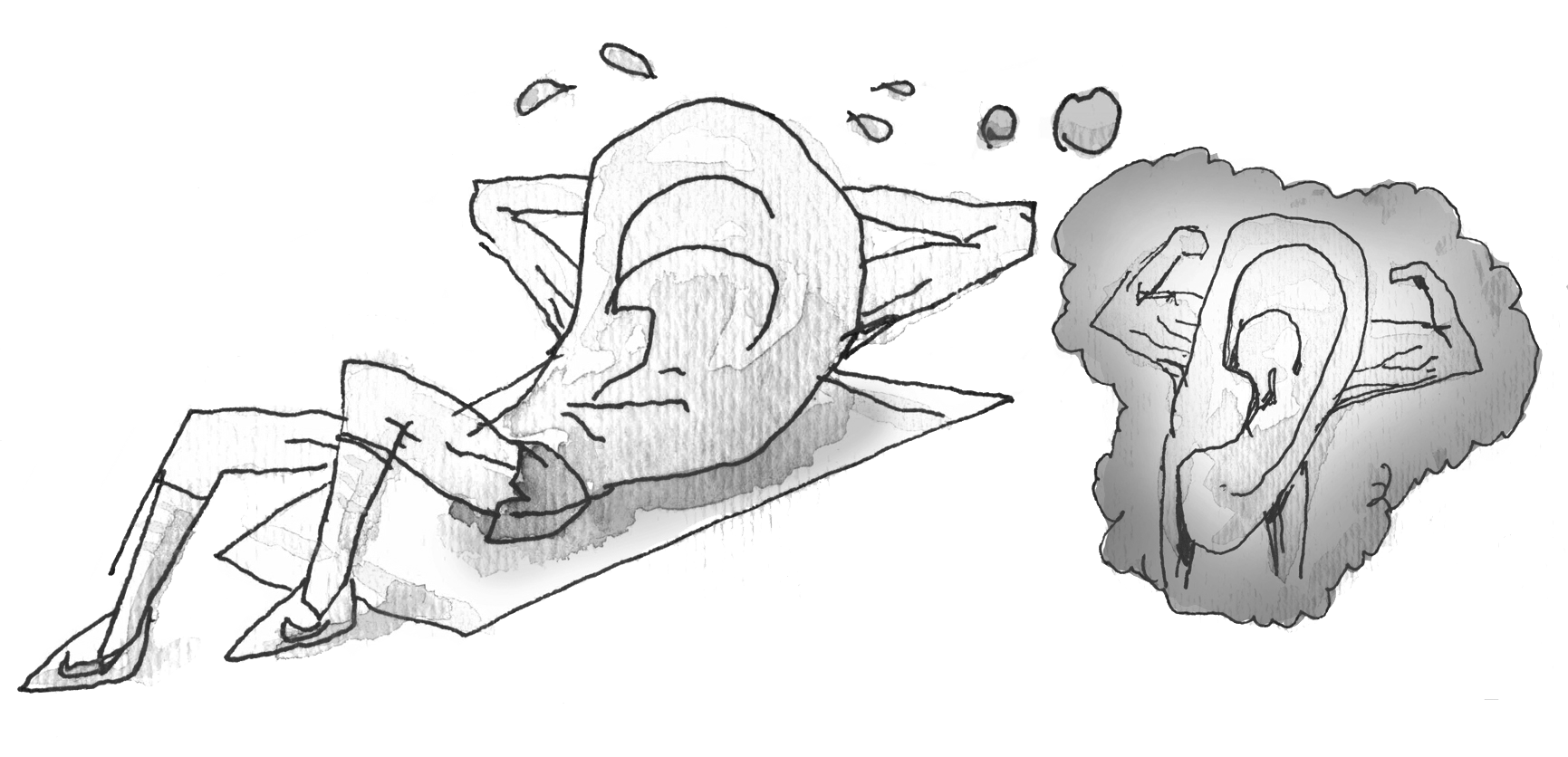
The article included one of my favourite illustrations we’ve ever commissioned, included here because it still makes me chuckle:
The article introduced the idea that ear training consists of developing two distinct skills:
-
Learn to recognise the different types of a musical element
e.g. different notes, different types of chord, different types of instrument, etc.
-
Learn what to call each type
e.g. “C,D,E,F, …”, “major, minor, diminished, …”, “oboe, flute, clarinet, …”
Sometimes the first part is easy. For example, most musicians can easily hear the difference between a major and minor chord without practice. Once they’ve been told that the “happy-sounding” chord type is called “major” and the “gloomy, sad” one is called “minor”, they have the second part too.
Using descriptive words like this is an over-simplification, but a helpful one when you’re just starting out. We’ll explore this more in subsequent chapters.
You might think that only the first step matters. After all, if you can always hear what category something fits into, why does it matter what label you put on it?
Well, if you read Chapter 5: Active Listening, you’ll know already that there are two good reasons for learning the labels:
- Having clear, well-defined labels for the types of thing you hear greatly speeds up learning to reliably classify them, by giving the brain something concrete to attach to the sounds you hear.
- Using the commonly-accepted terms helps you collaborate and play better together with other musicians, and learn from them, as well as other educational resources.
Almost everything we do in the process of Ear Training can be seen as developing both of these abilities together. However I’ve found it’s helpful to be aware of these two distinct skills, because it helps us get away from a strict “right or wrong” mentality and appreciate that our ear skills exist on a spectrum. Rather than thinking “I always get perfect fourths and perfect fifths wrong”, for example, we can become aware of how much we hear the difference, or how reliably we hear the difference, or what aspects of each type we can consistently tune in to.
It also helps us stay focused on the sounds, preventing Ear Training from becoming a purely intellectual quiz-passing exercise. In other words, we stay aware that recognising musical elements is a combination of Hearing and Head (and to some extent Heart if we’re using emotion-related descriptive words in the process). More on this when we explore different approaches to Ear Training below.
So Ear Training, then, is the process of improving our ears for music, and one way to measure that is by how reliably and accurately we can put suitable labels on the various musical elements we hear.
This immediately begs the question: What are we going to do with that ability to label the things we hear? Or, to put it another way, what about the Hands and the Heart?
Well, it should come as no surprise that the Integrated Ear Training approach we’ll be building up to below is one which incorporates all four H’s: Head, Hearing, Hands and Heart.
To better understand this approach, let’s first cover some of the other ways musicians have traditionally approached ear training.
1. Passive Ear Training
The first thing to say is that some musicians develop their musical ears without ever consciously “doing ear training”.
If you remember the example of the Beatles back in Chapter 1: Musicality when we talked about music theory, one beautiful thing about music is that it’s entirely possible to master the craft without ever doing dedicated “drills”, “exercises”, or “studying”.
Just like the Beatles mastered music theory without ever cracking open a theory book, some musicians develop the ability to play by ear, improvise, or write wonderful music without ever “doing ear training”.
For example, the jazz musician who spends years “woodshedding” their improv skills may well develop a free, creative, versatile ability to improvise purely on instinct. The blues guitarist who is constantly gigging and participating in blues jams may well find after a decade or two that they can generally “figure stuff out by ear” without thinking much about it.
This can actually perpetuate the Talent Myth, by adding further examples of musicians who can “just do it”. They can’t quite explain how they can do what they do, and even though it’s taken them years rather than being an ingrained “gift” since childhood, it adds to the mystery which commonly surrounds the skills of musicality.
However, just like in the case of theory, if we spend some time actively, intentionally practicing our ear skills, through the process of Ear Training, we not only improve dramatically faster, we also gain a conscious understanding of how we do what we do.
When I speak to musicians who’ve inadvertently gone the route of passive Ear Training, often they’re a little sensitive about their abilities. They know they can do it. Well at least, normally they can… most of the time…! But they’re never quite certain they’ll be able to pull it off. On the other hand, active Ear Training, while it doesn’t necessarily make your skills any more “perfect”, does generally produce a greater confidence in your abilities—because you have conscious understanding of how you’re doing it.
While we would never recommend passive Ear Training as the approach to follow (because of how painfully slow it is to produce real, usable levels of ability), it is valuable for making us aware of just how powerful the brain is when it comes to music.
We make this concrete with the idea of Convergent Learning (introduced in Chapter 2: Mindset and covered more specifically in the rest of Part II to follow). Although our active Ear Training will involve dedicated drills and exercises, it’s amazing how good our musical brain is at “joining the dots” beneath the surface.
Passive Ear Training also plays into the “Apply” part of the Learn-Practice-Apply process introduced below. In a way, those “woodshedding” musicians are doing solely the “Apply” step, and missing out on the power of what we’d call “Learn” and “Practice”. Or in terms of the H4 Model, we could say they’re doing mostly “Hands” with a bit of “Hearing”.
So it’s not that passive Ear Training is bad. It’s simply incomplete, just like the traditional approach to Ear Training we’ll cover next.
2. Traditional Ear Training
When I first encountered the idea of “ear training”, it was through a book-and-CD set which consisted of a series of exercises. I had one for “Golden Ears” audio training on frequencies and effects, and later another for Relative Pitch, and even Perfect Pitch.
At the time, this was a godsend. I had been flunking the “aural skills” section of my instrument exams for years, and so any process to actually improve those skills was a blessing!
It took me a number of years to realise the significant limitations of this kind of approach.
The traditional Ear Training method looks something like this:
- Pick something you want to learn to recognise, for example Intervals, Solfa (i.e. notes of the scale), or Chord Progressions.
- Limit yourself to a subset of the “types” of that thing, for example Major Thirds and Minor Thirds in interval recognition.
- Do some kind of exercise, drill or quiz where you hear an example of that thing, try to name what it was, find out if you got it right or wrong.
- Repeat step 3 until you master it (or go insane).
I’m only half joking with that last point! In reality most musicians get bored or frustrated, and simply give up. But remember that common definition of insanity: “doing the same thing again and again, and expecting a different result.”
This is another case of the “massed repetitions” approach to music practice (see Chapter 6: Superlearning). It does work, but it’s far slower and more frustrating than it needs to be.
For the first few years at Easy Ear Training our focus was on improving this process. Looking back, it feels like a clear case of “putting lipstick on a pig”.
It was helpful to gamify the exercises with an interactive mobile app. We were able to break things down in a useful way, help the student to track their progress, provide a clear progression, with a bit of flexibility to reduce the risk of getting entirely stuck at any point.
But the overall process was still a “brute force” one. And, most crucially, I found for myself and our students that it was actually entirely possible to ace every Ear Training quiz—and yet have little or nothing to show for it in your actual musical life. Everything was done in the abstract, divorced from real music or real musical activities.
This is why I would hear so frequently from musicians who had attended conservatory or done a music degree, struggled and eventually passed their Ear Training requirement there… but would sheepishly admit they still couldn’t play anything by ear, improvise, transcribe, or do any of the real musical tasks they thought Ear Training would enable them to.
The good news is that if you have spent some time already on traditional Ear Training, you’ll find that your past efforts pay off in a new way when you adopt Integrated Ear Training. Not only will Ear Training be easier and more enjoyable for you going forwards, you’ll be able to “connect the dots” in a new way, which may well that reveal your ears had actually developed much more than you thought, and you are finally able to start benefitting from those past efforts in the ways you had hoped to.
3. Learn-Practice-Apply
Learning from these experiences with traditional Ear Training, we developed a better approach when we launched the Musical U membership site in 2015.
Recognising that the drills and exercises alone could leave the student still confused and unable to actually benefit from their new quiz-passing prowess, we developed three distinct kinds of Ear Training modules:
- “Learn” modules introduced the concepts, the theory, and the terminology, as well as providing hints, tips and techniques to help recognise each type of musical element.
- “Practice” modules provided interactive versions of the recognition drills, sequenced in a way we knew would be effective, and providing flexibility for the student along the way.
- “Apply” modules showed step-by-step how to take those core recognition skills to real musical tasks, including hearing those elements in real music tracks, and using them to play by ear and improvise.
All of this happened in a community environment where members could track their progress, learn from their peers, as well as get direct help from an expert team.
This corresponded to the “Trifecta” of theory, ear training, and instrument skills, which you may remember from Chapter 1: Musicality. The “Learn” modules would provide the theory, the “Practice” modules would develop your ear, the “Apply” modules would help you bring it to instruments.
Once you see this approach, it’s clear that traditional Ear Training is actually providing learners with only “Practice”—the middle step of a 3-step process!
| TIP:
One simple but highly-effective piece of advice which we’ve taught from the outset but is often missing from traditional Ear Training material is this: When it comes to developing ear skills, “a little and often” is best. That means you will be far better off spending 5-10 minutes a day, every day, than grinding away for 30-60 minutes, once in a while. This can be explained in a number of ways:
The idea of “guerilla practice”, where you try to sneak in a few minutes here and there, throughout the day, can be particularly effective with Ear Training. Not least because it can be done without access to your instrument! So even if you’re used to the idea of setting aside a dedicated 30-minute block for “music practice”, and you really want to focus on Ear Training, we wouldn’t recommend working away at the same thing for 30 minutes. At the very least, tackle a wide variety of exercises, with no more than 5-10 minutes spent on any single one. All of the principles of designing your practice time from Chapter 6: Superlearning can be usefully applied here too. |
Learn-Practice-Apply was a big leap forwards, and it felt like we’d cracked it. Our members were getting better results in their Ear Training than any previous traditional methods had allowed them to.
But there was still something missing.
Yes, it made a big difference to cover the intellectual understanding, and provide specific tips to help the student with identifying each type of musical element. Yes, the way we implemented the drills and exercises was effective, drawing on everything we’d learned prior from thousands of students. And yes, having direct personal support from an expert team also helped reduce frustration and accelerate results.
I have to give a big tip-of-the-hat to our Head Educator Andrew Bishko for helping us see the missed opportunity. He actually called it out early on in his work with us at Musical U, but at first I wasn’t convinced. In retrospect, the way I had learned ear skills myself really biased me about how it “should” be.
Thankfully he persisted, and we began adapting the way we did things…
4. Integrated Ear Training
The big observation from Andrew was that it didn’t make sense to separate those three activities so much. His own ear skills had developed more through on-instrument activities (like those mentioned when talking about passive Ear Training above), and so to him, it was odd to spend days or weeks mastering the core recognition skills, and only then pick up your instrument and do some things with it.
As we explored more in this direction, we found that our members both enjoyed it more and improved faster, when we really integrated the whole process.
This came to dovetail neatly with the development of the H4 Model of Complete Musicality, so that Integrated Ear Training is a process of developing your Head, Hearing, Hands, and Heart—not as individual separate activities, but as four parts of an integrated whole.
We still leverage the power of each type of activity from the Learn-Practice-Apply model, because it’s still the case that “just studying”, “just woodshedding” or “just doing drills” is incomplete. But it’s done in a much, much shorter loop. Every single practice session includes a mixture of all of them: Head, Hearing, Hands, and an awareness of the Heart.
In this way, every step forward you take in training your musical ear has direct and immediate payoff for you, with real musical activities like playing by ear, improvising, transcribing, and writing music.
This is the approach we’ll be guiding you through in the chapters which follow.
 |
You’ll learn (Head) the concepts and terms you need to know. |
 |
You’ll practice (Hearing) the core recognition skills. |
 |
You’ll apply (Hands) those recognition skills using your instrument. |
 |
You’ll feel (Heart) a deep connection to and through the music. |
These will be done together, in an integrated way, which not only develops all four H’s but also the connections between them. The result is something which looks very different to passive Ear Training or traditional Ear Training, and delivers vastly better, faster results.
This is an approach which naturally involves many of the powerful methods of Superlearning (see Chapter 6: Superlearning) such as Deliberate Practice, the power of not finishing, Contextual Interference, and creativity. So you don’t necessarily need to think or plan for how to add Superlearning to your Ear Training, though there certainly are plenty of opportunities to do so if you like (for example, using Spaced Repetitions to determine what you focus on when).
What to Expect
When you adopt the Integrated Ear Training approach, the journey of developing your musical ear instantly becomes a far richer and more rewarding one.
Unlike passive Ear Training, which takes years and can feel like “a hope and a prayer” even once you seem to have got the hang of it, and unlike traditional Ear Training, which puts ear skills in a box off to one side, divorced from the real music and real musical activities you’re excited about, the Integrated Ear Training approach is the embodiment of Enjoying The Journey.
You get to design each Ear Training practice session in a way which perfectly matches your own Big Picture Vision, working towards the musicality skills you’re most passionate about, and providing clear, concrete payoff all along the way.
When we first taught this approach, the students were able to start playing by ear, improvising, and writing music literally from day one. In the chapters which follow, you’ll discover how that’s possible, and how to enjoy the same results yourself.