


Each of us has a distinctive speaking and singing voice, perhaps as unique as our faces and fingerprints. We have the capacity to recognise the speaking voice of hundreds of people we know.
In our spoken language, words consist of syllables in which longer vowel sounds are sandwiched between shorter consonant sounds. The specific ways that each of our bodies produces these vowels and consonants creates the individual sounds of our voices.
In music, this quality of sound is referred to as timbre (pronounced “tam-ber”), or tone colour. It’s sometimes referred to simply as “the sound”, or “the tone”. It’s partly determined by the instrument being used (both the type of instrument and the specific model) and partly by how that instrument is played.
Timbre comes through both in the musical “consonants” (the beginnings and endings of our musical notes) commonly known as “articulation”, as well as in the “vowels” (the longer sound which forms the middle of each note). In fact, if the only thing you did to increase the expressiveness of your playing was to start really paying attention to how each note starts, continues, and ends, it would go a very long way!
In spoken language we can express a great variety of emotions through our voices. Quite apart from the words we choose, we can convey anger, happiness, sadness, hope and more just with the sound of our voice. Similarly in music: beyond paying attention to which notes we’re playing, we can do a lot to bring out emotion by working with the timbre.
Timbre and Emotion
The mere sound of a musical instrument or voice can evoke emotion, even before our ears begin to piece the music together. For example, some people feel a sense of relaxation when listening to a harp, excitement with the distorted tone of an electric guitar, melancholy with the sound of a cello, or joy with the sound of an accordion.
While there are common responses like these, in fact our emotional responses to timbres are not universal, and may well reflect our upbringing, culture, and personal associations. To one person, the Scottish bagpipes may be the sweetest sound in the world, while to another it’s hard to even appreciate the music being played when they hear that distinctive sound!
What are your own favourite (or least favourite!) musical sounds? What feelings do they stimulate in you?
Articulation
Spoken syllables begin and end with a variety of consonant sounds, which help mark the boundary between one word and another. The musical language of emotion also has its “consonants”, referred to as articulation.
There are numerous ways that we can initiate a sound, as well as connect sounds together, and these vary widely according to the instrument, style, and technique.
Traditional “staff” music notation differentiates many of these with additional markings in the score. Some common ones include:
| Symbol | Term | Meaning |
|---|---|---|
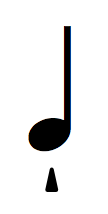 |
staccatissimo | Play extremely short and separated |
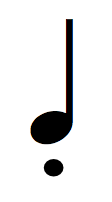 |
staccato | Play short and separated |
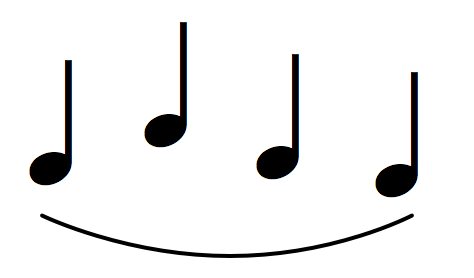 |
legato | Play smoothly, no breaks between notes |
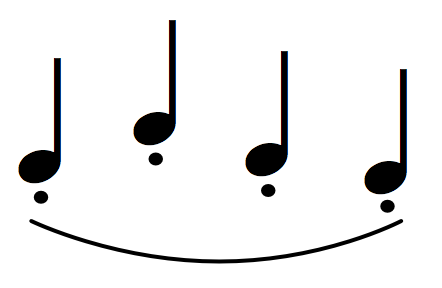 |
portato / mezzo-staccato | Play smoothly but with a slight emphasis on each note |
In reality the possibilities for articulation are endless, and go far beyond what may normally be notated in a score.
Also, while most of the discussion about articulation focuses on the beginnings of notes, it’s worth giving attention to the ends of notes. Do they end suddenly, with a clear, distinct finish? Do they tail off more gradually? Do any other aspects of the sound vary right at the end?
So we can see that varying the start and end of each note with articulation is a powerful way to bring the music to life. But what about that middle part?
The Body Of The Note
Depending on your instrument, you may have thought very little about what goes on between the beginning and end of the note… or you might have spent hours practicing it!
A pianist, for example, has no way to change the timbre of the body of the note after it is played, only the start when they press the key, and the end. On the other hand, wind and brass players are taught a lot about “developing your tone”, and so-called “long notes practice” is traditionally a key part of the practice routine. By changing the embouchure (mouth position) and flow of air through the instrument, a wide range of timbres can be created, independent of how the note starts or ends.
So what’s interesting to note is that, as we’ll explore below, there is both “the timbre of the note” as a whole, which all instruments can control, and also “how the timbre changes during the note”. Every instrument allows expressive choices about timbre by how the start and end of the note is played, and some can also vary timbre during the note’s sustained middle.
Exploring the Timbre of a Note
How exactly we explore timbre varies greatly with the structure and mechanisms of our instruments. Bowed string players adjust the details of their bow arm and finger pressure on the fingerboard. Acoustic guitar players focus on their left hand finger pressure and placement and on the variety of picking and plucking sounds available to them. Electric guitarists, synthesizer players, and DAW producers have a vast arsenal of timbres available to them at the stomp of a pedal, the flick of a button, or the click of a mouse.
If the options seem limited to you at first when thinking about your primary instrument, try thinking about your singing voice instead. Just as we naturally, intuitively know how to express different emotions when speaking, the singing voice is arguably unparalleled in its expressive possibilities, and the exercise below will be very revealing if you try it with your singing voice as well as any instruments you play.
Each timbre possibility we discover and connect with becomes part of our emotional vocabulary in expressing our music.
Unfortunately, sometimes we focus too much on attaining that one “perfect tone” on our instrument. Then as beautiful as that sound may be, we sacrifice the wide potential of emotional vocabulary available to us in changing timbres.
“Emotion” can be thought of as “Energy in Motion”. Indeed, if there is one thing that’s always the same about emotion, it’s that it’s always changing! This is powerful to keep in mind as you explore the possibilities in this chapter.
Timbral changes may be noticed between different pieces of music, different instruments, different styles, as well as within a given piece, or even across a short series of notes.
Let’s start exploring the possibilities with timbre, with the smallest possible unit: a single note.
EXERCISE: Exploring The Timbre Of A Note
|
Using Timbre to Shape a Phrase
Now that we’ve explored the timbre possibilities of an individual note, let’s see what we can do with a whole phrase. Naturally this includes everything we can do with each individual note, but now we can think too about how things change over the course of the phrase.
EXERCISE: Using Timbre to Shape a Phrase
|