


Our gateway into playing expressively will be the idea that there is a musical language of emotion. This language can be learned quickly, and you can “speak” it with your instrument or singing voice immediately, to provide a clear and reliable way for your feelings to be expressed through music. Merely speaking these musical “words” of emotion will automatically create more feeling and connection in both yourself and your listener, something we’ll then explore more in Chapter 18: Performance.
As with any language, it will take practice to achieve skill and fluency in the musical language of emotion. While we will suggest dedicated exercises in this chapter, your progress will increase dramatically if you aim to be expressive in everything you play or sing. That goes from the most “boring” scale or technical exercise through to the most challenging pieces of music you play.
What do we mean by “emotion”? Just like when learning a language, we want to go beyond the most basic vocabulary and have a rich range of expressive possibilities. It is often hard for us as humans to capture emotions accurately with words, and our goal is not to try to conclusively “define” each emotion word with corresponding musical techniques, but for the sake of sketching out an emotional landscape we might want to explore, here are some emotion words you might like to have in mind as we continue:
- Happiness, Joy, Pride, Relief, Cheerfulness, Hope
- Fear, Anxiety, Nervousness, Horror, Panic
- Anger, Irritation, Rage
- Sadness, Exhaustion, Boredom
- Embarrassment, Shame, Disappointment
- Love, Caring, Contentment, Satisfaction
- Excitement, Surprise, Shock, Amazement, Wonder
In the process of learning this language of emotion, you’ll be placing a lot of attention on details. Not just which notes you’re playing, but on the beginning, middle, and end of each and every note.
This attention to shaping everything you play with expression will keep you very busy at first. You may even feel that it is the exact opposite of that free, flowing feeling of just “being” the music which is our goal! However, it is just this intense engagement with the details of musical expression that will unlock an abundant world of musical possibilities for you.
In various contexts throughout this book we discuss the importance of music being a conversation, featuring both “input” and “output”. For example, the Play-Listen/Listen-Play of Expansive Creativity (Chapter 15: Improvisation), the Listen-Engage-Express of the Play-By-Ear Process (Chapter 14: Playing By Ear), the Plan-Play-Reflect of Deliberate Practice (Chapter 6: Superlearning), and the 3 C’s of Performance Free-Flow (Chapter 18: Performance). And if there is a musical language of emotion, we must learn to both understand and speak it!
As we learn this language, we will experience both how the sounds of this musical language of emotion make us feel, which we’ll refer to as “Outside → In”. Then, equipped with this “vocabulary”, we will access our own creativity to start expressing our own emotions musically, which we’ll refer to as “Inside → Out”.
A word of warning: The exercises below involve some wide-ranging exploring and experimenting. More than likely, this will make you uncomfortably aware of how restricted and limited your expressive choices have been until now! Remember Growth Mindset (Chapter 2: Mindset): this isn’t a failing, but rather a wonderful new opportunity for you to have discovered. And as you spend time exploring and experimenting in these ways, you will find your playing automatically starts to become more expressive, as you internalise the musical language of emotion.
Learning The Language
We will start learning the musical language of emotion by familiarising ourselves with how the four dimensions of a musical sound can each be used to shape a musical phrase expressively: Pitch, Rhythm, Timbre and Dynamics.
If you’ve read Chapter 5: Active Listening or Chapter 15: Improvisation, these four dimensions should be familiar! As you read through the explanation of each dimension below, you can use your Active Listening skills to start listening for it in all the music you hear and play each day. What do you notice about the variety of each dimension, the choices being made, and what the possibilities are? As always, it will reward you to keep notes on your observations, and reflect on what you’re learning.
For each dimension we will first explore the possibilities present in a single note, and then how we can use our choices in that dimension to shape a musical phrase. Finally, we’ll practice using all the dimensions together to play the music we love with greater expression.
Phrasing and Expressive Choices
Notes and motifs join together to form musical phrases—larger meaningful groups, analogous to sentences in spoken language. Our musical language of emotion can powerfully shape these phrases, transforming them from a simple series of seemingly-unrelated notes into a cohesive, musically-compelling expression.
In spoken language, we enhance sentences with the sounds of our voices, shaping the words and groups of words with loudness and softness, enunciating more or letting words run together, speeding up or slowing down… and so many other sonic and visual enhancements, including our facial expressions and body language.
So we can see that in verbal communication, the actual words are only a part of the picture. All these things and more work together to express very precise shades of meaning and emotion. In the same way, in music the “dots on the page” are only part of the picture. The four dimensions of a musical sound which we’ll be exploring can all be used together to infuse meaning and emotion into each musical phrase.
As we explore, you will notice that certain choices seem to go together naturally. For example, have you noticed a tendency to play louder when you play faster, or slow down when you play more quietly? When playing scales, do you tend to grow louder as the notes go up? Maybe softer as they descend?
Challenging ourselves to create new and sometimes unexpected combinations can result in some really special musical moments. Slow does not always have to equal quiet, and fast does not always have to equal loud. Sometimes mixing and matching the energies that it takes to play with these different qualities of music can result in a new way to express something that we haven’t quite been able to before.
Finding (or Choosing) the Phrasing in Music
When listening to music, we naturally recognise the phrasing i.e. which notes group together, especially in the melody. Through years of experience, as well as our inbuilt biological capacity for understanding spoken language, we instinctively interpret all the variations in Pitch, Rhythm, Dynamics and Timbre to recognise when one musical “sentence” has ended and the next one is beginning.
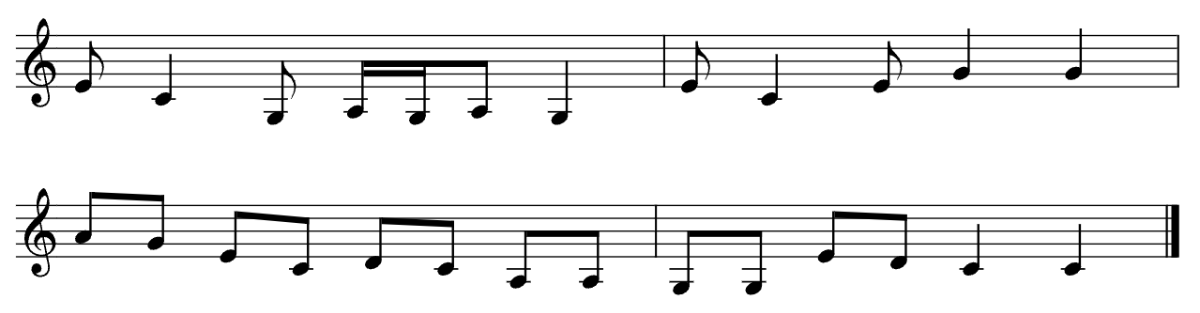
When reading music notation, that process is not always so easy. Our written music divides into regular groups of notes, shown with vertical bar lines in staff notation, but these do not necessarily line up with the phrasing at all! For example, looking at this score, it may be difficult to tell at first glance where the phrases begin and end and how many there are:
When we add the lyrics to this score, we can now easily see how the musical phrases line up with the phrases and sentences of the lyrics, where each starts and ends, and when it would be appropriate to pause, take a breath, articulate differently, or do something else to express each phrase:
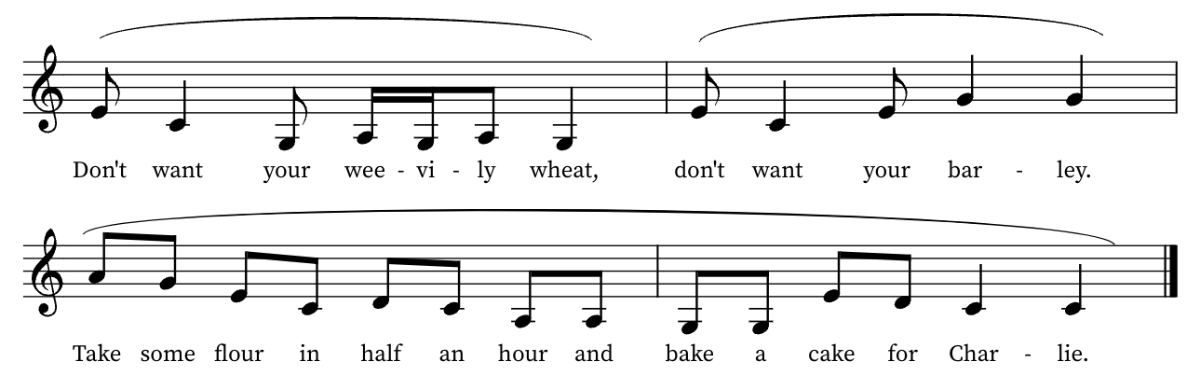
With instrumental music notation, we do not have the luxury of lyrics to guide us in our phrasing, so often the first task to playing expressively is to decide for ourselves where the phrases lie. Looking for longer notes, resolutions and rests can all be clues, but sometimes the phrasing is really open to interpretation.
We can discover through exploration how we wish to shape our phrases with all our expressive musical language. In the exercises which follow you’ll have the chance to try this with each of the four dimensions individually, as well as all together.
Explore and Experiment
The spirit of all of the exercises which follow is to explore and experiment.
Our goal is not to “find the answer”, but rather to “explore the possibilities”. Some things may sound terrible to you, while others make you think “gosh, I should always play it like that!” This is a great opportunity to start acknowledging and valuing your own aesthetic judgements. There are no “right” and “wrong” answers here. Playing expressively is all about your own musical taste and intention.
It’s also important to keep in mind that the note-by-note microscopic attention and experimentation is not something you will necessarily carry out for every piece you play in future! As you learn the language of emotion, these choices will become more and more instinctive for you.
| TIP: As you go through this chapter, the expressiveness of your playing will naturally increase. You might like to create a before-and-after comparison, to help you see how far you’ve come by the end: 1. Choose a piece you can play comfortably. Before you continue through this chapter, record yourself performing the piece. 2. Then, after trying the various exercises in this chapter, perform and record the piece again, aiming to make use of some of the techniques and ideas you’ve learned and practiced. 3. Compare the two recordings to see how the expressiveness of your playing has increased! |
The exercises are designed to help you experience both “Outside → In” (hearing and appreciating the emotions created by certain musical choices) and “Inside → Out” (expressing emotions yourself, through your own musical choices).
To avoid repeating the same guidance and suggestions each time, here are some pointers to help you get the best results with the exercises:
General Guidance
- As you do each exercise, try to stay as present and mindful as you can, both of the physical movements you’re making, and the sounds you’re hearing. Leverage all four H’s: as you read through the sections below, you’ll be equipped with information and knowledge about what’s possible (Head). You will be given instructions in the exercises about what to try (Hands). And you will have the opportunity to bring your attention to the sounds created (Hearing) and emotions evoked (Heart).
- If you play multiple instruments, try each exercise with each instrument, and see what commonalities and differences emerge. Repeat the exercises with your singing voice too. You may find it much easier to express the emotions! Pay attention to the choices you’re making, both instinctively and consciously. Then repeat the exercise on an instrument and see what you can “translate” across from what your singing voice has revealed.
- Record yourself doing the exercises with an audio recorder or (even better) a video camera, and listen or watch back. It can be hard to realise in the moment everything we’re doing and every aspect of the sounds created. When we watch or listen back we can learn even more.
- Make notes of your discoveries. These may be certain aesthetic choices (e.g. “I love how this song comes out when I play with a broad timbre and legato articulation”) or rules of thumb you’re noticing are helpful for you (e.g. “For playing quieter, it really helps to loosen my grip a little”, or “I tend to make the notes more disjointed in fast passages than I mean to—remember to play through from one note to the next.”)
Single-Note Exercises
For exercises which invite you to choose a single note to work with:
- Don’t overlook or rush through these! Although we typically think about “playing with expression” as it applies to whole phrases or pieces, it all boils down to our note-by-note choices. Until today, if somebody asked you to “play a C”, you would likely have played a C, and thought that if you played the correct pitch, you’d done the job. As you explore the expressive possibilities of all four dimensions, possibly using various instruments and your singing voice, you’ll discover that there is a vast universe of what “playing a C” can sound like, and the musical effect created.
- Repeat the exercise, choosing a different note each time. Notice how the options available to you and the playing technique required to produce them may vary across your instrument’s range.
Phrase-Based Exercises
For exercises which invite you to choose a musical phrase to work with:
- Choose phrases which are well within your currently abilities, so that your full focus can be on the expressive explorations, rather than needing to devote some attention purely to “playing the right notes”. Remember that it’s better to play a very simple phrase with great expression than a fast, complex phrase robotically!
- Choose phrases of one or two measures. That typically means roughly 4-8 seconds in duration.
- Once you feel like you’ve explored a given phrase enough, repeat the exercise with another one. This can be from the same piece or a different piece.
- Try to select phrases from songs or pieces which you think are expected to convey a wide range of emotions. It can be enlightening, for example, to try a phrase from a fast, heavy rock song and then one from a soulful love ballad. This will help you to explore more widely and experiment more freely, helping you become fluent in the full musical language of emotion more quickly and easily.
We are now ready to start learning the musical language of emotion, by exploring the expressive possibilities of each of the four dimensions in turn.