


So far we’ve introduced the Rhythm Syllable building blocks of Ta, Ti-Ti, Tika-Tika, Ti-Tika and Tika-Ti. These alone can take you a long way! They cover the most common ways of subdividing a beat in simple meter, which as you may recall from Chapter 12: The Beat means subdividing the beat into two even parts. They correspond to rhythmic patterns featuring quarter, eighth and sixteenth notes.
But what if we wanted an eighth note sandwiched between two sixteenth notes? And what about compound meter, subdividing the beat into three even parts?
Let’s add some more Rhythm Syllable building blocks to our toolkit. You can practice with these using any of the exercises covered so far, simply by introducing them as new possible choices in your rhythmic patterns.
Too
Nice and simple: a note which lasts for two beats can be expressed with the rhythm syllable “Too”:

(Stick Notation just uses the traditional staff notation symbol for a half note)
Remember to hold the syllable for the full duration of the two beats!
Syncopation and SynCOpa
In Chapter 12: The Beat we emphasised the prime importance of the Beat, and how it allows the listener to make sense of musical rhythms and orient themselves in time, anticipating when notes are likely to occur.
As always in music though, there is as much creative power in defying expectations as in meeting them! When we place or emphasise notes at unexpected times, it’s referred to as syncopation. The use of syncopation varies across genres. For example, it was relatively rare in Western Classical music but very common in jazz, and has become so common in mainstream pop and rock music over the years that to describe it as “unexpected” is now somewhat misleading!
So syncopation isn’t about doing something so odd and unusual that the listener is consciously surprised by it—but rather, just a diversion from the strict placement of notes on beats and subdivisions which we’ve considered so far. If we see that “grid” of beats and measures (with the first beat of each measure being emphasised) as being what the human body and ear “expect” rhythms to align to, then syncopation is when notes are timed or accented differently to that.
We’ve already experienced a form of syncopation in the previous chapter, in the exercise where you were invited to try clapping early or late, compared with the pulse. You will have experienced how unsettling—but also exciting!—this can feel.
Syncopation can occur on multiple levels. Beat-level syncopation is achieved by emphasising the beats that are normally “weak”. Remember from Chapter 12: The Beat that in most genres, beat 1 is usually the strongest. So:
- In duple meter, emphasising beat 2 creates syncopation.
- In quadruple meter, emphasising beats 2 and 4 create syncopation.
- In triple meter, emphasising beats 2 and 3 create syncopation.
Let’s experience this effect:
EXERCISE: Beat-level Syncopation
|
Division-level syncopation happens when the rhythmic emphasis falls on a beat subdivision rather than the start of the beat. Again, this can mean notes are placed “off the beat” or that the notes which are off the beat are the ones which are emphasised.
EXERCISE: Division-level Syncopation
|
This demonstrates division-level syncopation through emphasising notes. What about by placing the notes at unexpected times?
Probably the most common rhythmic pattern of this kind is a shorter note on the beat, followed by a longer note, so that the longer note is the prominent one but is displaced slightly later than the beat.
The rhythm syllable we can use to represent this is, fittingly, called “synCOpa”. It is said with a short “syn-“, a longer and emphasised “-CO-“ and a short “-pa”. For example, the pattern just mentioned, of a quarter note sandwiched between two eighth notes can be written like this:

This pattern can be found in “Weevily Wheat” in the Starter Songs in [Chapter Nine Solfa][Chapter Nine], for example.
Try one of the earlier improvisation-based exercises, including synCOpa in your creations! Start simple, for example “Ta, Ta, synCOpa, Ta, Ta, synCOpa, …” and really pay attention to the more interesting, jazzier sound and feeling it creates:

Unlike the rhythm syllables covered so far, synCOpa can be used at different levels of granularity. The same spoken pattern can be used to represent an eighth note sandwiched between two sixteenth notes, for example:

Tri-po-let
Another way to mix things up compared with the strict rhythmic grid is to divide a simple-meter beat into three equal parts instead of the expected two. This is called a triplet.
Triplets are often a real challenge for musicians to learn to make sense of and play! Fortunately, this is a great example of the strength of Rhythm Syllables over the traditional approach.
Our building block for triplets is actually the word itself, but pronounced as three syllables: “Tri-po-let”. Like synCOpa, the Rhythm Syllable Tri-po-let can be used at different levels of granularity, for example eighth-note triplets which fill one beat:

Or sixteenth-note triplets which fill half a beat:

Or quarter-note triplets which span two beats:

Notice how even though it might look a little awkward to span two Beat Blanks like this, it actually makes it much clearer how the notes of the triplet are timed, relative to the Beat—something that’s often very confusing for musicians with traditional score notation.
Tam-Ti and Tim-Ka
You may be familiar with the idea of “dotted notes”. In traditional score notation, one can extend the duration of a note by half its original length again by writing a dot after the note symbol. For example, a dotted quarter note lasts 1½ beats. The remaining time left by that “half” can be filled either with another note or with a rest.
Remember that we can handle rests by audiating the Rhythm Syllables, entirely or in part. And so our building blocks are:

The dotted quarter note followed by an eighth note is Tam-Ti Sometimes Tai-Ti or Tum-Ti are used instead, but we prefer Tam-Ti for consistency of adding the “m” to imply the dotted version. and the dotted eighth note followed by a sixteenth note is Tim-ka. The order can also be swapped, producing Ti-Tam and ka-Tim:

Take some time to play around with these new rhythm syllables. In particular notice how the Ti-Tam and ka-Tim patterns create a syncopated feel.
Swinging the Beat
If you experimented with a series of Tim-ka’s you might have noticed it reminded you of something else. Rather than our brain interpreting it as dotted quarter notes followed by eighth notes over a steady beat, you may have started to feel it as expressing a steady Ti-Ti rhythm, but with a swing feel.
You’ll often hear musicians refer to “swung rhythms”, “swing rhythms” or “shuffle rhythms”. In fact it’s not just the Rhythm which is swung in genres like blues, country and jazz—it’s the Beat itself.
In duple or quadruple meter, instead of the beat’s subdivision in two being two parts of equal duration, they follow a pattern of long and short pairs: looong, short, loooong, short, loooong, short, loooong, short.
EXERCISE: Straight to Swung Beat
|
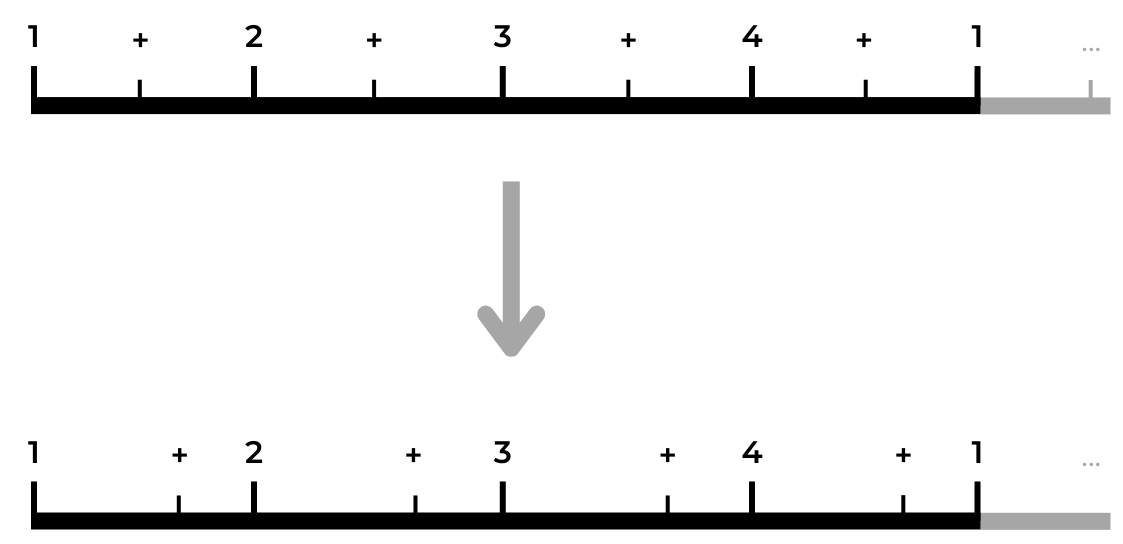
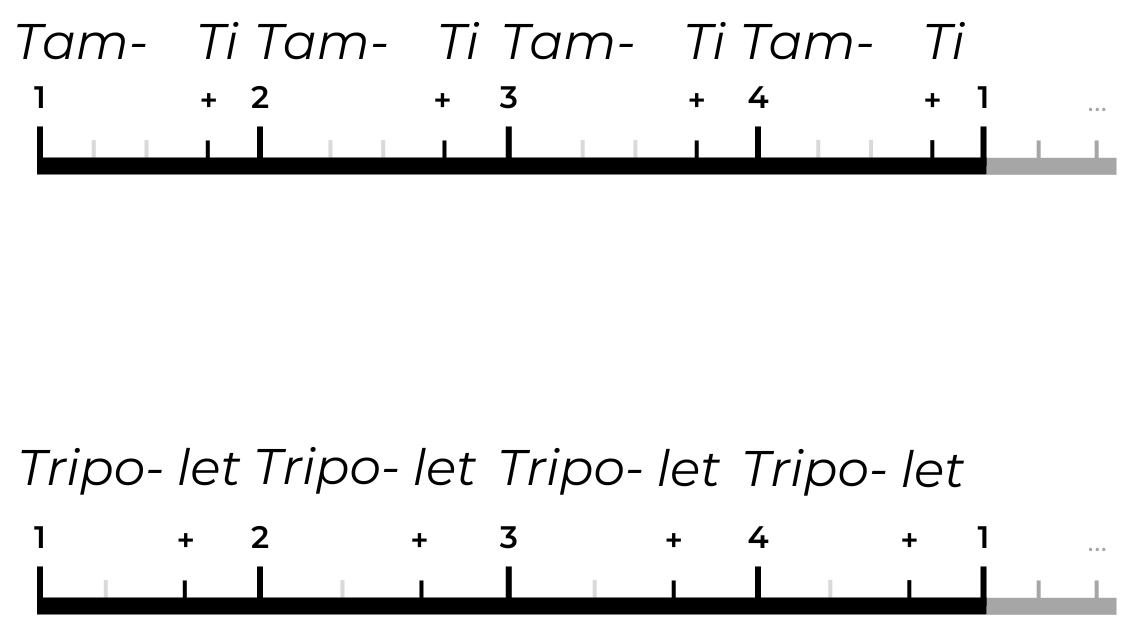
Swing is really something you feel more than think through. So although the rhythm syllables suggested above can help ease you into it, don’t get caught up trying to “translate” the normal rhythm syllables of a rhythm into swung equivalents! It’s a shift in the way you feel the Beat, which you then express the same rhythm on top of. You’ll find some examples of turning a straight-Beat melody into a swung version in the Additional Resources.
| TIP: One of the easiest ways to feel a swung beat is by thinking about skipping rather than walking. We walk down the street with steady left-right-left-right timing, suitable for expressing a straight beat, as we experienced in the previous chapter’s exercises. But if you were to skip along the street instead, the timing would become more like riiiiiiiight-left, leeeeeeft-right, riiiiiiiight-left leeeeeeft-right, etc. It naturally creates a pattern of long/short subdivisions for us, suitable for a swung beat. So if you’re having difficulty understanding, feeling, or expressing a swung beat, or if the final step of the exercise above (where you try playing a piece or song swung) is tricky for you… Skip around the room, and try it again! |