Just like with our Pitch building blocks, improvising can be a fun and effective way to really familiarise ourselves with these new building blocks for Rhythm, as the simple Garden Gate exercises above demonstrate.
Now let’s incorporate some of the movement-based exercises we explored in the previous chapter on The Beat to take our rhythmic creativity even further.
EXERCISE: Rhythm Dance with Rhythm Syllable Improvisation
- Create a steady Beat at a moderate tempo, using the Rhythm Dance introduced in the previous chapter (reminder: out with left foot on 1, bring right foot to meet it on 2, out with the right foot on 3, bring left foot to meet it on 4).
- Begin by counting the Beat: “one, two, three, four”
- Now substitute Ta for the numbers: “Ta Ta Ta Ta”
- Next move through each of the rhythm syllables introduced so far: “Ti-Ti, Ti-Ti, Ti-Ti, Ti-Ti” then “Tika-Tika, Tika-Tika, Tika-Tika, Tika-Tika” then “Ti-Tika, Ti-Tika, Ti-Tika, Ti-Tika” and finally “Tika-Ti, Tika-Ti, Tika-Ti, Tika-Ti”. Pay attention to keeping things synchronised and notice how the feel of the rhythm changes depending on the syllables you use.
- When you’re ready, start mixing it up. You can ease in by just changing the syllable on one of the beats of the measure, for example “Ta, Ta, Ta, Ti-Ti”, and expressing the same pattern for the measure several times before changing it again.
- Explore all different combinations of the rhythm syllables. Have fun with it!
- If you’d like to, feel free to change from quadruple meter (four beats to a measure) to triple meter (three beats to a measure).
|
Notice how easy these building blocks make it to create very varied and interesting rhythms! For example “Ta, Ti-Tika, Tika-Ti, Ti-Tika” is a rhythm you might have found tricky to sight-read or come up with when improvising before, but using these syllables it’s an easy creative choice to make.
If you have difficulty with this exercise, you can use clapping instead of the full Rhythm Dance to begin with. Just clap your steady beat and speak your chosen syllables. Go as slowly as you need to, giving your brain time to make the choice for each beat—just remember to keep the slow beat nice and steady, so that the rhythms exist over a pulse rather than becoming disjointed.
You should naturally find yourself starting to be able to “think ahead” to the rhythms you’d like to express in the next measure. This is a great step forwards in being able to improvise creatively on-the-fly.
Our next step is to use the Rhythm Syllable building blocks without speaking them aloud.
EXERCISE: Rhythm Improvisation
- Use either simple stepping on the spot, or the full Rhythm Dance if you’re comfortable with it, to express a steady Beat at a moderate tempo.
- Now start to clap on each beat, thinking Ta in your head with each one.
- Next move on to a few measures of clapping Ti-Ti’s, then Tika-Tika‘s, and so on. Notice how audiating the corresponding rhythm syllables makes it easy to know how your claps should be timed—most likely easier than just thinking “I need to sub-divide each beat in four”, for example.
- When you’re ready, start mixing up your rhythm syllable choices, to express your own rhythmic ideas!
- Once you’re comfortable doing this with clapping, select a single note on an instrument you play and repeat the exercise playing that note. Start again with just a single building block at a time, getting the hang of each before starting to mix them up and be creative.
- If you’d like, you can try switching to an external source of the Beat, for example a metronome, a music track with a prominent pulse, or a drum loop (as mentioned in the previous chapter).
|
Remember to focus on feeling and hearing. The beauty of the Garden Gate exercise (and Rhythm Syllables in general) is that they’re so simple, you free up mental capacity and can really focus on the sound and the physical experience of the rhythms.
In Part III we’ll discuss creativity and Improvisation much more. For now, just know that any time you feel inspired to go beyond the instructions or “rules” of a creative exercise like this, you are very welcome to! For example, if you’re enjoying improvising rhythms using one note and you want to introduce a second note, and a third, feel free. You may find yourself starting to improvise quite interesting and creative music, just with these simple building blocks.
EXERCISE: Rhythmic Scales
- Grab your instrument, and express a steady Beat at a moderate tempo using your body. Depending on your instrument, you may be able to step on the spot or use the Rhythm Dance, or just use foot-tapping or head-nodding.
- Play up and down a scale on your chosen instrument with one note per beat.
- Now go through the same steps as before: use each rhythm syllable in turn and play a note of the scale on each note of the syllable. For example, with a C Major scale and the Ti-Tika building block you would play C on the first Ti, D on the Ti- of Tika, then E on the –ka, all within the first beat of your pulse. Then the F on the next Ti, G on the Ti– of the Tika, A on the -ka, and so on:

- Remember to audiate the rhythm syllables (hear them in your head).
- When you’re ready, start mixing up the syllables you use!
|
If you’ve read Chapter 6: Superlearning, you may recognise this as a form of Contextual Interference. So don’t be surprised if you fumble the scale a bit at first! You are challenging your brain in a new way. Not only are you gaining proficiency with these rhythmic building blocks, you are also developing a more resilient and versatile ability to play the scale and its corresponding fingering.
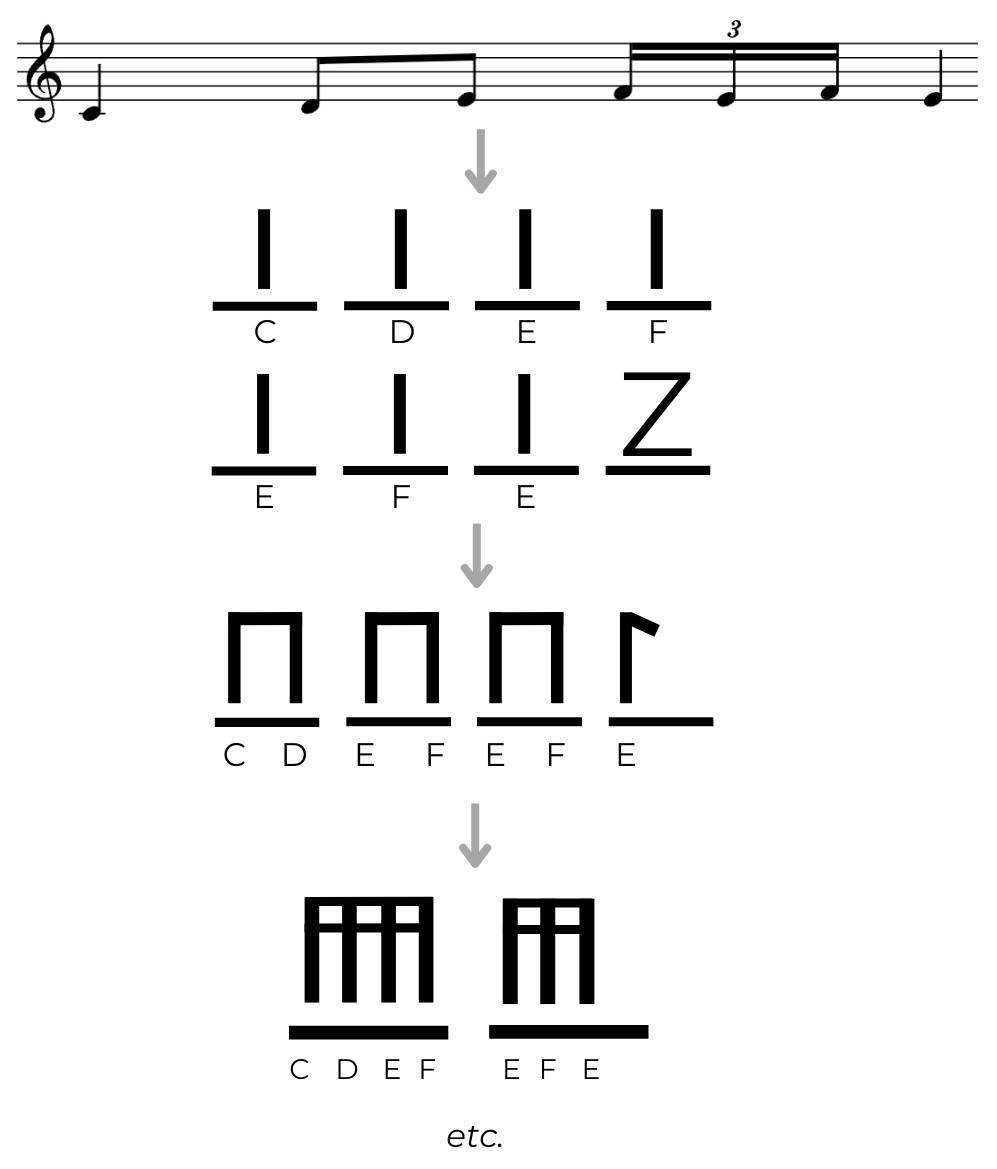
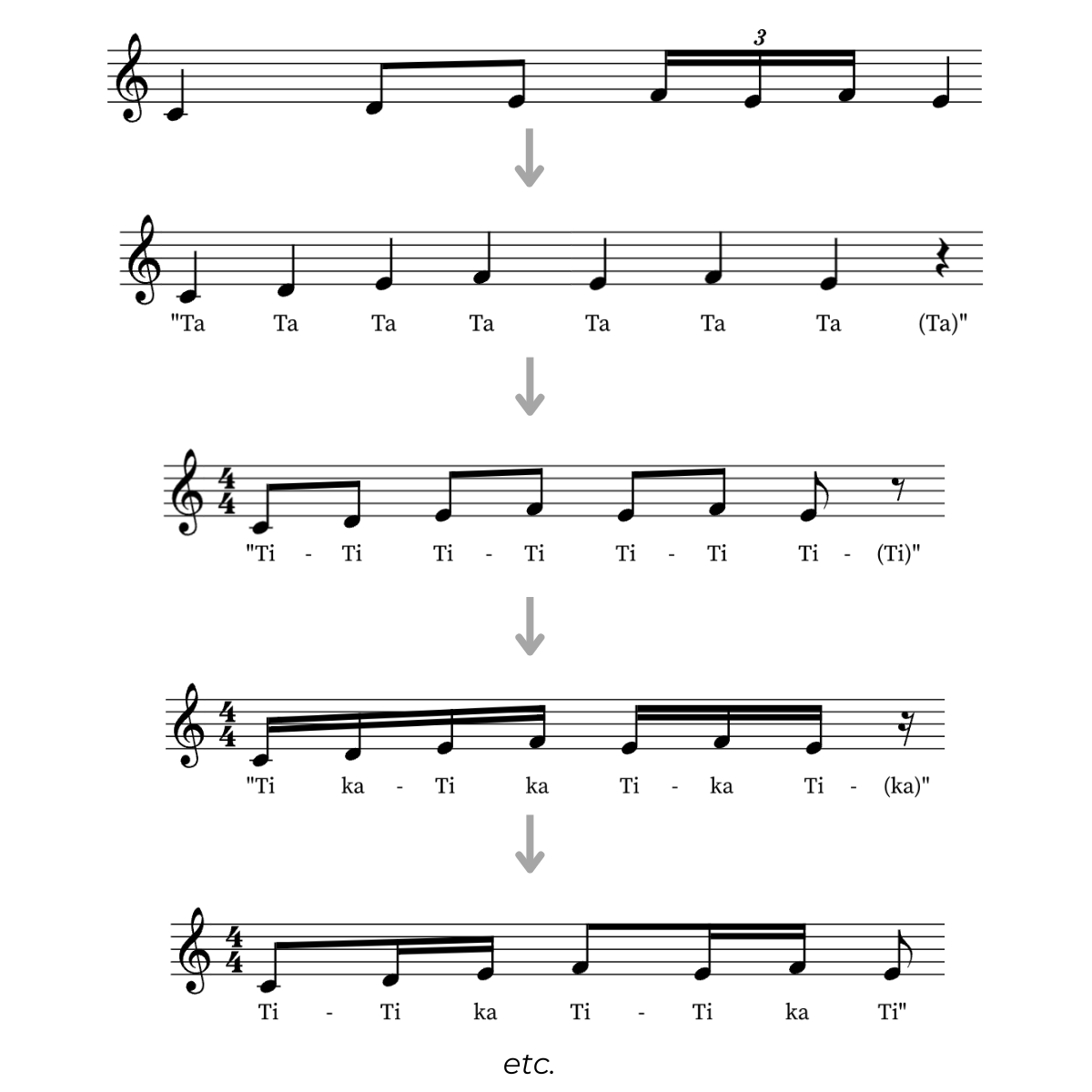
EXERCISE: Rhythmic Improvisation with a Melody
- Select a short melody (say, two measures) which you are comfortable playing. It will help to have the notation in front of you.
- As before, express a steady Beat at a moderate tempo with your body, in a way that’s compatible with your instrument.
- Play through the melody with the rhythms as written.
- Now “straighten out” the rhythm by replacing every note’s duration with Ta i.e. playing one note per beat.
- Next move on to the other building blocks in turn i.e. playing through the melody pitches on Ti-Ti’s, then all Tika-Tika’s, Ti-Tika’s, etc.
- When you’re ready, start mixing up the building blocks to improvise your own rhythms for the melody pitches.
Example using Stick Notation:
Example using Staff Notation:
|
This is an example of the “Constraints and Dimensions” part of the Expansive Creativity framework you’ll learn in Chapter 15: Improvisation: we are constraining the Pitch dimension by using the given series of note pitches, allowing us to freely explore the Rhythm dimension in interesting ways.
EXERCISE: Composing Rhythms
## 1. 1. Draw a line of four Beat Blanks:

- Using the Stick Notation corresponding to our Rhythm Syllable building blocks, write a rhythm. You might like to also write the rhythm syllables underneath. Example:

- Now try performing the rhythm you composed by speaking the rhythm syllables!
- Repeat this using different combinations of rhythm syllables.
- When you’re ready, try a Call-And-Response improvisation: First perform your measure as written, then improvise one measure with rhythm syllables. For example if you wrote “Ta, Ta, Ti-Ti, Ta” you might follow it up with “Ta, Ti-Ti, Ti-Ti, Ta”. Write down your response in Stick Notation afterwards.
|
This is a great way to become more fluent with the correspondence between Rhythm Syllables and the Stick Notation representation, as well as bridging the gap between Improvisation and Songwriting.
You can also make good use of the Starter Songs included in Chapter 9: Solfa which are shown with Stick Notation and feature all the rhythm syllables we’ve covered so far, as well as some from “Going Further” below. Looking at the Stick Notation, can you figure out the corresponding Rhythm Syllables and speak them aloud? You can check yourself against the traditional staff notation also provided, or the recordings included in the Additional Resources.
Then, when you’re ready, try the reverse, going from sound to symbol:
EXERCISE: Transcribing Rhythms
- Listen to a short melody which seems to have a simple rhythm. You can start with recordings of the Starter Songs from Chapter 9: Solfa which all use only the rhythm building blocks introduced so far.
- Echo back the rhythm of the melody using a neutral sound like “bah”.
- Now use your familiarity with Rhythm Syllables to determine which syllables correspond to the pattern of bah’s you spoke.
- Repeat the rhythm in rhythm syllables and then write it down in Stick Notation. Perform it from the transcription you just created, and compare with the original to see if you got it right. If you’re using a song from the Starter Songs you can also check back against the Stick Notation provided there.
|


