


The auditory processing system of the human brain has considerable overlap between how it processes spoken language and how it processes musical sounds. The big idea with Rhythm Syllables is to leverage our brain’s capacity for language, and your lifetime of prior experience subconsciously and automatically recognising rhythmic patterns in speech.
Instead of a notation-first approach where we try to figure out analytically how a series of written symbols should sound, Rhythm Syllables take a sound-first approach, assigning a spoken syllable (or combination of syllables) to each building block of rhythmic patterns.
You may have come across the idea of using a spoken word or phrase to help you remember the rhythm corresponding to different note symbols, such as “ap-ple” for a pair of eighth notes and “wa-ter-me-lon” for a series of four eighth notes together.
Let’s try using that simple idea to create our own rhythms:
EXERCISE: Garden Gate
|
You have just improvised rhythms using quarter and eighth notes! Simple as it may seem, this has been a breakthrough moment for many members inside Musical U, realising that the intimidating skill of “improvising” could actually feel easy and natural for them. And this is just the beginning…
This simple exercise demonstrates how our spoken language skills can provide a gateway into the musicality of Rhythm. We can see how our Hands, Hearing and Heart can be immersed in rhythmic creativity, with literally zero Head knowledge required!
This informal approach of using random words which naturally have various rhythmic patterns is illustrative—but has limitations.
The Rhythm Syllables approach is similar, in the sense that you can look at written rhythms and speak aloud how they would sound, but there are two important differences from that informal approach:
A. The syllables we use are consistent across each rhythm pattern (just like how with Solfa we use a single, distinctive name for each note of the scale), and
B. The syllables are devoid of any additional meaning which would engage the linguistic part of the brain and distract from the pure rhythms.
There are a few established systems of Rhythm Syllables in use today, including the Konnakol approach which is core to Indian music traditions. We’ve found that the Kodály ones we’ll introduce here are a very effective balance of being immediately-usable while still complex enough to allow for sophisticated rhythmic development.
Just like naming notes with Solfa rather than letter names brought us closer to the sounds and to the way the brain naturally interprets Relative Pitch, these Rhythm Syllables reflect the actual musical sounds rather than the mathematical theory of rhythm (e.g. “quarter note plus two eighth notes”) or visual symbols in traditional notation (e.g. a quarter-note symbol followed by two eighth-note symbols). This helps us gain an instinctive, physical understanding of rhythm, and connects Head, Hands, Hearing and Heart.
Once you learn and practice Rhythm Syllables, as well as the corresponding Stick Notation, you will be able to use these building blocks to easily create rhythms, interpret written rhythms, and write down rhythms you hear.
Building Blocks of Rhythm
In the previous chapter we introduced Stick Notation as a simplified way of writing rhythmic patterns over a set of Beat Blanks. For example, here’s how we would show a steady pulse, clapping or playing once per beat:

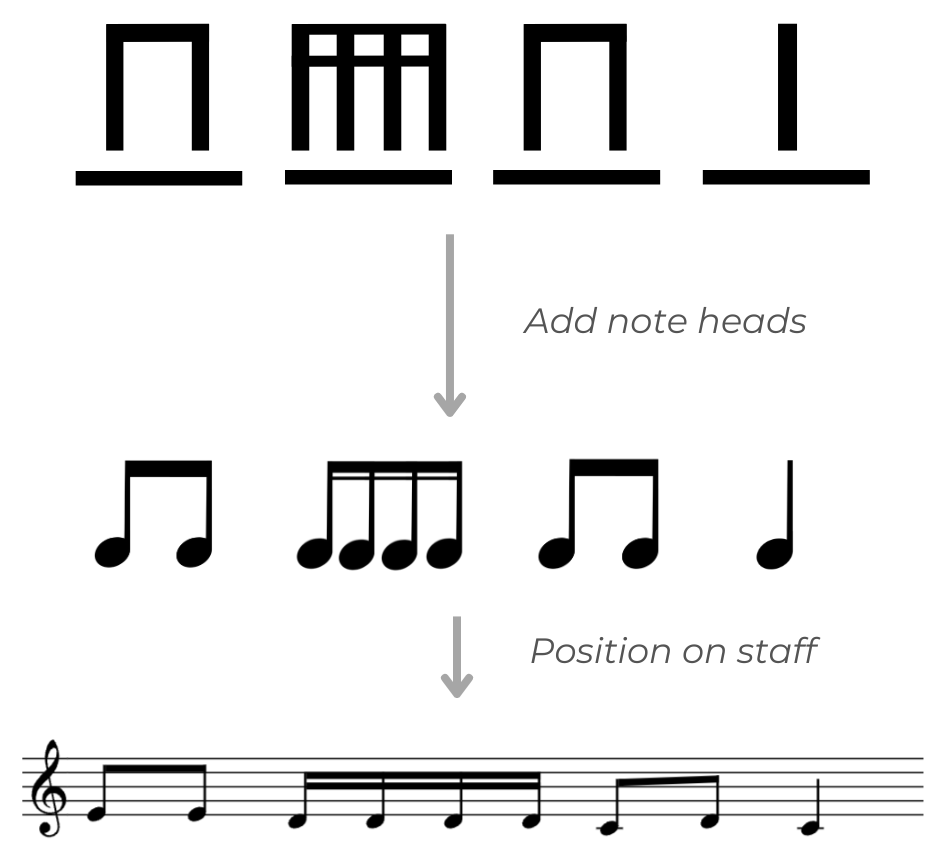
As a reminder, this is a simple, fast way to write rhythms, which is essentially the traditional score notation but with staff lines and note heads removed (i.e. stripping away the Pitch dimension entirely). This means you can easily extend Stick Notation to full notation simply by adding the note heads and placing the notes at the right vertical location on the staff:
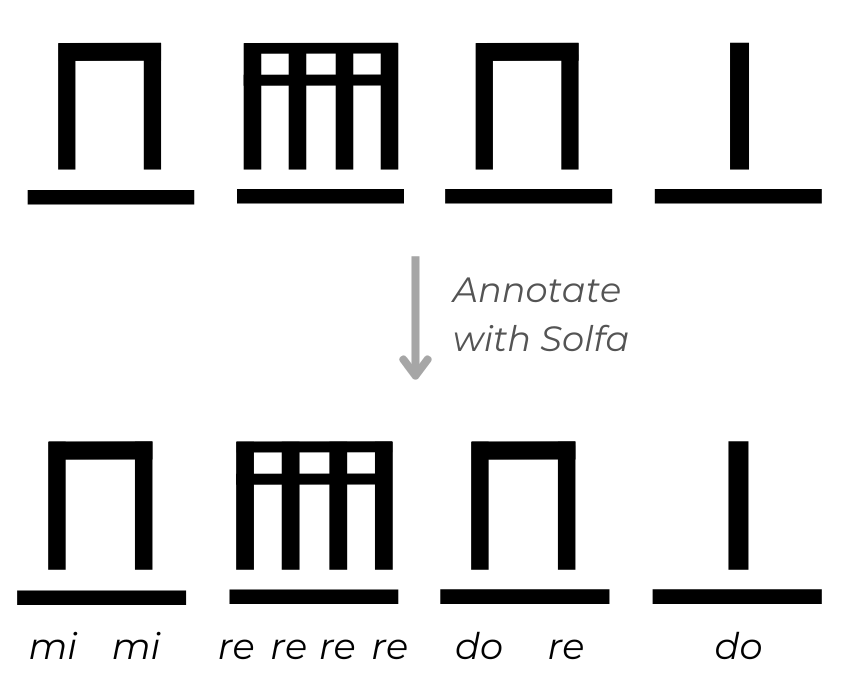
Or even just by annotating below with the Solfa syllable of each note:
Now we’ll introduce the Rhythm Syllable building blocks, using Stick Notation to illustrate each one.
Ta
Ta is the rhythm syllable we’ll use to represent a note that is one beat long:

You would speak this as “Ta Ta Ta Ta”, with each “Ta” synchronised with the Beat. For example, if you were stepping or clapping the beat, you would say “Ta” each time you stepped or clapped.
We can show a one-beat rest with the symbol “Z”. For example, here’s how we could represent clapping on beats 2 and 4 only:
If you were speaking this rhythm you could speak the “Ta” of the rest in your head (i.e. audiate it): “(Ta) Ta (Ta) Ta”.
Ti-Ti
Our next building block is “Ti-Ti” (pronounced “tee tee” with a long “e” sound) and represents subdividing the beat into two equal parts:

If there’s need for a single “Ti” rather than a pair, it’s written like this:

EXERCISE: Garden Gate With Rhythm Syllables
|
We will introduce some more rhythm syllables below, but you would do well to practice with just these two for at least a few days, if not a week. You can play with this “Garden Gate with Rhythm Syllables” exercise and also make use of the Starter Songs from Chapter 9: Solfa which use only Ta and Ti-Ti. Look out for Ta’s and Ti-Ti’s in the other music you’re working on! Any quarter note can be spoken as a Ta and any eighth note pair as Ti-Ti.
Tika-Tika
Next, to subdivide the beat into four equal parts, we use “Tika-Tika”, with a short “tih” sound this time (unlike the long “tee” of “Ti” in Ti-Ti). Here is the stick notation for four beats of sixteenth notes:

You might wonder why we write this as “Tika-Tika” rather than “Ti-Ka-Ti-Ka”. It both helps distinguish the “ti” of “Ti” from the “ti” in “Tika” and more clearly opens up combinations of eighth and sixteenth notes, which we can express as “Ti-Tika” and “Tika-Ti”:

EXERCISE: Rhythmic Improvisation with Tika-Tika, Ti-Tika, and Tika-Ti
|
Notice how sophisticated your rhythmic creations can be already, just with this small number of building blocks! If you look at the Stick Notation of the Starter Songs in Chapter 9: Solfa you’ll notice how many of them use only these building blocks.