


Now that you’re familiar with how Solfa works, let’s look at some ways you can start practicing with Solfa, and developing your ability to both produce and recognise notes using Solfa.
Solfa Practice
Here are some exercises which we’ve found particularly effective, for daily development and reinforcement of Solfa skills. With all of these, you can use any toneset you like. Your goal may be the full major scale, but starting out with just do, re, mi and gradually extending to the pentatonic and beyond will help ensure you don’t get overwhelmed or frustrated unnecessarily.
You can watch a video demonstration of each of these exercises taken from inside Living Music in the Additional Resources.
EXERCISE: Sing Solfa ScalesAs we’ve already explored in earlier exercises, simply singing up and down the scale with solfa syllables is an important foundation for Solfa Ear Training.
This could begin with just the drm toneset: do re mi re do. Then build to:
|
While it may seem like this isn’t “testing” your ear in the way other Ear Training exercises do, in fact by requiring yourself to produce the right pitches for each solfa syllable, you are implicitly training your ear to know how they should sound.
This is even more powerful if you add hand signs, or introduce the variations below, which can all usefully be begun by singing up and down the scale you’ve chosen to use for them.
Once you’re comfortable singing up and down a given scale in stepwise motion (i.e. no notes skipped), you can try the following exercise:
EXERCISE: Audiate the In-Between “Stepping Stone” NotesThis is both a useful practical technique and a standalone practice exercise. For a scale you can comfortably sing in Solfa step-by-step, try picking certain notes to omit. When you get to that note, instead of singing it, audiate it (imagine it in your mind’s ear—see Chapter 3: Audiation for more). |
This is a fantastic stepping stone to being able to jump around the scale from any note to any other. It’s also a really handy technique when you’re using Solfa to play by ear or transcribe, since in the context of a given melody, you might not immediately recognise a note—but if you can sing up in your mind from do to that note’s pitch, you have an easy way to identify it in two steps.
If you’re practicing with hand signs, you can still make the sign for the audiated note—and in fact, this is a great showcase for the power of Hand Signs, as you’ll start to find that physical “cue” of making the right hand sign helps you start jumping straight to the note you need.
If you want a great, fun, and creative way to really get intimately familiar with the solfa notes, look no further than the next exercise. This is probably my favourite solfa practice exercise, and the one which had the biggest impact for me as I learned Solfa.
EXERCISE: Improvise Melodies in Solfa
|
If you enjoy this exercise, here is a more advanced version:
EXERCISE: Sing “One of Everything” Melodies in Solfa
For example, if you’re using the minor pentatonic (la do re mi so la’) you might improvise any of the following melodies: la mi re do so la’ la’ do so re mi la mi re do la la’ so As you can imagine, this really puts your skills to the test! But the lovely thing about it is that it’s up to you how ambitious to be. You can begin with mostly stepwise motion, and you can take your time to decide each next note (e.g. to audiate the “stepping stone” notes as in the previous exercise). |
The next exercise is a trickier one, but very powerful. As you’re aware by now, Solfa is all about relating things to the tonic. For most musicians, most of the time, the music will be in a major key and that tonic is going to be do. You therefore get a lot of “bang for your buck” by really practicing the relationships of each note to do.
EXERCISE: Sing Each Interval From do
|
Remember that you don’t need to start with the full major scale! You might begin practicing this exercise with just do, re and mi, and including the repeated do for completeness: do do… do re… do mi… do re… do do…
If you’re a comfortable singer then this should be “so simple you cannot fail”. If you do find it tricky, use an instrument to play the notes along with your singing for reference and/or use the audiation technique from #2 to help with the skips.
| Zac Says… I like to call this “solfa pivots” and find that it’s very powerful to do from all notes in a toneset, and then add more notes to the toneset. For example: dd dr dm rr rd rm mm mr md Once that’s comfortable, add in so or fa, and do all the “pivots” again. |
For bonus points (and to help you start making connections to the Intervals approach we’ll cover in the next chapter) you might like to sing the Solfa, then sing the corresponding interval name:
EXERCISE: Sing And Name Each Interval From do
|
For the major pentatonic toneset, going up from do you would sing:
do re, major second
do mi, major third
do so, perfect fifth
do la, major sixth
do do’, perfect octave
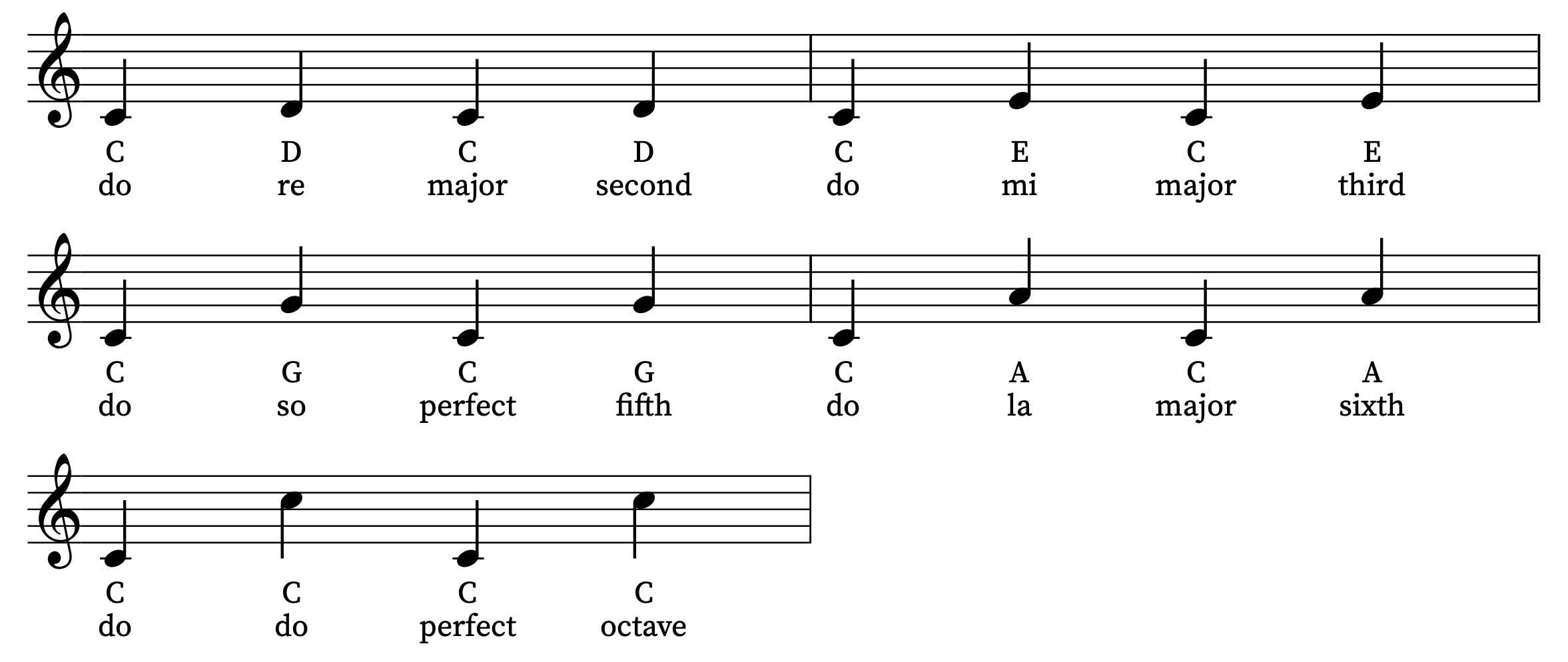
And coming down from do’ you would sing:
do’ la, minor third
do’ so, perfect fourth
do’ mi, minor sixth
do’ re, minor seventh
do’ do, perfect octave
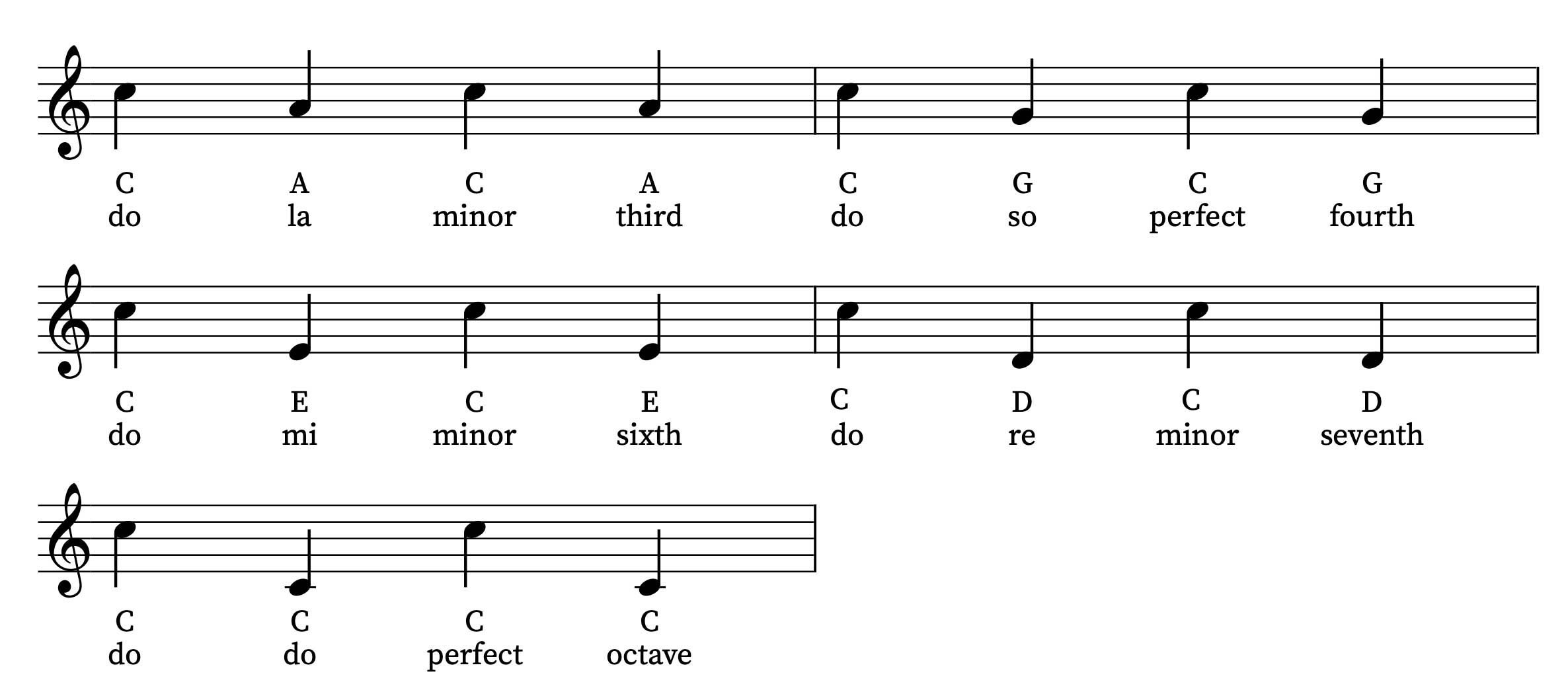
Once you’re comfortable going up from do and down from high do’ like that, it can be helpful to mix the two by singing the inversion pairs:
do re, major second, do’ re, minor seventh
do mi, major third, do’ mi, minor sixth
do so, perfect fifth, do’ so, perfect fourth
do la, major sixth, do’ la, minor third
do do’, perfect octave, do’ do, perfect octave
e.g.
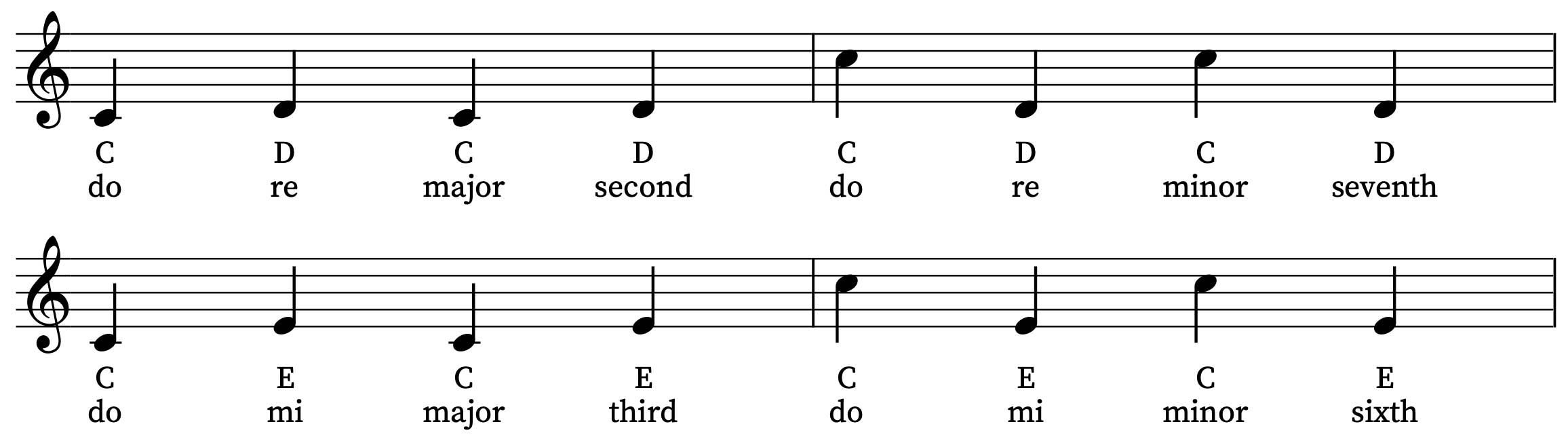
etc.
Naturally you can extend this to the full major scale too:
do re, major second, do’ re, minor seventh
do mi, major third, do’ mi, minor sixth
do fa, perfect fourth, do’ fa, perfect fifth
do so, perfect fifth, do’ so, perfect fourth
do la, major sixth, do’ la, minor third
do ti, major seventh, do’ ti, minor second
do do’, perfect octave, do’ do, perfect octave
This can be a real challenge, and you may want an instrument handy to check your pitching to begin with, but it is an extremely effective way to internalise the links between Solfa and Intervals within the scale.
Sing Solfa Songs
One key tenet of the Kodály approach was what we can call “Song-based learning”. Although Zoltán Kodály made use of “exercises”, even those were carefully composed to be musical, not just abstract series of notes. He was also philosophically very determined that all musical learning should be based on music, and specifically the folk music of the student’s culture.
I would encourage you to use a range of approaches to develop your Solfa skills, including the applied activities below and dedicated “drills” above, but if you’re putting together a practice routine for Solfa, singing a handful of songs with the solfa syllables should almost certainly be a part of it. In fact, if I had to pick just one way for you to practice, it would be singing songs in solfa.
On top of the inherent benefit, if you make this a daily habit, you will quickly find yourself instinctively wanting to figure out and sing the solfa for other melodies you hear or play. It’s as much a mindset as it is a habit. Form the habit, and the mindset will follow.
The process is very straight-forward, just an expansion of the earlier exercise “Sing Solfa Songs Which Use The Toneset”:
EXERCISE: Sing Solfa Songs
That’s it! Just doing this regularly, with a handful of songs, will quickly and easily build up your familiarity with the sound of each syllable, and improve your ability to pitch them on-demand. |
| Almut Says… It is surprising how natural this can feel after a time. A few days ago I had set myself a timer to remind me of making a phone call. When the timer went off, I was busy doing something else and just hit “stop” and continued with what I was doing. A bit later I had this solfa melody in my head: do do do do so mi. I was a bit confused where this came from, sang it out loud and realised that this was my timer ringtone. I then remembered that I was supposed to make the call :) |
When it comes to song choice, folk songs are often conveniently diatonic (i.e. the major scale with no accidentals, though they may be in different modes as noted above) and have the advantage of featuring idiomatic patterns, what we might refer to as “musical vocabulary”. One can argue for using folk music “on principle”, as many Kodály educators would, but from a purely practical perspective, there’s a huge advantage in using the music which all modern music has evolved from. You don’t just learn to recognise each solfa note in isolation, you get familiar with the “vocabulary” that’s commonly used.
You’ll find a small collection of suggested “Starter Songs” at the end of this chapter, drawn from the English and American folk heritage.
We already saw one concrete example of this when discussing the drm toneset: one very common pattern in music is to finish a melody with the sequence mi re do. This gives a satisfying “coming home” feeling, and once you practice singing some folk songs which end in that way (or, in the case of Hot Cross Buns or Mary Had A Little Lamb, feature it throughout), you’ll notice yourself starting to spot it everywhere! Now you have a handy shortcut: you can recognise that “unit” of three notes in one fell swoop, any time it crops up—or indeed use it yourself, as part of Improvisation or Songwriting.
Speaking of which…
Applied Activities
If you remember our Integrated Ear Training approach, the goal is not to just do “ears” practice (Hearing) or even just “singing” practice (Hands), but to develop our instinct for pitch and rhythm through a combination of all four H’s (Head, Hands, Hearing and Heart) and in a way that’s always connected to real music.
So as well as singing through songs in solfa, you can practice in any or all of the ways below.
In all these cases, we can see that Solfa is useful as a “middle step” between sound and symbol, helping you figure out pitches based on the musical role they play, before then pinning things down to a particular key.
The important thing to remember is to match the activity to your current Solfa skillset, and particularly which solfa syllables you are focused on and experienced with.
Start simple (meaning short passages of music that are melodically and harmonically simple-sounding), and be prepared for “mystery notes” in case accidentals are being used, or you haven’t yet familiarised yourself with the full major scale in solfa.
You can use a placeholder syllable where needed. For example, when I introduced my two young kids to Solfa we focused on do, re and mi. When we first tackled a song featuring so, we just sang “Bob” for that mystery note, until it was time to reveal its true name! That way we could highlight “some other note is being used there”, even before we knew its name and its exact place in the scale.
This is the secret to what I mentioned in the previous chapter, that we were able to get musicians playing by ear and improvising from day one with Integrated Ear Training: restrict the note choices to begin with, and you’ll be surprised just how easy playing by ear and improvising become for you! And from there it’s just a matter of gradually extending the set of solfa notes you’re familiar with.
Playing By Ear
Listen to a (simple!) melody line, sketch out the Pitch Contour, and identify the key. Now sing the scale in Solfa, and use that to identify each of the notes. You can use an instrument to help you at first.
Once you’ve got it, practice singing the melody with the solfa syllables (you might like to add this to your daily “Solfa Songs” practice!).
More on this in Chapter 14: Playing By Ear, with the Play-By-Ear Process.
Transcribing
Similarly, if your goal is to write down the notes of the music you hear, you can start by identifying the key, and then use the solfa scale as a helpful indicator of which notes are most likely to be used.
Figure out the notes in Solfa first, then (if you choose) translate them to letter names to write them down in traditional notation.
Improvising
Choose a key (perhaps to match a backing track), and play the scale. Then sing it in Solfa. Now use those solfa notes as your options to improvise with.
At first this can be simply picking solfa notes somewhat at random. You might like to restrict yourself to the pentatonic scale, for the reasons discussed earlier in this chapter. You can start with “stepwise motion” meaning only moving up and down the scale note by note but choosing your next direction each time. Then introduce “skips” where you leap from one note to one which is elsewhere in the scale. The Practice exercises covered earlier will help you get comfortable with these leaps in Solfa.
More on improvising in Chapter 15: Improvisation, when we introduce the Expansive Creativity framework.
Writing Music
Just like with improvising above, you can use the solfa scale as your set of options for choosing melody notes.
This is a great way to get more familiar with the musical role of each note. Which ones sound “resolved” or like they complete a melody? Which ones stick out, or sound unstable? What can you learn about stepwise motion and “skips” by experimenting with the melodies you write?
Even if you don’t (yet!) consider yourself a songwriter, composing your own solfa melodies is a fantastic way to extend the activity of “singing solfa songs”, allowing you to create your own practice songs for any given toneset or sequence of solfa notes, and hone your skills in exactly the way you need, in a fun way which nurtures both your creativity and Singing skills.
We’ll explore Solfa for composing further in Chapter 16: Songwriting.