


The Full Major Scale
As soon as you’re comfortable with the major pentatonic, the full major scale is within reach! You’ve now seen on the Pitch Ladder what we mentioned earlier—that the pentatonic exists within the major scale—and have hopefully also experienced how the notes of the pentatonic all “play nice” together.
If we return to the Pitch Ladder for the full major scale…

… you can see that it’s just fa and ti which you haven’t yet become familiar with. These are the two notes which have just a Half Step between them and an adjacent note in the scale, and this means they both tend to “stick out” a bit, compared to the notes of the pentatonic.
As you begin to introduce fa and/or ti to your Solfa practice, you will likely find them relatively easy to get the hang of. Not only can you add them one at a time to the pentatonic toneset you’re now well familiar with, their distinctive sound which “sticks out” from the comfortable pentatonic context you’re used to will make them easy to spot and to sing.
You can use the exercises above, as well as those in the “Additional Exercises and Activities” section below, to introduce each of the two notes.
If you have any difficulty, remember Convergent Learning and The 80% Rule. In particular, you can always restrict the toneset further. For example, if adding fa to the pentatonic feels like too much to handle, you can spend some time with just do re mi fa. Or if adding ti is getting you in a muddle, going down to the low ti can help you tune your ear in—for example with the ti, do re mi toneset. Using various tonesets like this will help you get a feel for the relationships between various combinations of the solfa notes, and building up to the full major scale will become much easier.
Accidentals
A popular misconception about Solfa is that it’s only suitable for the major scale, and can’t handle music featuring accidentals Meaning: when a note is raised or lowered from the pitch which belongs in the scale. For example if an F♯ appears in a melody in the key of C Major. The “F” note in C Major is F natural, and so the sharp F is an out-of-key note, called an “accidental”. . As a result it seems suitable for “basic” music such as folk songs, but not appropriate for genres such as jazz where accidentals are common.
In fact, Solfa can handle accidentals quite easily, and in a way which is fully aligned with the overall system. To indicate a note has been raised or lowered from the default scale degree pitch, we simply modify the syllable sung:

This is elegant because we are still conveying the musical meaning of the note (its place in the scale), and so all of the aural advantages of using Solfa (i.e. the correspondence to our sense of Relative Pitch) still apply.
We won’t be focusing on accidentals in this chapter, since for most musicians getting up to speed with the pentatonic or the full major scale will be a huge leap forwards! However it’s good to be aware of the system, so that you can draw on it as needed when you bring your Solfa skills to real music. Simply refer to the table above. If you want to get more fluent with them, singing up and down the chromatic scale (perhaps with sharps on the way up, flats on the way down) including hand signs is a great core exercise to work with.
Minor Keys and Scales
If you have some musical experience, you’ve probably been wondering already whether Solfa can be used for minor keys as well. There are two approaches which can be used.
The first approach is to simply use the accidentals defined above, to modify the notes as required to make the key’s scale minor. Specifically, flattening the third (mi becomes me), sixth (la becomes le) and the seventh (ti becomes te). This works fine and is neat for showing the difference between major and minor, but it’s a little cumbersome and there is a different approach which is actually a better fit for the strengths of Solfa.
In the prior chapter we defined a Key as “a set of note pitches, with one chosen as the tonic”. The major key and its scale are created when we choose a set of note pitches and a tonic which produce a particular sequence of intervals (W-W-H-W-W-W-H where “W” indicates a Whole Step and “H” a Half Step). These correspond to the do-re-mi-fa-so-la-ti-do’ sequence we’ve been using so far.
If we use that same set of notes but select a different one to be the tonic, this is called a mode of the major key. There are seven modes in total, since we can start from any one of the seven pitches.
We introduced Solfa above based on the major scale (which is named the Ionian mode). In fact, Solfa doesn’t have any inherent preference for which note is the tonic.
To use Solfa in a different mode, we needn’t rename our notes. We simply choose a different Solfa syllable as our tonic. For example, you might be familiar with the Dorian mode based on the second degree of the major scale—we would simply treat re as being our tonic.
The huge advantage here is that although some familiarisation is necessary for each mode, the bulk of the work we do in Solfa Ear Training transfers naturally from one mode to the next. In particular the distinctive character of each note (and hence your ability to recognise them by ear) carries across directly.
So what’s the significance of all this to minor keys and scales? Well, the minor key and its corresponding scale (the “natural minor” scale) is actually the Aeolian mode of the major scale, created by selecting the sixth degree of the major scale as the tonic.
You can therefore sing a natural minor scale in Solfa as:
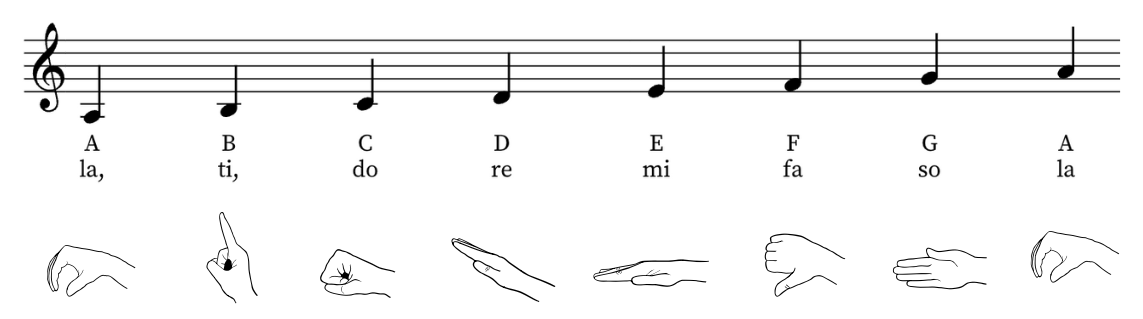
We call this “La-based minor” in Solfa, indicating that we’re handling the tonality not by keeping our tonic as do and adding accidentals, but instead simply rooting everything on la.
Again, the big advantage is that the same Ear Training can power both skill sets. Once you’re comfortable singing, say, a major pentatonic (do re mi so la do’) it takes very little practice to be able to sing a minor pentatonic (la do re mi so la’). And likewise for recognising notes from the minor scale—once you’ve got the hang of Solfa in major, extending to that different mode tends to come quickly, and in our experience much easier than by sprinkling in accidentals.
The thing to keep in mind is the “Descriptive” mindset for music theory (see Chapter 1: Musicality). If we took a “Prescriptive” approach, then it seems sensible to add accidentals: “We make a minor scale from a major scale by lowering these scale degrees by a half step.” However, if we look at how the music actually works, and why people began using the minor key, and what’s going on when they write or play music in other modes, under the hood what’s happening is the selection of a different tonic note from the same set of note pitches. That’s why it makes sense and why it benefits us so much to use a naming approach and Ear Training process which reflects that.