


There are varying opinions about the best sequencing to gradually familiarise yourself with the seven solfa notes (and beyond). With children, the most widely-used traditional Kodály approach starts with so and mi, since that combination (an interval of a Minor Third) commonly appears in children’s rhymes and has been found to be relatively easy for young children to mimic. From there it’s common to add la, and then move on to do, re, and later fa and ti.
With adults, especially those who have had some musical training, we have found that starting with do, re and mi is easy and feels natural. If you’ve spent a lot of time playing major scales, for example, that sound of the start of an ascending major scale (i.e. do, re, mi) will be very familiar. It also has the advantage of immediately including the tonic note, something which is left a bit fuzzier for longer in the traditional approach with children. Whether this matters from an aural perspective is debatable, but for the adult learner who intellectually understands the idea of “the tonic”, we’ve found it’s more rewarding to start from a set of notes which includes it.
Where to go from there? One option would be to continue up the scale, with fa and so. However, there’s another five-note option which is actually more useful and effective, which is to complete the pentatonic scale by adding so and la.
This major pentatonic scale, corresponding to the first, second, third, fifth and sixth notes of the major scale, is ubiquitous in Western music. Across a startling variety of independently-arising musical cultures around the world, the same pentatonic pattern has emerged, featuring in a wide range of folk music traditions. These have then formed the basis of our modern genres, from Classical through rock, pop, electronic and more.
Both the major and the closely-related minor pentatonic are staples among lead guitarists when soloing, and this actually gives us a hint about why the pentatonic is such an apparently-natural feature of music…
If we come back to our Pitch Ladder and Pitch Ruler and compare the notes of the major scale with those of the pentatonic scale, you might notice one significant difference:
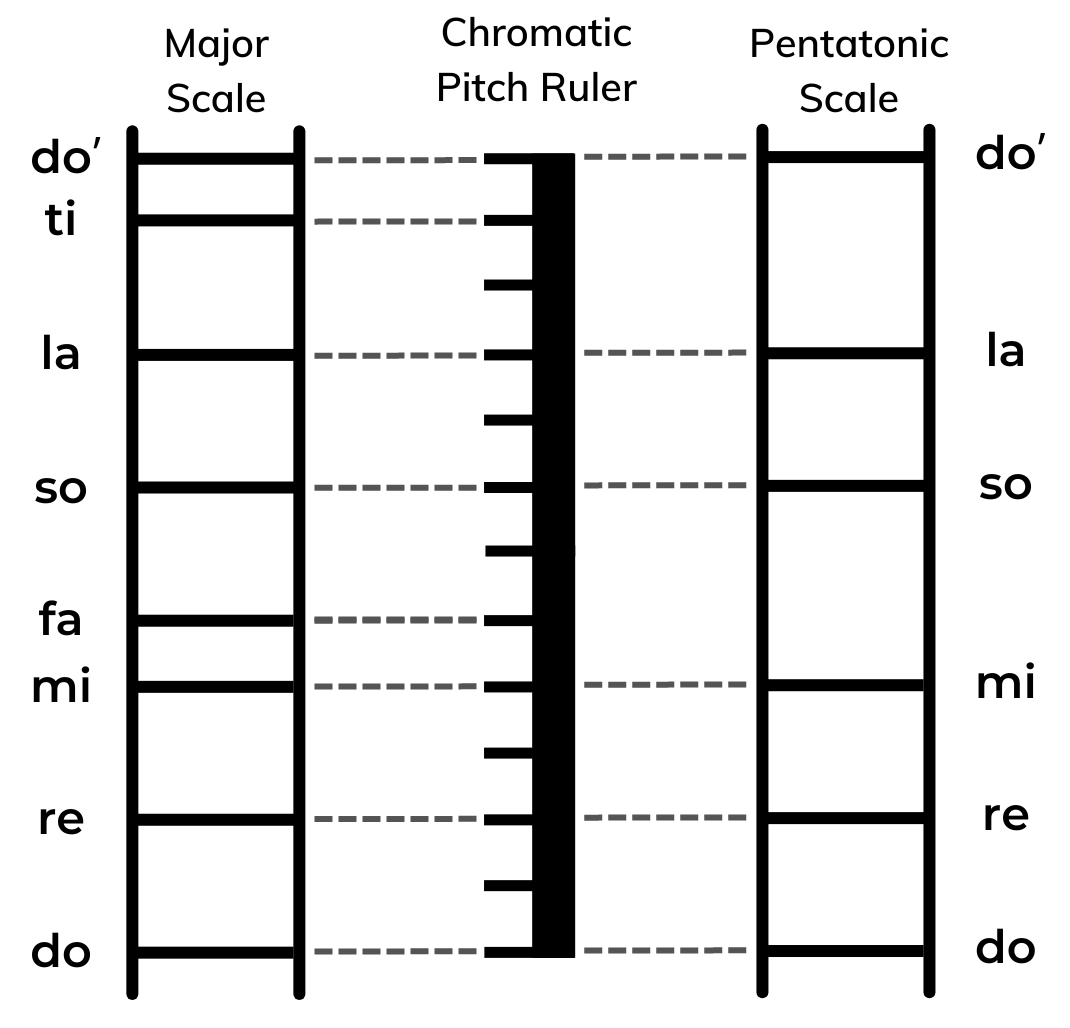
While the notes of the major scale are separated by either one or two chromatic steps, all the notes of the pentatonic are separated by at least two. As we’ll discover in the next chapter on Intervals, notes separated by just one chromatic step (the interval of a “Minor Second”) have a particularly dissonant sound (meaning harsh, clashing, uncomfortable) when played together.
The result is that the pentatonic scale has no dissonant note combinations. Every pair of notes sounds good together, and you can freely wander around a pentatonic scale when improvising, knowing that you’ll never hit a note that sounds “bad”, “wrong” or uncomfortable.
This combination of features—that it’s a “skeleton” inside the full major scale, that a large amount of music only uses the pentatonic scale, and that all the notes “sound good”—make it the ideal choice for learning Solfa. We can draw on a large library of music (both traditional folk tunes and modern songs) which use it. It’s easy, fun and feels “safe” to experiment creatively with it. And it isn’t a distraction from learning the full major scale—it’s a stepping stone towards it.
Once you’ve got the hang of Solfa with the pentatonic scale, simply adding fa and ti to your skillset can be done quickly, and with the added benefit that since those are the notes of the major scale which tend to “stick out” most, it’s relatively easy to start spotting them and getting the hang of recognising them too.
Step 1: drm
As mentioned above, we’ve found that do, re, and mi are a good place for adults to get started with Solfa.

You can begin familiarising yourself with these three scale degrees using the Basic Drill (as outlined above) as well as either or both of the following:
EXERCISE: Sing The Toneset
As you progress, you can try skipping step 2—so playing just the do as your prompt, and producing the re and mi entirely by ear. |
EXERCISE: Sing Solfa Songs Which Use The TonesetAt this end of this chapter you’ll find a set of Starter Songs, grouped by the toneset they use.
|
Use these three—the Basic Drill, singing the toneset, and singing songs in solfa—to begin to familiarise yourself with the characteristic sounds of do, re and mi. You can also start to make use of all the “Additional Exercises And Activities” covered at the end of the chapter.
The main thing to focus on at first is the feeling of “coming back home” to do, and how re and mi each sound in relation to do. Words fail in describing the character and role of each note—it’s something you’ll find comes more instinctively and subconsciously as you practice. As a suggestion though you can listen for how re sounds a bit unstable or unresolved, creating a sense of tension that makes you want to return to do, while mi is a bit more stable but floats above do, recognisably “not home”.
As mentioned above in my story about the workshop (where attendees found it surprisingly easy to identify do vs. re vs. mi) when you’ve just heard the three notes played, you probably won’t find it hard to identify each, just relying on your musical memory of which pitches match. As you practice, that “template” for the three scale degrees’ pitches will become more internalised and instinctive.
One of the additional exercises introduced below is worth mentioning sooner rather than later, which is to improvise your own melodies. This can flow very naturally from singing up and down the 3-note scale—simply experiment with moving through the notes differently. For example, sing do re mi re mi re do, or it could be do mi re mi do. You can also repeat notes e.g. do do re do re re mi. This is a fun, creative, and highly effective way to really ingrain each of the solfa notes in your musical mind.
One of my favourite things about the drm toneset is that it provides one widely-usable bit of “musical vocabulary”: a considerable number of songs and pieces will use the sequence mi, re, do to finish a phrase or even the whole piece. Spend a few days singing Hot Cross Buns as suggested below, and you’ll likely start hearing this little sequence jumping out at you all over the place! And suddenly you have a little three-note phrase you can always play by ear, transcribe, or improvise with.
Now is a great time to start singing songs in Solfa! You’ll find some recommendations for songs which use only the drm toneset at the end of the chapter.
Step 2: Add so
Once you have a firm grip on the drm toneset, you can introduce so!
The good news: so is a leap in pitch from mi, so tends to stick out as being noticeably higher than the do, re and mi. The bad news: that can also make it more challenging to produce the right pitch yourself!

As you practice with Hand Signs, remember that they are intended to show the highness/lowness of the pitch by the height of your hand, as well as indicating its identity with the particular hand shape. So as you move from mi to so, you’ll want to leave more of a “gap” than when you move from do to re or re to mi, to reflect the structure on the Pitch Ladder.
One very helpful reference for many musicians will be the arpeggio of the major scale: do mi so. You can usefully practice this pattern as well as the whole drms toneset, which will get you more comfortable with those “skips”, and use it as a mental reference for finding so. We’ll talk more later in the chapter about the technique of audiating in-between notes, but for now the tip is simply that if you have a sense of your do and want to pitch so, you can audiate the arpeggio pattern do mi so in your head, which may well be easier than trying to leap to so in one bound.
You can practice with introducing so using the same exercises mentioned above for drm, and all the other exercises and activities introduced later in the chapter.
Something interesting about introducing so is that we actually have two options: we can introduce the so above do, or we can instead (or as well) introduce the so below do, written with a comma after: so, Many songs will actually use the so, do re mi toneset rather than the do re mi so toneset.

As you’ll learn in Chapter 11: Chords and Progressions, the fifth scale degree so plays a pivotal role in both the structure of common chords, and the most commonly-used chords in progressions. With the drms toneset you are also getting familiar with two common intervals: the Major 3rd (between do and mi) and the Minor 3rd (between mi and so) which also feature widely in scales, melodies, and chords.
Continue practicing by singing songs in Solfa. You’ll find recommendations for songs which use only the drms toneset at the end of the chapter.
Step 3: Add l (+ d’)
Once you’re comfortable with the drms toneset, you can introduce la. This is a step above so, creating the following structure of three notes together, then a gap, then two notes together:

You can use the same practice exercises again: the Basic Drill, Singing The Toneset, and Singing Solfa Songs Which Use the Toneset.
Remember that with the Hand Signs you’ll want to move your hand up and down to reflect the smaller gaps between do, re and mi, and between so and la, and the larger gap from mi to so. Spoiler alert: in the future, that’s where you’ll slot in fa!
As with so, you can also introduce the “low la”, meaning the la below do, written la,

_________________________________________________________
Side Note:
This can be an easy gateway to exploring minor tonality in Solfa: using the toneset la, do re mi so la produces the minor pentatonic scale, so simply using the same notes but putting your emphasis on la, rather than do, you’ll start to hear the minor flavour created. Begin by just getting very comfortable moving from do to that low la,
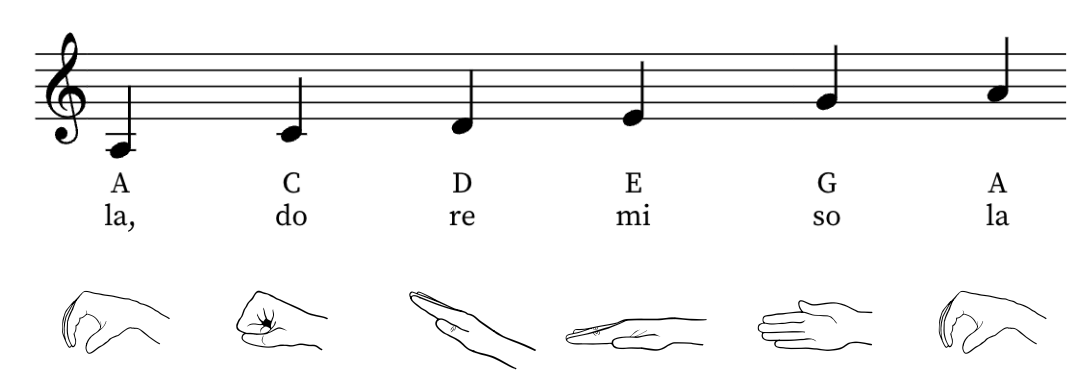
Play around with melodies using do re and mi and then move down to la, and finish phrases on the la, rather than the do . Listen for how things start to feel and sound darker and more mysterious. More on this below!
_________________________________________________________
Now is also a great time to add the high do: do re mi so la do’, completing the pentatonic scale!
You now have a wide range of possibilities to explore with improvisation activities, especially when incorporating the low so and low la, or exploring those minor, la-based melodies.
And don’t forget to keep singing solfa songs! Once you reach the full pentatonic scale in your Solfa practice, there is a great wealth of songs to choose from. You’ll find recommendations for pentatonic songs at the end of the chapter, as well as pointers on where to find even more.