


Later in the chapter we’ll suggest a range of ways you can practice Solfa and integrate it into various musical activities. Let’s get started with our “Basic Drill” exercise, and look at how to recognise Solfa degrees.
How To Use The Basic Drill
Remember that our Basic Drill is simply “listen to some examples of different types of building blocks, and for each one try to recognise which type it is.”
EXERCISE: The Basic Drill For SolfaWith Solfa, the Basic Drill would look like this:
|
Generally you’ll stay in the same key and toneset for a series of examples, allowing you to keep a sense of the tonic and compare the sounds of different scale degrees, before periodically changing the key.
At first in step 1 you’ll probably want to play through the whole set of notes you’re working with, up and down, to establish that whole toneset in your mind’s ear. To challenge yourself more, you can then move on to playing only the tonic, do, and relying on your own singing or audiation to find the others.
You can use this Basic Drill as a simple way to assess your current skills (for example, it’s a clear way to pinpoint which Solfa degrees you tend to mix up or struggle to recognise) and a process for improving your skills, in conjunction with everything covered below.
So, equipped with that Basic Drill, how do we make sure that recognising the degree you heard is not just a random guess?
How To Recognise Solfa Notes
In the following chapters on Intervals and on Chords and Progressions, we’ll equip you with a range of ways to “tune in” to the characteristic sound of each type of those musical elements. We will lead with ear-based recognition, and use singing as an accelerator for developing your skills.
With Solfa, our approach will be a bit different. Why? Because the most powerful way to train your ear to recognise notes with Solfa is through singing. We will focus first on learning to produce each solfa syllable with our singing voice, and allow that to train our ears.
Many musicians are surprised to find that they already have some rudimentary Solfa skills. For example, I once taught a workshop where I played the notes do, re, mi, naming each, then played one of the three at random, and asked attendees to name it. Almost without exception, they got it right!
Now, you might say, that’s easy enough when it’s just three notes and you’ve just heard all three pitches to compare with. That’s true. But it’s a small step from there to hearing only the do, and singing or audiating the re and mi yourself before answering.
In a sense, this is what we are trying to do with all our Solfa Ear Training: to establish the solfa scale in our musical mind as a skeleton or template, against which we can compare any notes we hear. And the most effective way to ingrain that template, along with the corresponding solfa syllable names, is to practice singing it, and practice singing melodies using it. Almost all the exercises and activities introduced below can be seen as some form of doing this.
You can start to familiarise yourself with Solfa now by simply singing through the major scale using the solfa syllables and corresponding hand signs:
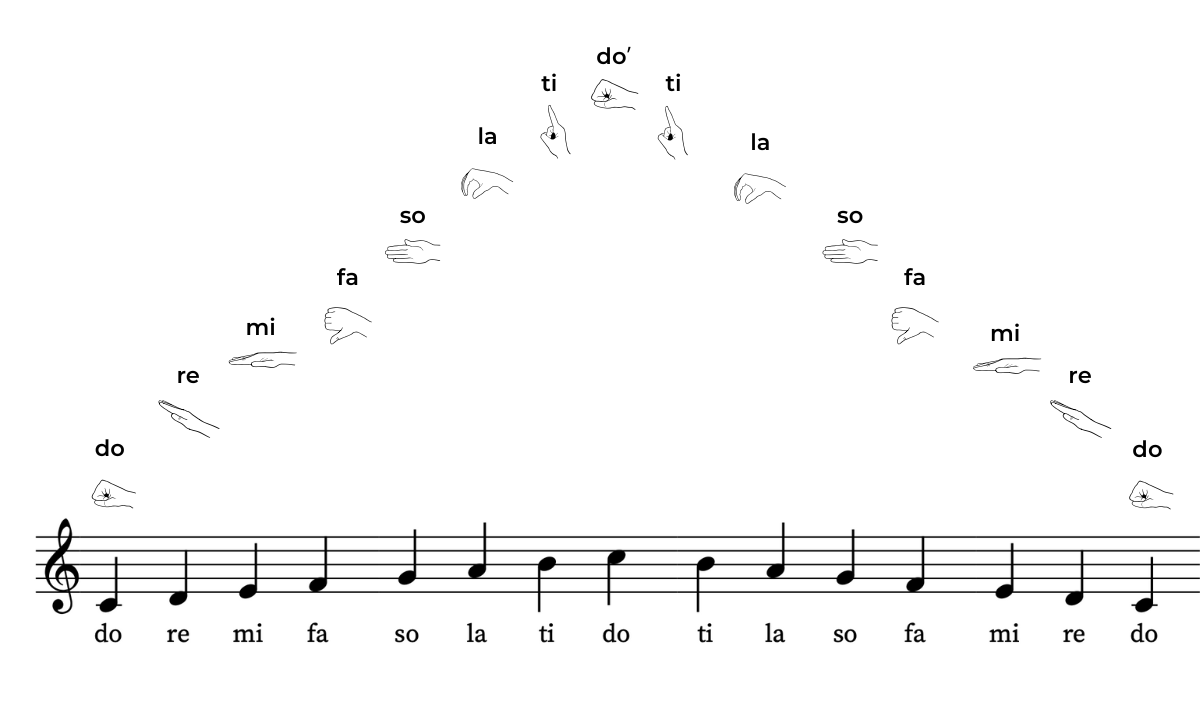
Go up and down the scale, slowly, checking your pronunciation of the syllable and the shape you’re making with your hand. You can begin with just the first two or three notes, singing up and down: do, re, mi, re, do. Gradually add further notes as you get comfortable.
Be sure to move your hand up and down as you make the signs, to show the rise and fall in note pitch that way too. In subsequent diagrams, for the sake of space we won’t necessarily arrange them vertically like in the one above—but hand signs should always involve this vertical movement too.
| Andrew Says… To me, solfa isn’t just a scale—it’s a matrix of pitches. Think of a family, a rather large family with seven members. Each one is a distinct individual within the family. We can line them up from oldest to youngest, like a musical scale, but through the day they all interrelate in a matrix of complex patterns, depending on their unique personalities and their role in the family. Most importantly, each one is always himself or herself. When one takes center stage—perhaps through a birthday party, meal preparation, or a graduation—the matrix of relationships re-forms around them, establishing a different family “mode” of being. They all keep their names and identities, even if one is in the spotlight. When we name our pitches with solfa syllables, we access this same natural truth about the family matrix of pitches and their musical relationships. |
Seven syllables and signs may seem like a lot to take in at once—but on the other hand, imagine how much music will unlock for you once you master just these seven notes!
You actually don’t need to master the entire scale at once though. In fact, what we recommend aiming for first is just five of those seven notes: the ones which form a major pentatonic scale.