


When you first encounter Solfa it can seem a bit strange and arbitrary. Why are we putting some whole other set of names to musical notes? Is it all about singing? Isn’t it just for kids? If it works so well, why isn’t everyone using it? So it’s worth taking a moment to look briefly at its historical origins, before we dive into the practicalities and how it can be useful for you in the modern day.
The earliest known origins of Solfa are in the 11th Century, when an Italian Benedictine monk named Guido d’Arezzo noticed that in the hymn “Ut Queant Laxis”, each line began on the next-higher note of the scale—from the first note of the scale up to the sixth—and therefore one could use the first word of each line as a way to refer to each note. He realised that it would be valuable to have a clear way to refer to each degree of the scale, regardless of the specific key of the music. As we learned in Chapter 8: Relative Pitch, this matches the way our ear naturally interprets musical pitches.
This produced the note names ut, re, mi, fa, sol, and la. This proved a helpful tool for singers to learn new songs by ear and to sight-read from notation, and in time “ut” was replaced with “do” and “ti” was added for the seventh scale degree (after temporarily being “si”, still used in some traditions).
This system is known as “moveable do solfege” a.k.a. Solfa. Why “moveable do“, you might wonder? We’ll unpack that a bit below.
Another big step forwards came in the 19th Century. An English music teacher Sarah Ann Glover created a system for teaching sight-singing based on this “moveable do” idea and using the same syllable names for the notes. Then another English music educator, John Curwen, developed this further with one significant addition He also introduced a written/spoken way of indicating rhythmic patterns, an early precursor to the approach used by Kodály and which you’ll discover in Chapter 13: Rhythm. : a way of showing each note visually with different “hand signs”:
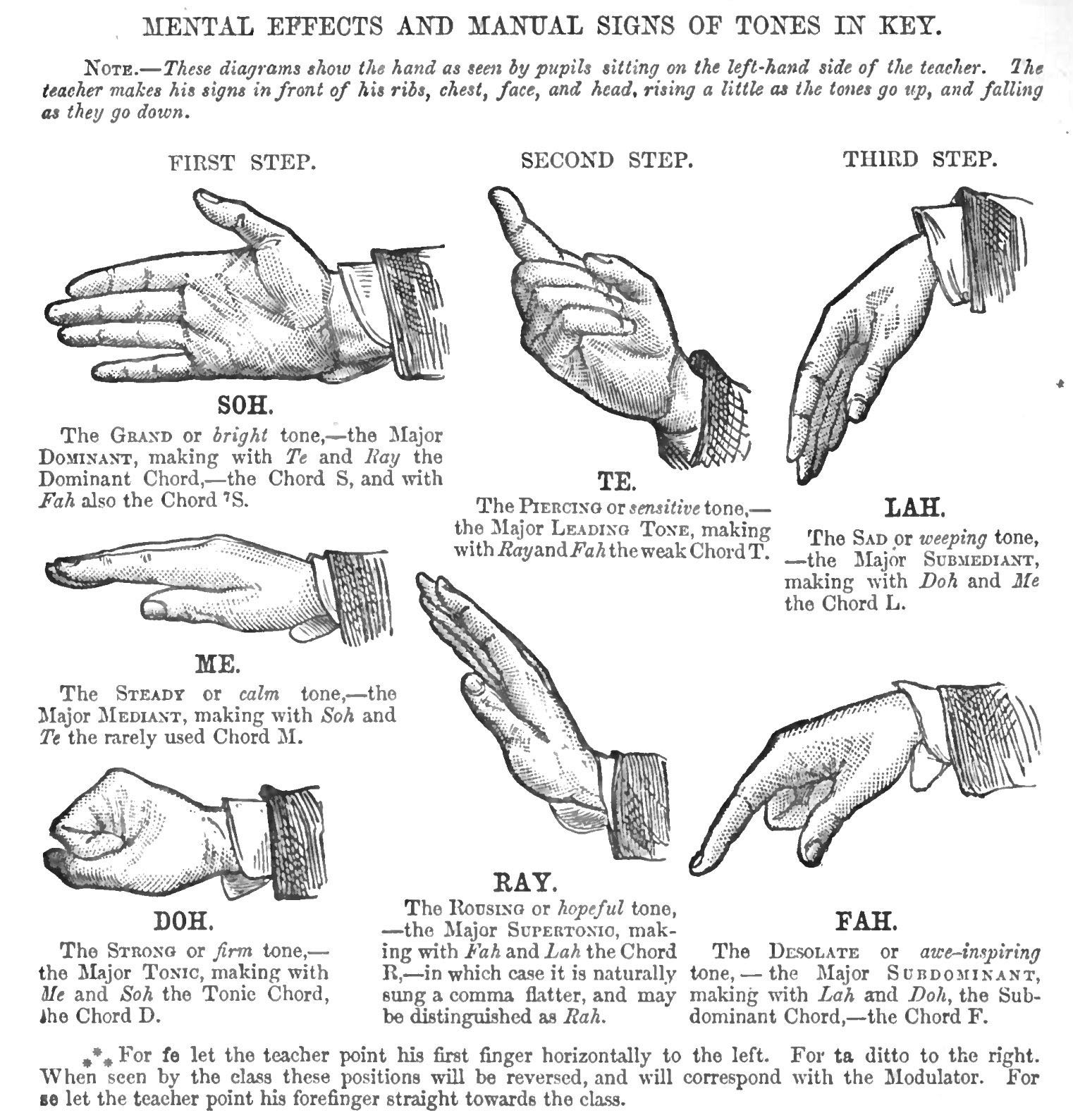
(Extract from The Standard Course of the Tonic Sol-Fa Method, John Curwen. 10th edition, 1892)
Curwen popularised this method and it became widely used throughout Britain at the time, with sheet music for singers typically including the solfa syllables below the notes to enable easy sight-singing. As this chapter goes on, you’ll understand how singers could simply look at the written solfa syllables and immediately know how the music should sound.
The third significant leap forwards for this methodology was in the 20th Century when the Hungarian classical composer and devoted music education reformer Zoltán Kodály (pronounced like “cod eye” with emphasis on “eye”) both developed the approach further, and campaigned to popularise it in his home country of Hungary. This dramatically improved the standards of childhood music education, to the extent that the approach spread internationally as people noticed the incredible musicians beginning to emerge from Hungary Let’s not overlook the fact that the huge number of “talented” Hungarian musicians were produced not by a sudden genetic trait or mysterious “gift”—but by a revolution in how they learned music. .
Depending on who you speak to, what happened next was either:
- A. The Kodály approach continued to thrive, and lives on in vibrant Kodály-based music education traditions around the world. Or
- For a mixture of historic/political reasons, and the increasing cultural focus on learning to play music from written notation as being the “gold standard” of learning music, the Kodály approach remained a niche methodology.
I would say both are true.
I have enormous appreciation and respect for the lively communities of Kodály music educators around the world, including the professional bodies and associations which support and promote the approach (such as the British Kodály Academy and the Organization of American Kodály Educators) and the individual teachers who study and apply the approach. In certain places, and in certain educational systems, the Kodály approach is alive and continuing to have massive positive impact on young musicians.
At the same time, as someone who spent 25+ years studying music in a range of ways and a range of places in the United Kingdom, and perhaps only heard of Kodály once or twice—and as someone who’s devoted their life to adult music education—it pains me that the average adult music learner today has likely never even heard of Kodály, let alone benefitted from the approach in the way they could.
The Kodály approach certainly isn’t the only place Solfa is used today, but both Kodály and more broadly Solfa have gradually come to be used only in very rare or niche contexts, or exclusively in childhood music education. This, to me, is a tragedy.
When I did discover Kodály myself, it was a revelation. I had already been doing ear training and even running Easy Ear Training / Musical U for several years, but had always focused on Intervals for Relative Pitch. I had a basic understanding of Solfa but hadn’t really practiced with it. I had come across the name “Kodály” (alongside some other traditional music education approaches which do put emphasis on musicality, such as Dalcroze, Orff, and Music Learning Theory) but I hadn’t really explored it.
Around 2016 I decided to investigate further, and began taking 1-to-1 lessons with one of the top Kodály instructors in the U.K., Cyrilla Rowsell. She was one of the few I could find who was experienced teaching adults Kodály, rather than only children (though even then, generally with a view to training them to teach children rather than primarily for their own musicality).
From my very first lesson, it was mind-blowing! She got me doing things with pitch and rhythm that I’d never been able to do before—and I was hooked.
As I began to see the power of the Solfa system, as well as the Rhythm Syllables system you’ll learn about in Chapter 13: Rhythm, I realised we needed to bring these into what we did at Musical U.
We collaborated with Anne Mileski, one of the top “teachers of teachers” when it comes to all things Kodály, to create our very first standalone course, Foundations of a Musical Mind. The incredible results which that course delivered for students (ranging from complete beginners who’d thought themselves “tone deaf”, through to experienced music teachers and professional musicians) meant that we continued to double down on integrating these tools into all of our musicality training.
So although I wouldn’t say Musical U follows the Kodály approach (since there are things in that approach which we don’t necessarily adhere to, and there’s a vast range of topics we cover which go around and beyond Kodály) I have to give enormous credit to Zoltán Kodály and the amazing teachers who’ve continued his work over the years. A lot of what you’ll learn and benefit from in this chapter has strong roots in the traditional Kodály approach.
| Zac Says… Before taking Foundations, I had been obsessively studying music theory for a few years, and drilling scales on the piano. I didn’t understand how any of the theory I was studying and the scales I was practicing could be used to make music. Anything I tried to compose or improvise was not satisfying and did not excite me. I had been making music for years with DJing, sampling, improvising on the keys, and rapping, so I knew I could make music. But when I tried to apply theory and scales to making music it seemed to make my music worse. In my obsessive pursuit of music theory understanding I did discover ear training apps, and I’m really good at playing games so I would get good scores and advance through the levels. But it didn’t help me make music and didn’t help me understand the music I heard. I would score well on interval and chord quizzes but when listening to music and trying to figure out the intervals and chords I was just like, “huh?” It was frustrating and confusing. Foundations totally changed my life. It equipped me with a process of learning theory and training my ear by listening to actual music and creating my own music. The theory and the ear training clicked into place and I could improvise and compose with greater awareness, confidence, and satisfaction. It’s been about six years since I first went through Foundations and I’m still discovering new benefits from using the the solfa and rhythm syllables. |
Solfa vs. Intervals
Solfa and Intervals are often seen as two alternative approaches to recognising note pitches by ear. As we’ve already covered when introducing our pitch building blocks in Chapter 8: Relative Pitch, they are in fact a wonderful pairing to use together.
It can be enlightening to compare and contrast the strengths of each and how best to use the two. We’ll do so in the following chapter on Intervals, so that if you’re reading through the chapters in order, both topics will have been introduced first. If you know a little about Solfa and Intervals already, you have my permission to flip ahead and read that now, if you like :)
How Solfa Works
Solfa is, in its essence, simply a system for naming each note of the scale, relative to the tonic. In the previous chapter, we talked about the prime importance of the relationships between note pitches, and how it’s the relative pitches which give everything in music meaning, rather than the “absolute” pitches or specific letter names.
The entire Solfa system hinges on one powerful observation: if the way our brains and ears interpret musical pitches is all based on the relationships of notes to the tonic, then the way we identify notes should be too.
It’s a simple idea, but one with enormous power for us as musicians interested in developing our instinct for pitch, and specifically our sense of Relative Pitch.
In Solfa, we give the root note of the major scale (the tonic) the name “do”. When speaking, we tend to pronounce that like “doe” (as in “a female deer”!) but to be accurate when using it in Solfa activities, it should be pronounced more like the very start of the word “Dorothy”. This is because we want our Solfa names to be a single syllable, so we should avoid it becoming a two-syllable sound with the diphthong “w” sound at the end of “doe”.
No matter what letter name our tonic might be, it is always referred to as do. We then give each of the other notes in the major scale their own names too:
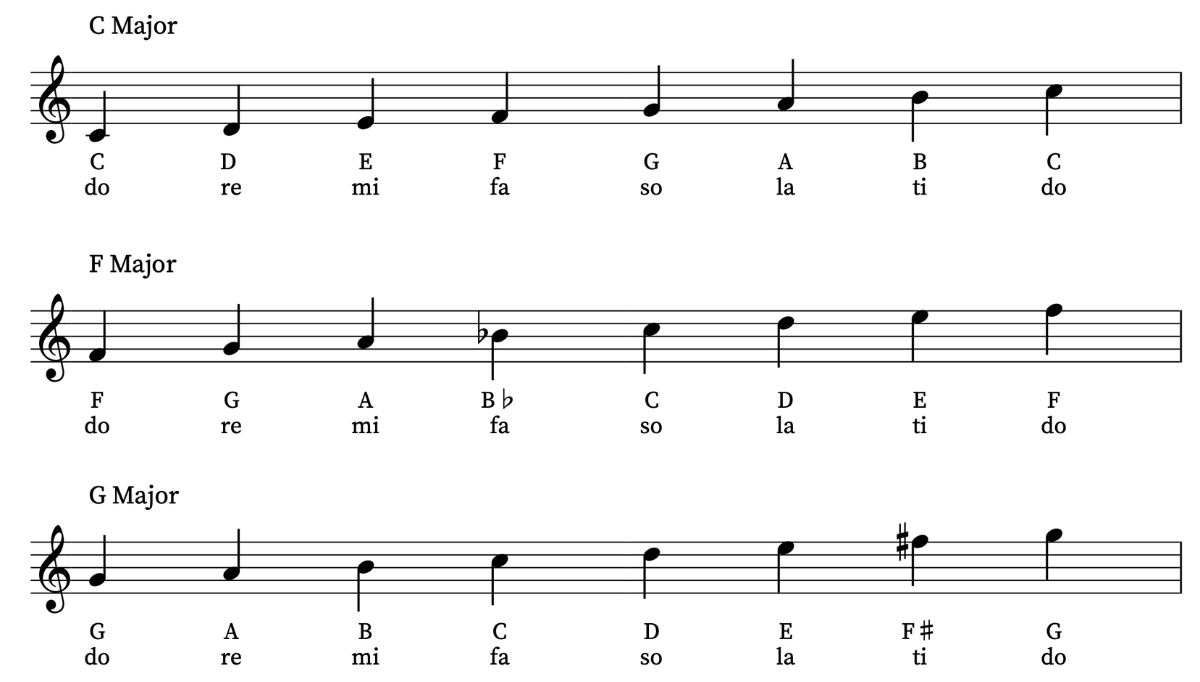
Note: As we continue, we’ll show some examples on the staff like this. If that notation isn’t familiar to you, you can simply focus on the letter names beneath the notes. We will often use C as the tonic of the scale, but this is purely for clarity and consistency. All the patterns and distances could be based on starting with any note as the tonic.
Notice that no matter our starting note, the Solfa names (which we can call “syllables”, since they are each a single syllable in length) are always the same. The first note is always do, the second is always re, and so on.
Here is how to pronounce each of the syllables:
You may come across the syllable “sol” used for the fifth scale degree, rather than “so”.
This was the traditional syllable (and is where Solfa gets its name from: “sol-fa”) but over the years “so” has become more standard. This is primarily because it is more easily singable as a single syllable—similar to wanting to avoid the diphthong of “doe” mentioned above.
| Solfa Syllable | Pronunciation |
|---|---|
| do | “doh” (as in “Dorothy”, not “doe”) |
| re | “reh” (as in “resin”, not “ray”) |
| mi | “mee” (as in “I am me”) |
| fa | “fah” (as in “near or far”) |
| so | “soh” (as in “soil”, not “sew”) |
| la | “lah” (as in “hey la, my boyfriend’s back”) |
| ti | “tea” (as in “nice cup of tea”) |
You might like to try singing up a major scale now, using each of the Solfa syllables.
There are further details of the Solfa system, including how minor scales and chromatic notes can be handled, which we’ll cover below. But really, what’s explained above is all you need to get started!
What’s remarkable is just how far we can go in developing our ears, simply by adopting this different way of naming notes. The specific activities which will help you do that will be our main focus for the rest of this chapter.
The Pitch Ladder
One visual representation which can be helpful is to imagine the notes of the scale as existing on a vertical set of steps, which we can call a “Pitch Ladder”:
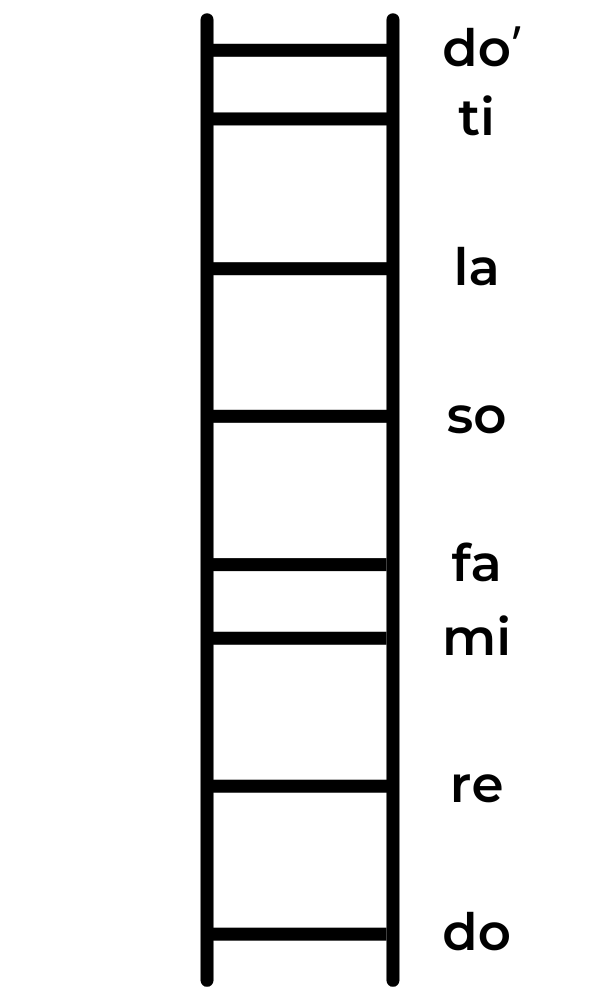
You’ll notice that not all the rungs are equally spaced! Here is the Pitch Ladder alongside a “Pitch Ruler” which has all 12 (“chromatic”) steps of the octave:
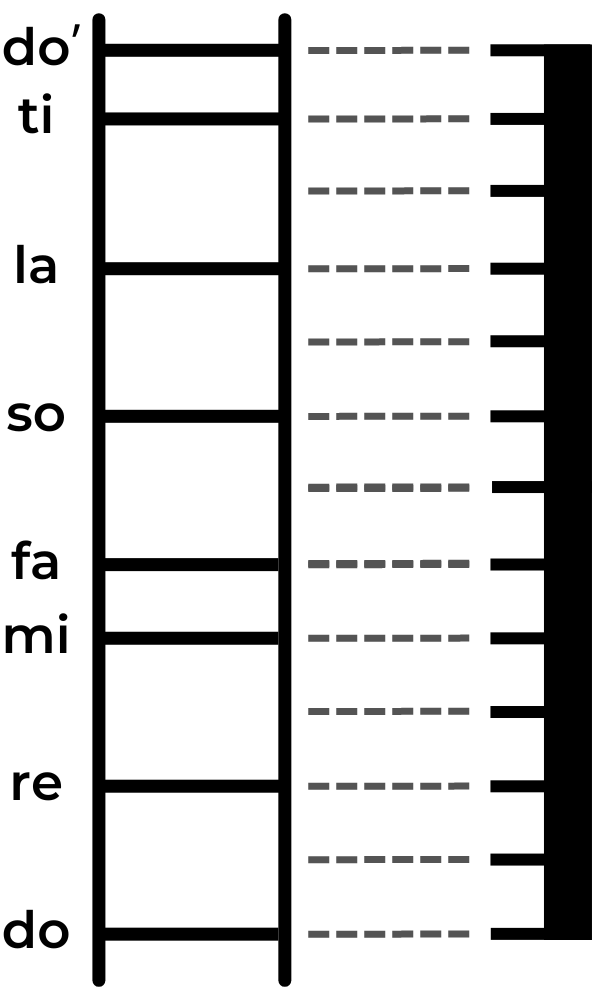
Notice that all our Pitch Ladder steps correspond to steps on the Ruler, with most being two rungs apart (which we call a “Whole Step” or “Major Second”) and some being just one rung apart (which we call a “Half Step” or “Minor Second”). We’ll explore this a bit more in the following chapter on Intervals.
For now, you might find the Pitch Ladder a helpful visual aid as you practice moving between Solfa notes.
Fixed vs. Movable Do
We mentioned that Solfa is sometimes called “solfege”. The reason we prefer the term “Solfa” is that although the word “solfege” can be used to refer to the same thing, it can also refer to a distinct system which uses the same syllable names—but for a very different purpose.
The two solfege systems are called “Fixed Do” and “Movable Do”, and both use the syllables do, re, mi, fa, so, la, and ti.
The approach we introduced above, and what the term Solfa is exclusively used to mean, is “Movable Do”. This refers to the fact that the name “do” is given to the tonic, no matter what note that is. So the note letter we call “do” moves, depending on the key. In C Major, “do” is C. In D Major, “do” is D. And so on.
With the other system, “Fixed Do”, the name “do” is always the note C. This means that it’s essentially just a different set of names for the different pitch classes in music. In certain countries, such as France, this is simply how they refer to notes, either instead of (or as well as) using the letter names.
Because Fixed Do solfege does not correspond to the musical relationships of the major scale, it doesn’t bring any of the Ear Training advantages that Movable Do does. If you were to try learning to recognise the Fixed Do notes of do, re, mi etc. by ear, you would simply be doing Absolute Pitch Ear Training—which, as discussed in the previous chapter, is not a useful route forwards!
So Fixed Do solfege isn’t a system for understanding music by ear, the way Movable Do solfege is. It’s worth knowing about, since this can cause confusion. For example if you’re collaborating with musicians who grew up in a country where “do” always means C.
Fortunately, to save us from having to constantly specify that we’re using Movable Do, we can simply avoid the term “solfege” and instead use the term “Solfa”, which always refers to Movable Do.
What’s In A Name?
Often when musicians first encounter Solfa they wonder “If Solfa is just a system for identifying scale degrees, why don’t we just use numbers?”
For example, instead of mi, why don’t we just say “three”? Instead of ti, why don’t we just say “seven”?
That can seem like a simpler solution, since you don’t need to learn which Solfa syllable corresponds to each degree. However, that’s something which is quick and easy to learn, and there are some considerable advantages to using names instead of numbers:
- We avoid confusion with other musical elements we use numbers for. Numbers are everywhere in music! We use them to refer to our place in a piece (e.g. “measure 37”, “verse 3”, “movement 2”), we use them to count time (e.g. “one, two, three, four, one, two, three, four”), we use them to number fingering on piano (e.g. right-hand thumb is 1, right-hand index finger is 2, etc.), we use them to identify chords in functional harmony (e.g. 1 or I for the tonic chord, 4 or IV for the subdominant, 5 or V for the dominant), and so on. By using dedicated syllable names for scale degrees—names which aren’t used to mean anything else—it helps make immediately clear what we mean when we say them.
-
The names are single syllables, making them more easily singable. If you’re trying to sing a melody using scale degree numbers, “seven” can quickly become awkward! All the Solfa syllable names (including the chromatic variants which replace e.g. “flat seven”) are just a single syllable. They’ve also been chosen to have distinctive vowel and consonant sounds.
-
The names are chosen such that their leading consonants are unique. This allows us to write only the first letter of each, as a shorthand (e.g. “mrd” for “mi, re, do”). That’s helpful, for example, when quickly jotting down a melody you hear. We can also append a comma to indicate “one octave lower” (e.g. l, d would be ascending from the la below a do rather than moving downwards from the la above) and an apostrophe to indicate “one octave higher” (e.g. s l t d’ would be a sequence running upwards from so up to the do above)
-
These names are a common language among musicians who know the system. So while “a rose by any other name would smell as sweet”, if you learn to recognise the scale degrees as “Bob”, “Jeff”, “Danny” or any other names you might quite validly choose, you’ll have a harder time communicating effectively with other musicians.
-
Finally (and in my opinion most importantly), using distinctive names allows us to more easily associate each scale degree with its musical “character” or role. As humans we’re hard-wired to attach meaning to names. Just like when you get to know someone called “Diane Jones” you come to associate various traits, behaviours and relationships with that name, you will come to get to know do, re, mi and the other Solfa notes quite intimately.
I know that if you’ve never learned Solfa before, that can be hard to imagine, but musicians who train their ear for Solfa really do start to hear “oh, there’s a re, now we’ve moved to fa” etc. simply by virtue of how each of the Solfa notes has its own “personality” through its own distinctive sound and the role it plays, musically.
Hand Signs
Everything we’ve covered so far would already be enormously useful for you, in developing your Relative Pitch and learning to identify notes by ear. However, there’s an additional part of Solfa which massively amplifies its power—as long as you’re willing to get a little weird!
Each of the Solfa notes has a corresponding “Hand Sign”: a distinctive shape you can make with your hand, to indicate that note. You can combine making that shape with moving your arm up and down to indicate the pitch of the note too, so that you can actually demonstrate a melody, even in total silence.
Remember in the last chapter when we explored the idea of the Pitch Contour, and mentioned you can show pitch by moving your hand or a pointing finger vertically up and down? Hand Signs take this to the next level by giving each scale degree its own hand shape. This lets you indicate precisely which notes of the scale you’re moving between as you move your hand up and down.

Note that while this 2D view of the hand signs generally shows them well, for la your hand should be facing forwards, not across, so that the backs of your fingers are facing away from you rather than sideways. You can also see these demonstrated in a video in the Additional Resources.
The shapes can seem arbitrary—even arcane—when you first see them, but they’re actually quite elegant in their design. For example:
- do is a firm, closed fist, like a solid rock—just like the firm stability of the tonic note.
- re slopes upwards from do, reflecting how it sounds like a departure from the tonic.
- mi and so have a flat hand and flat, horizontal position—showing how they are stable points of the scale, like do, and contrasting with the other notes which have curved, sloping, or pointing shapes.
- fa has thumb pointing downwards to where mi would be, just like the sound of fa wants to resolve down to the stable mi a Half Step beneath.
- ti has index finger pointing upwards to high do, just like the sound of ti wants to resolve up to the stable do a Half Step above.
So why is all this useful? It’s because this makes your experience of the note pitches physical in a powerful additional way. Opinions vary about whether the concept of “learning modalities” such as you being primarily a “visual learner” or an “auditory learner” hold weight or not, but one thing’s for sure: adding this physical component to Solfa is valuable and effective for any musician.
If you practice Solfa not just with the sung syllables but with the corresponding hand signs too, it develops a visceral instinct for note pitches which the singing alone does not. In other words, you start to instinctively want to make the corresponding hand sign when you hear or sing a particular scale degree, because you’ve made that association. We’ve found this greatly accelerates the learning of recognising notes using Solfa, and I would strongly encourage you to give it a try—even if you feel a bit silly doing it, at first!