


The renowned producer of the long-running radio show This American Life, Ira Glass, once gave an interview in which he discussed the creative process, and he said something that has stuck with me ever since, and which I’ve often shared with members at Musical U:
“Nobody tells people who are beginners—and I really wish somebody had told this to me—all of us who do creative work, we get into it because we have good taste. But it’s like there’s a gap, that for the first couple years that you’re making stuff, what you’re making isn’t so good, OK? It’s not that great. It’s really not that great. It’s trying to be good, it has ambition to be good, but it’s not quite that good. But your taste—the thing that got you into the game—your taste is still killer, and your taste is good enough that you can tell that what you’re making is kind of a disappointment to you.
A lot of people never get past that phase. A lot of people at that point, they quit. And the thing I would just like say to you with all my heart is that most everybody I know who does interesting creative work, they went through a phase of years where they had really good taste and they could tell what they were making wasn’t as good as they wanted it to be—they knew it fell short, it didn’t have the special thing that we wanted it to have.
And the thing I would say to you is everybody goes through that. And for you to go through it, if you’re going through it right now, if you’re just getting out of that phase, you gotta know it’s totally normal.
And the most important possible thing you can do is do a lot of work—do a huge volume of work. […] Because it’s only by actually going through a volume of work that you are actually going to catch up and close that gap. And the work you’re making will be as good as your ambitions. It takes a while, it’s gonna take you a while—it’s normal to take a while. And you just have to fight your way through that, okay?”
Fortunately with musical Improvisation, it needn’t take years to start playing things which sound good! And the key is to have a way to let your taste be your guide.
The Play-Listen/Listen-Play technique fixes a common problem with Improvisation (and creativity in general): the tendency to be “all output”, with no feedback loop in place to assess, analyse, and learn from what you created. In other words, we tend to be “all Play, no Listen”.
The idea is simply to intentionally create a feedback loop:
- Play, and Listen to what you are playing.
- Listen to the music, and Play something in response.
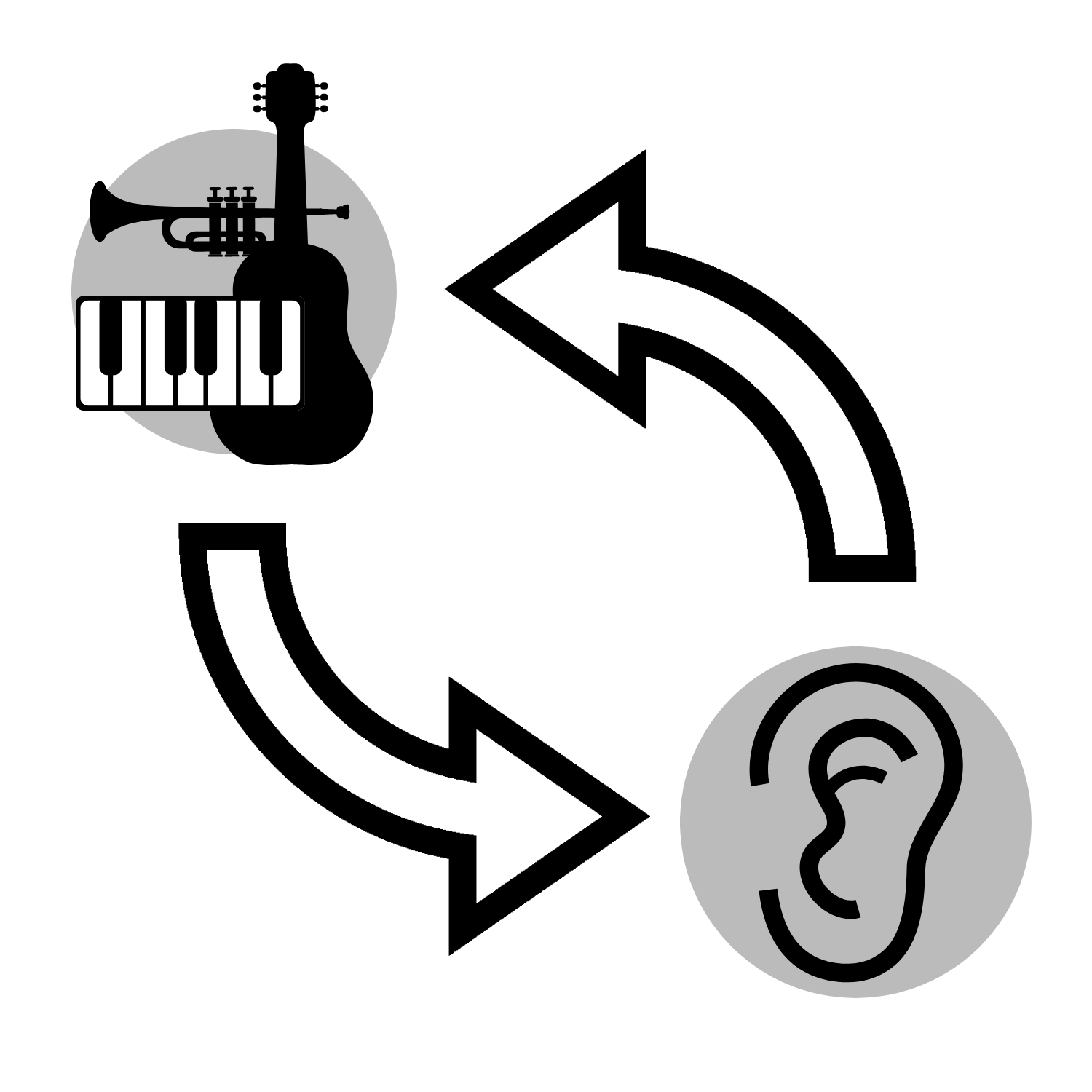 |
With Play-Listen, your source of inspiration is the music you just played, whether something learned, random, inspired, intentional, or anything else. With Listen-Play, you can be responding to a music recording, another musician, or what you yourself just played. |
These two form a loop, creating a conversation (input plus output) between you and the musical context you are in.
Play-Listen/Listen-Play lets you leverage your ear skills (both Active Listening and Ear Training) and forms connections between Hands, Hearing, Head and Heart. It is what lets you shift from a mentality of “did I get it right?” to “how did that sound?”
Just like adding the “Reflect” step in Superlearning (see Chapter 6: Superlearning), this allows you to become your own best teacher, and nurtures the agency and authority we talked about earlier. Your own creativity (your personal “taste”, to use Glass’ word) starts to come through.
Depending on where you’re applying the Play-Listen/Listen-Play technique, you may be relying on (and therefore developing) your musical memory. For example, if you were improvising call-and-response phrases with another musician, where your improvised phrase formed an “answer” to their musical “question”, you would need to absorb what you heard fully and retain it long enough in the “Listen” step to then be able to “Play”. It’s helpful to be aware of this, to make sure you’re not over-taxing your musical memory and struggling as a result of that, rather than the improvising itself.
As always, the foundational skills of Audiation and Singing can be a huge accelerator and amplifier for you. Audiation can be used both to create the musical stimulus (i.e. you “Listen” to something that’s purely in your mind) or to re-create it after you heard it, so that you can Listen again before responding. Singing can be used both to echo back what you heard before responding, and as a stepping stone to “Play” by letting you express your improvised musical idea without the added burden of translating it onto an instrument.
If you’ve read Chapter 14: Playing By Ear, you’ll see clear parallels with the Listen-Engage-Express process. The major difference is the idea of making this a continual back-and-forth loop, so that whether your musical stimulus is something external, something imagined, or what you yourself just played, you are continually feeding back from Listening to Playing and vice-versa. This is what lets your creative instinct start to emerge.
Let’s try this out, with something our Head Educator Andrew Bishko named the “Babbling Baby” exercise, inspired by the way young children find their way into spoken language by babbling nonsense to begin with. Hearing both their own babbled nonsense and what, to them, is the nonsense babbled by adults around them, they start to gradually mimic and repeat back particular sounds and patterns, until comprehensible speech emerges. One can take analogies between spoken language and music too far, and we’re not suggesting a direct neurological correspondence between this exercise and how babies learn to speak. It’s simply a helpful and freeing analogy to inspire you in this initial exercise.
EXERCISE: The Babbling Baby
|
If you do this for a few minutes, it’s more than likely you’ll discover a musical idea or two that you think actually sounds pretty good! Take a moment to recognise yourself as a musical creator and enjoy how purely through experimentation and your own judgement you were able to come up with something you liked the sound of.
As we continue with the other two techniques we’ll put more structure around this Improvisation practice, but the spirit of this exercise—to create something musical and let our own ears and taste be our guide—is at the heart of the Expansive Creativity approach.
Here’s a variant exercise you can try which bridges between Improvisation and Playing By Ear, using Audiation and/or Singing:
EXERCISE: Babbling Baby With Singing/Audiation
|
Now that you’ve had your first taste of the Play-Listen/Listen-Play technique and started adopting the Improviser’s Mindset, let’s move on to the next technique: Constraints and Dimensions.